









Select a language
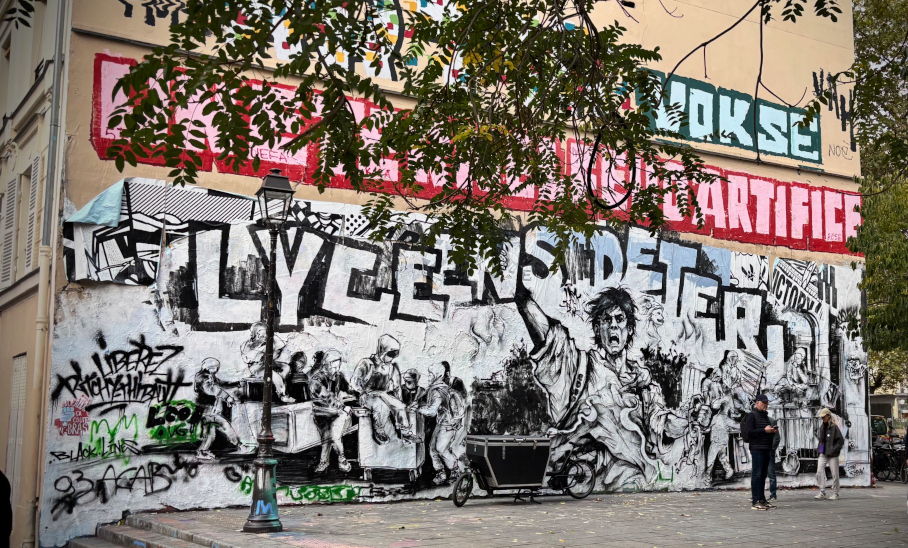
On 17 September 2026, a number of teachers at the Antoine de Saint-Exupéry state secondary school in Créteil, east of Paris, went on strike: they were protesting against the lack of teachers and school nurses, as well as poor conditions, as France Inter reports. From Créteil, the protests have spread like wildfire – sometimes quite literally – across France.
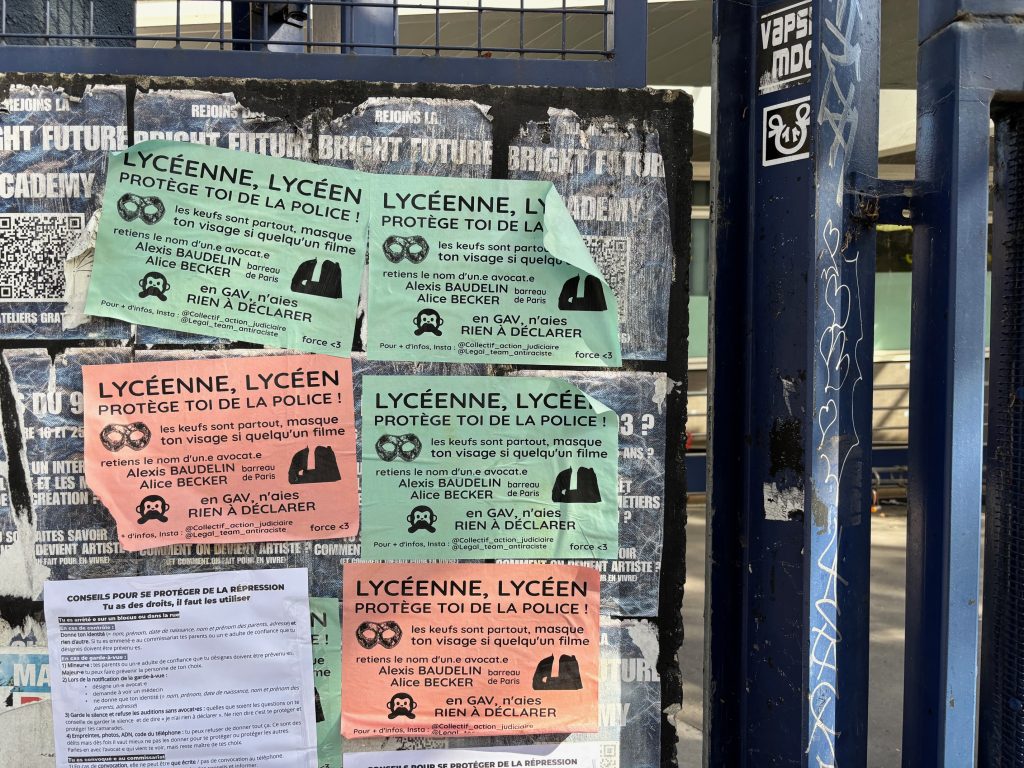
We met Lya and Blanche, two 16-year-old students in Paris, at one of the protests on 6 October. “It’s true that they’re exploiting the violence to get media attention and win over the public,” they told us. “But this is really a movement of secondary school students protesting against the national [education] system. Of course, there are incidents of violence on both sides [...]. We’re organising a peaceful blockade; we’re not here to smash everything up, we’re here to demand our rights.”
In the media, scenes of violence often take up more space than the demands themselves, but this movement, emerging from France, is shedding light on the state of schools across Europe.
What are the youth movement’s demands?
Among the demands of the movement are replacement of absent teachers, clean classrooms equipped with the necessary facilities (including desks and chairs), decent teaching conditions, less overcrowding and lighter timetables.
The figures support the students’ demands. “The public secondary education system now has fewer teachers than in 2008, even though it is educating 250,000 more pupils,” reports Le Monde. “Pupil numbers have continued to rise in both general and technical secondary schools: in public education, more than 70% of classes have over 30 pupils, and in 20% of cases, over 35.” The same paper also reports that the number of unfilled teaching posts has doubled between 2018 and 2024.
One of the key issues is the university admissions system, the infamous Parcoursup – an online platform where applicants enter up to 10 preferences for degree programmes – which many pupils and teachers consider unfair and lacking in transparency. Bettina, who prefers not to give her surname, is a 50-year-old Spanish teacher at a state-subsidised private secondary school in Paris who took part in the demonstration on 6 October alongside her pupils.
For Bettina, the admission system amounts to a “scandalous selection process. Many pupils – generally those from the most disadvantaged neighbourhoods, or where there is the greatest shortage of teachers – are unable to gain access to the courses they wish to study via the platform.”
The issue of poor building conditions is already common knowledge. French secondary schools are on average 61 years old, rising to 71 in the case of vocational secondary schools. Only 15% of buildings have been built or renovated since 2015, and over a third of schools have reached or exceeded their maximum capacity, according to Le Monde.
In addition, a report from 2023 describes an education system that fails to compensate for inequalities of origin. France is one of the worst-performing OECD countries in this area, explains Le Monde, because “inequalities are reinforced throughout the pupils' time in school”. “Even at the same educational level, pupils still follow different pathways, depending on their background”, Johanna Barasz and Peggy Furic, authors of the report, explain. “62% of the children of unskilled manual workers obtain their baccalaureate, compared with 94% of the children of managers.”
Beyond French schools
The OECD’s PISA 2025 report had warned of these inequalities, writes Lola García-Ajofrín in El Confidencial. “Fifteen-year-old French students achieved results close to the organisation’s average; however, pupils from more privileged socio-economic backgrounds scored 100 points higher in science than those from less privileged backgrounds: a gap equivalent to between two and a half and three years of learning.”
Rodrigo Castañeda Valle, an analyst at the OECD’s Directorate for Education and Skills, points out that the overall picture “does not suggest that France is the only country in Europe facing this challenge.” In Spain, the gap stands at 71 points compared to the OECD average of 85, in a ranking led by Romania, where family background accounts for 122 points.
The condition of school buildings
Dilapidated buildings is another issue shared by several European countries.
At least 97 state schools in 16 counties across Romania have toilet facilities classified as “inadequate”, explains Adelina Mărăcine of HotNews. What this means is open-air latrines, or lack of access to running water and connection to the sewerage system. On 9 October 2026, the Romanian government allocated 7.849 million lei (1.6 million euro) to refurbish these schools.
Ion-Ovidiu Pânișoară, professor of education at the University of Bucharest and director of the university’s Department of Teacher Training, explains to HotNews that Romania faces many of the same issues raised by the students protesting in France, including inadequate school facilities, insufficient resources, excessive workloads and teacher burnout. “In my view,” Pânișoară told El Confidencial, “the situation here is in some ways worse than in France. I don’t think there are many schools in France with outdoor toilets.”
‘It was about time that the shortcomings in the education system were brought to the fore. What students in France are demanding should be taken for granted, both there and here’ – Argyro Karakitsou, 17
That said, adequate toilet facilities are indeed one of the demands in France. While there are no reports of outdoor toilets, problems include unsanitary conditions, lack of toilet paper, and broken doors.
“An open-air toilet does not simply mean the absence of a building; It means a lack of concern,” continues Pânișoară. “A child who attends a school that is in deplorable condition learns that school doesn’t matter. Pupils are told that education is important, but the conditions tell them otherwise.”
In the last academic year, over 10,000 Romanian teachers demonstrated in Bucharest against austerity measures set out in Law 141/2025, which include an increase of two teaching hours per week, the merger of several schools, and an increase in class sizes.
In Bulgaria, where according to the OECD more than half of schools have fewer than 200 pupils, there are schools that struggle to provide heating, indoor toilets, sports facilities or laboratories, says Desislava Koleva of Mediapool.
Prefabricated classrooms in Greece
In Greece, Kostas Zafeiropous of Efsyn explains, “almost two-thirds of school buildings were built before 1985. According to the PISA 2025 survey, 47% of Greek 15-year-olds attend schools where headteachers report that inadequate infrastructure — including structures, air conditioning and heating — hinders teaching, whilst 46% attend schools where teacher shortages are reported.”
The problems are particularly evident in special education facilities and on remote islands, the journalist reports. Researchers from the Technical University of Crete visited more than 250 schools across every region of the country as part of the “Contemporary Places of Learning” project. They discovered huge disparities, ranging from modern, well-equipped schools to laboratories housed in damp basements, schools lacking adequate playgrounds, and facilities that fail to meet educational needs.
At the Heraklion School of Art in Crete, “Most lessons are held in prefabricated classrooms and, in some of them, water drips on our heads”, explains Anthoula Digenaki, president of the school’s student council, who talked to Efsyn during the mobilisation of Greek students on 8 October.
‘We’re the future, but it seems they’re not paying much attention to us’ – Aiden, 16
Argyro Karakitsou, 17, a pupil at a state upper secondary school in Athens, says that “sometimes a subject isn’t taught for the first two or three months of the school year, or, when a teacher is absent due to ill health, no substitute is appointed until they return.” For Karakitsou, “it was about time that the shortcomings in the education system were brought to the fore. What students in France are demanding should be taken for granted, both there and here.”
In Spain, where responsibility lies with the autonomous communities (or regions), it is estimated that before the pandemic around 50,000 pupils were attending lessons in prefabricated classrooms. Of these, around 20,000 were in Catalonia, around 12,000 in Valencia and around 11,000 in Andalusia.
Classrooms like ovens
As for the conditions in which pupils are supposed to learn, the situation in France “is starting to become very worrying”, says Bettina in Paris. With reference to the climate crisis, Bettina reveals that “last year we ended up with classes of 35 pupils, with windows that barely opened or didn’t open at all, and temperatures in the classrooms reaching 40 degrees.”
In Austria, as Theo Anders of the Austrian newspaper Der Standard explains, 88% of the more than 1,500 pupils and teachers surveyed in a study conducted by the Austrian Institute of Technology during the June heatwave felt that the temperatures in their schools were causing stress, and three-quarters found it difficult to concentrate.
More than half complained of headaches. As one teacher at a school in Vienna told Der Standard, “you walk into the staff room and are hit by a wave of stale air. Airing the room overnight? Forbidden: someone might break into the building and steal something! Air conditioning? Ha ha.”
Aiden, 16, whom we met on the fringes of the protests in Paris on 6 October, sums up the feelings of his European peers: “we’re the future, but it seems they’re not paying much attention to us.”
🤝 This article was produced as part of the collaborative project PULSE. Contributors included Desislava Koleva (Mediapool, Bulgaria), Theo Anders (Der Standard, Austria), Kostas Zafeiropous (Efsyn, Greece) and Adelina Mărăcine (HotNews, Romania).
🗣️ Have a question, comment or suggestion? Share it with us through the PULSE reader form – we read and reply to every message. Be part of Europe’s conversation. Your experiences and ideas can inspire the next stories we tell. Join the PULSE readers’ community by filling in this short form.
Do you like our work?
Help multilingual European journalism to thrive, without ads or paywalls. Your one-off or regular support will keep our newsroom independent. Thank you!