













Select a language
Between 2015 and 2025, Italy issued approximately 302,000 removal orders against foreign nationals. Only about 66,000 people actually departed – just 22 out of every 100 orders – and in no single year did the execution rate exceed one-third. This is the baseline finding of Espulsioni. Un’analisi della politica di rimpatrio italiana, 2015-2025, a report published by ActionAid Italy and the University of Bari that reconstructs a decade of Italian deportation policy. To compile the data, researchers were forced to rely heavily on freedom of information requests (FOIA), as no public dataset exists.
The Italian case mirrors a broader trend across the European Union. The EU’s new Return Regulation urges member states to ensure “sufficient” detention capacity and places a heavy emphasis on agreements with third countries – a strategy Rome has pursued for a decade. “For ten years, Italy has relied entirely on coercion,” says Giuseppe Campesi, scientific coordinator of the report. “The underlying premise is that to make deportations work, you have to instill fear: threaten detention, lock people up, and force them onto airplanes.”
More detention, fewer returns
The metrics favored by the Italian government must be viewed with caution. The ministry of the Interior often highlights the ratio of deportations to sea arrivals, a figure that reflects maritime arrival trends rather than state administrative capacity. Between 2017 and 2019, while sea arrivals plummeted from 119,369 to 11,471, the total number of deportations remained virtually unchanged – yet the ratio of arrivals to departures surged from 6.2% to 65%. A more meaningful way to understand the effectiveness of Italy’s migration policy is to compare the number of returns with the number of removal orders issued.
According to data collected by ActionAid Italy, 2022 saw the highest number of orders, reaching 37,000. However, the actual number of returned people – 4,480 – is among the lowest of the past decade. By 2025, the gap between orders and returns had narrowed considerably, with 21,600 orders compared to 6,800 returns. At first glance, the ratio between these two figures (12.11% in 2022 compared with 31.48% in 2025) suggests that Italy's policy is becoming more effective.
Seen this way, returns never exceeded a third of the orders, and the 2025 improvement owes more to fewer orders than to more departures.

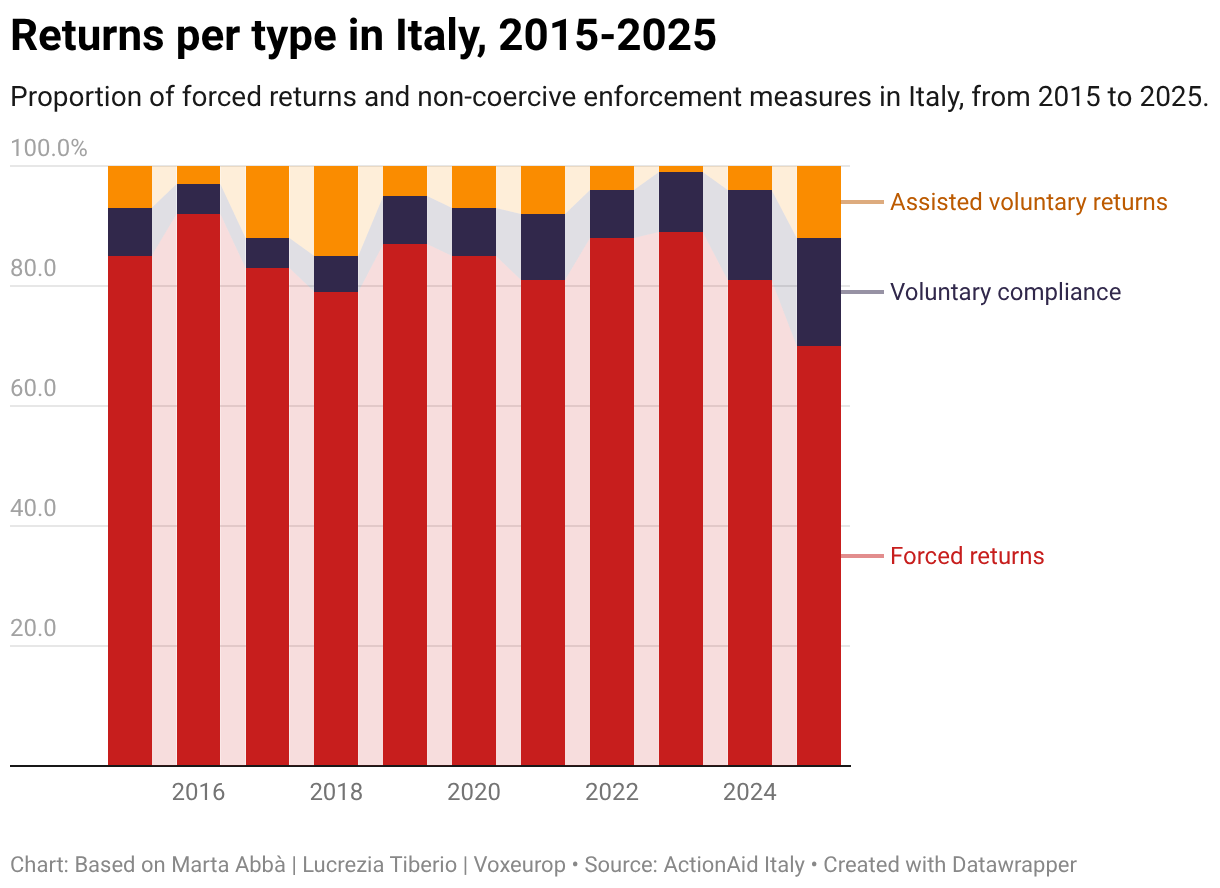
How people leave matters as much as how many. Forced removals dominate throughout the decade, while people leaving on their own after receiving an order remain a small minority.
Data regarding Pre-Removal Detention Centers (“Centri di permanenza per il rimpatrio”, CPRs) – administrative facilities where migrants await expulsion – directly refute the notion that increased detention leads to higher return rates. In 2025, CPR admissions hit a record high of 6,835. However, actual deportations executed from these centers fell to 1,732 – a 45% decline compared to 2022. During the same period, forced deportations carried out directly – without passing through a CPR – increased fourfold.
Each successful deportation from a center now accounts for roughly 148 aggregate days of detention, more than double the average of previous years. Meanwhile, the administrative cost of detaining an individual per deportation rose from approximately €6,455 in 2023 to €16,560 in 2025 – a 156.5% increase. Behind this rise lies a costly expansion of the detention system: €217.1 million between 2018 and 2025, more than half spent on building and refurbishing centres, much of it in Albania.
These centers frequently hold individuals who have almost no prospect of being deported. Excluding Tunisian nationals, 64% of people admitted between 2018 and 2024 belonged to nationalities with execution rates below 15%. “A person is held in a CPR solely to be deported; that is the legal justification for detention,” Campesi points out. “Yet for many of those detained, we know from day one that expulsion will never happen.”
The system's capacity to deport relies disproportionately on a few nations. Between 2022 and 2024, Tunisia alone accounted for roughly half of all forced returns. When charter flights to Tunis were suspended in 2025, returns collapsed from 1,705 to 360, with no alternative taking their place. “Italy ultimately finds itself dependent on the whims of authoritarian regimes,” says Campesi. “And their cooperation can vanish overnight.”
The most counterintuitive finding concerns visa policies. Where citizens can enter the EU without a visa – such as Albania, Kosovo, Moldova, and Georgia – execution rates are at their highest, and many individuals leave voluntarily. In Kosovo, voluntary departures account for 57.9% of total returns. Conversely, where legal channels are entirely blocked – such as Tunisia, Egypt, and Nigeria – departures occur almost exclusively via escorted charter flights: 93.5% of forced returns to Tunisia take place on dedicated flights.
“Those who know they can re-enter legally in the future have an incentive to leave on their own,” Campesi explains. “It is widely assumed that open borders make controlling irregular migration harder. In reality, the opposite is true.”
Numbers not subject to “interpretation”
Uncovering these statistics proved difficult. For 2025, the Ministry of Interior provided aggregate totals but refused to release the breakdown by nationality that it had disclosed in previous years. Among the official justifications was a desire to prevent the data from being “subject to interpretation.” An official appeal filed in May was also rejected. Without these figures, it is impossible to determine whether the collapse in deportations to Tunisia was offset elsewhere.
This is not an isolated incident. Although provincial prefectures conducted 45 inspections of detention centers, only 21 reports were made public. In one instance, the refusal cited the “political and media sensitivity” surrounding CPR management and the risk of public protests. The Ministry also withheld the locations of new planned facilities, classifying them as national defense and security infrastructure.
“We are witnessing maximum opacity precisely where the state's use of force demands the most rigorous public scrutiny,” says Fabrizio Coresi of ActionAid Italy. “This information vacuum shields government policy from accountability, suppresses data that fuels dissent, and shifts the burden of seeking basic truth onto civil society.”
While Campesi stresses he has no evidence of direct ministerial interference, he points to a broader administrative issue. “I did not request these figures from the minister, but from a public official bound by law,” he says. “Worrying about how facts might be interpreted is a concern for politicians, not state administrators. This raises serious questions about civil service independence from political control.”
‘Italy ultimately finds itself dependent on the whims of authoritarian regimes. [...[ And their cooperation can vanish overnight’ – Giuseppe Campesi
The ultimate casualty is democratic oversight. “The lack of transparency makes it impossible to assess not only the efficiency but the public justification for administrative detention,” says Coresi. “Without a solid base of information, Parliament is effectively sidelined. Public debate will continue to react to manufactured emergencies rather than measuring the emergencies produced by the policies themselves.”
The difficulty of obtaining public data also hampers broader understanding of migration policies and human rights compliance. Who gets deported? When invoking non-disclosure for 2025, the Ministry cited the need to protect data pertaining to nationality and gender.
“The absence of gender-disaggregated data is a major obstacle. The inability to track how many women are detained and deported prevents the implementation of targeted protection strategies,” says Francesca De Masi, president of BeFree, a Rome-based feminist cooperative that supports victims of trafficking and abuse. Italian law provides mechanisms to protect women who have suffered violence in their origin countries, along migration routes, or upon arrival in Italy. However, access to these legal guarantees requires early identification.
According to De Masi, women frequently end up in detention centers simply due to alarmist and criminalizing narratives surrounding migration. “The risk is ignoring the underlying reasons that led these women into irregular status,” she says. Factors such as domestic abuse, economic dependence, language barriers, and social isolation are often primary drivers. De Masi argues that CPRs cannot be reformed and that no one should be held in such inherently violent environments.
“Prior to 2020, the women's section at the Ponte Galeria CPR in Rome had over ninety places; today there are five. Detention has become arbitrary – it is a matter of sheer chance whether a woman ends up in a detention center or outside where she can seek help,” De Masi warns. These women are not inherently vulnerable; they are rendered vulnerable by power structures, and the forced return system is one of them. “It is a system as simple as it is cruel,” De Masi concludes.
Exporting a broken European model
According to Gianfranco Schiavone, a legal scholar with the Association for Juridical Studies on Immigration (ASGI), there is little political incentive to make the deportation system functional, which explains its opacity. “The primary objective is generating easily digestible political propaganda. Questions like ‘What purpose does this serve?’ or ‘How effective is it?’ have no place in a public debate built on simple, emotional rhetoric rather than evidence.”
From the European Commission's proposal in March 2025 to the final EU Council approval on October 1, Europe has signaled its intent to step up forced returns – including through off-shore “return hubs” in non-EU countries. This push to outsource migration management draws inspiration from the Italy-Albania protocol, though under the new framework, jurisdiction would shift to host nations. “The concept of third-country return hubs is likely unworkable for both legal and financial reasons,” says Schiavone.
The Regulation permits transferring migrants subject to a return decision to centers outside European borders. To date, preliminary discussions have taken place with Uganda and Rwanda, though no concrete proposals have been finalized. The push to externalize EU borders stems not only from EU institutions, but from joint member-state coalitions. Five EU countries – Germany, Austria, Denmark, Greece and the Netherlands – announced in Vienna on 16 November the creation of a “return platform” in Rwanda for rejected asylum seekers.
“We cannot pretend that the legal protections for someone held in a third country will match those within EU territory. How does a detainee 6,000 kilometers away exercise the right to legal counsel or visits?” Schiavone asks. Under the Regulation, an expulsion is deemed complete the moment a person is physically transferred to a third country – regardless of whether it is their country of origin.
“Europe is hoping that, through financial incentives, it can find governments politically unscrupulous enough to accept these deals. It is predictable that these will be authoritarian states lacking judicial oversight or opposition – effectively rogue states.”
Schiavone concludes that Europe’s increasingly repressive measures amount to dangerous policy experiments: “This framework did not work in 2009, 2015, or 2026. It is astonishing that after decades of systemic failure, European policymakers refuse to reconsider their strategy, operating on the flawed assumption that making a broken system harsher will somehow make it work.”
Do you like our work?
Help multilingual European journalism to thrive, without ads or paywalls. Your one-off or regular support will keep our newsroom independent. Thank you!