












Select a language
“Casa Caterina opened its doors in 2018. It represented the first attempt in Italy to run a shelter specifically for trans people on the migration pathway,” says Antonella Ciccarelli, Coordinator of the Society and Rights section at CIDAS.
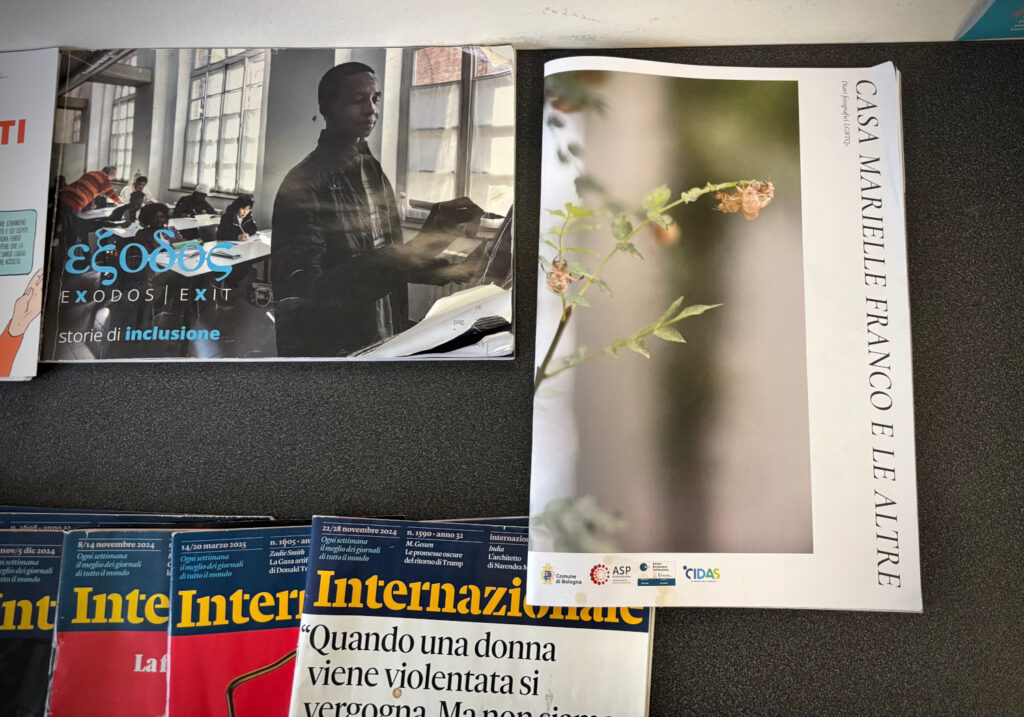
I met Ciccarelli on a November morning at the cooperative’s headquarters in Bologna. At the entrance, among other material for consultation, I found Casa Marielle Franco e le altre (“Casa Marielle Franco and the others”), a photographic work by Francesca Leonardi and Simona Pampallona that recounts the experience of Casa Caterina and other shelters for transgender migrants in the Emilian capital.
Today, these facilities accommodate 28 people in seven shelters named after feminist and LGBT+ rights activists, such as Marielle Franco, bell hooks and Sylvia Rivera.
The shelters in Bologna are run as part of the Italian Ministry of the Interior’s SAI Reception and Integration System. As Ciccarelli explains, the Ministry collaborates with local authorities that are free to decide, on a voluntary basis, to participate in the project. At the local level, the municipality then makes use of third sector entities to provide various services (legal advice, guidance, professional retraining, job placement, language classes, etc.). All those who are entitled to access the service are either asylum seekers or holders of residence permits.
Once the project was launched, Ciccarelli tells me, the main challenge was to “try to develop a specific model of intervention.” In addition to a multidisciplinary team (legal advisers, anthropologists, and guidance counsellors), there is also a peer support worker, i.e. “a person who has a comparable migration background, or – for example – an experience of gender transition.”
The peer support worker allows shelters to “create a more immediate relationship of trust, while also addressing issues that are more difficult for us to deal with.” The latter include issues related to “medicalisation and gender transition”, as well treating sex work or leaving sex work in a non-judgemental way.
The creation of this position was the result of a long-standing collaboration with MIT (Movimento identità trans, “Trans Identity Movement”). MIT provide access to their counselling service, for the physical, mental, and social health of trans people, in collaboration with the local health authority and the Sant’Orsola Malpighi Hospital in Bologna. Another important element of this collaboration is access to a “community space where LGBT+ people can meet and create a social network,” Ciccarelli adds, so that those in the shelter can “talk to other trans, gender non-conforming or non-binary people about their experiences.”
Bologna and the trans community
"The history of Bologna is truly unique in Italy," says Anita Garibalde da Silva, MIT’s project coordinator. Since the 1970s, Bologna has been one of the most open cities in the country towards this community.
MIT was founded in Bologna in 1979 under the name Movimento italiano transessuali (Italian Transsexual Movement). “For the first time in Italy, a group of trans people spoke out in a political, public, and structured way,” says Garibalde da Silva. “The biggest change since then has been the transition from mere survival to the possibility of imagining rights, health, and dignity.”
In 1982, Italy introduced Law 164, which made gender transition possible through both surgery and the modification of personal data. This was no small feat for the time, especially for a country with such a strong Catholic tradition. Even so, Italy’s legislation came long after the first such legislation was introduced by Sweden in 1972.
‘The biggest change since then has been the transition from mere survival to the possibility of imagining rights, health, and dignity’ – Anita Garibalde da silva, Mit
In 1995, Marcella Di Folco, running for the Bologna municipality, became the first transgender person to be elected as a municipal councilor in Italy. Today, Porpora Marcasciano, another central figure in MIT, sits on the Bologna City Council.
In addition to the dedicated counselling centre, MIT provides assistance and protection to transgender people in detention facilities, coordinates a help desk for LGBT+ migrants, offers social and health support at local facilities and services, carries out harm reduction and support activities for transgender sex workers, and provides legal support against discrimination and violence.
“Over the years, Bologna has recognised this political and social role,” continues Garibalde da Silva. “The attention of local institutions, shared projects, and integration with the social and health network have created an ecosystem that has allowed the trans and LGBT+ community to flourish in a more protected environment than in other cities. Of course, critical issues still exist, but compared to Marcella Di Folco’s time, the picture is radically different: today, transgender people can count on services, understanding, expertise, and community spaces that simply did not exist before.”
Not everything is perfect, however: discrimination is still a reality, access to work remains complicated, and trans people are disproportionately affected by precarity. “The trans and LGBTQIA+ community experiences a two-speed existence in Italy. On the one hand, thanks to the work of associations and organisations such as MIT, there are examples of excellence; on the other hand, we still lack a modern and coherent legislative framework.
“Compared to the rest of Europe, Italy is lagging behind. Countries such as Spain, Malta, Portugal, Ireland, and several northern countries have introduced self-determination laws, advanced protections, and national strategies for LGBTQIA+ people. In Italy, many rights exist only due to case law or the work of the third sector. The work of associations – and Bologna is an important example in this context – partly compensates for institutional shortcomings, but it cannot replace the responsibility of the state,” concludes Garibalde da silva.
| The situation in Europe |
| According to data from the European Union Agency for Fundamental Rights (FRA, 2024), based on a total of 98,272 LGBT+ people residing in the EU, 36% reported that they had experienced discrimination related to their sexual or gender identity in 2023. The survey found that respondents who identified as “asylum seekers or refugees” reported much higher rates of discrimination because of their LGBT+ identity (54%) than those who did not identify as such (37%), as Tara Morris of FRA’s media team explains. A similar trend is observed for those who identify as members of a minority group, whether in terms of religion (47% versus 37%), ethnicity or migrant background (43% versus 37%), or skin colour (43% versus 37%). Morris adds that the same is true for incidents of hate-motivated harassment, which are more frequent among LGBT+ respondents who are asylum seekers or refugees (66%), or who identify as belonging to a minority group due to ethnicity or migrant background (61%), or skin colour (60%). |
At the intersection of migration and gender identity
Altreconomia reports that “according to the 22nd edition of the SAI Annual Report, compiled by the Statistical Data and Thematic Studies department of Cittalia, as of 31 December 2023, there were approximately 218 LGBT+ beneficiaries of the System out of a total of 54,512 beneficiaries accepted throughout the year (0.4%).” This figure is “totally underestimated,” says Ciccarelli. The people in question “take a long time to come out, and there are many reasons for this.” If a person has fled “from a country where being gay can lead to a severe judicial punishment,” they may still live in Italy as a migrant in a “community of their country of origin, which may replicate the same cultural practices.”
‘From a political point of view, what we do is fundamental; I believe it was necessary to make LGBT+ asylum seekers visible, because very often they are left invisible’ – Antonella Ciccarelli, CIDAS
Before the creation of Casa Caterina, “there were no facilities dedicated to this specific group within the SAI,” explains Ciccarelli. This “does not mean that before 2018 there were no lesbian, gay, trans, bisexual or intersex people in the reception system,” she adds with a smile, “they were simply placed in facilities for single men or single women.”
“Since the creation of Casa Caterina, we have become a national reference point and have begun to receive many reports from across the reception system.” This system, Ciccarelli notes, “has undergone dramatic cuts over the years.”
“From a political point of view, what we do is fundamental; I believe it was necessary to make LGBT+ asylum seekers visible, because very often they are left invisible: I believe that within the process of self-determination, having a space where you can come out and freely live your sexual orientation and gender identity is an essential political practice of liberation,” concludes Ciccarelli.
Bologna’s efforts have been replicated in a number of Italian cities with the help and support of CIDAS.
| The cases of Greece and Spain |
| In Spain, the percentage of people granted refugee status due to persecution based on sexual orientation has gradually increased in recent years, reaching 11.4% of all refugees. This represents an increase of 2.5% compared to 2022. Support for new arrivals is provided by qualified staff with specific skills. There is close cooperation when it comes to training, awareness-raising, documentation, and other areas. Specialised organisations include the Madrid Programme for Information and Support for LGBT+ People, the Catalan Association for the Integration of Homosexual, Bisexual, and Transgender Immigrants (Acathi), and the Melilla Association of Lesbian, Gay, Transgender, and Bisexual People (Amlega). In Greece, organisations that provided accommodation for LGBT+ migrants have been forced to shut down due to cuts in funding from USAID and UNHCR-supported programmes. The most affected by these cuts are trans women, who report discriminatory treatment or indifference from the police, have difficulty finding employment, and also suffer discrimination within communities of their country of origin. |
🤝 This article was produced as part of the PULSE project, a European initiative supporting international journalistic collaboration. Federico Caruso (Obct), Lola García-Ajofrín (El Confidencial), and Dimitris Angelidis (EFSYN) contributed to its creation.
Do you like our work?
Help multilingual European journalism to thrive, without ads or paywalls. Your one-off or regular support will keep our newsroom independent. Thank you!