







Select a language
Edouard Gaudot is a historian and political scientist. A teacher, consultant and writer, he has worked at the College of Europe in Natolin (Poland) and at the European Parliament. He co-founded the magazine Green European Journal. His latest book is Les 7 Piliers de la Cité (Plon, 2022).
Voxeurop: How can we explain this disappointing result for Europe's ecologist parties, in particular in France, Germany and Belgium?
Edouard Gaudot: If you look at the map of Europe and the Greens, there are some pleasant surprises. You have Greens who have been elected in places where they had little or no presence. For example, Croatia, Slovenia, and Romania. Admittedly, these are small countries, so it's not as significant as [the failure of the Greens] in large countries, which will have massive repercussions in the European Parliament.
The results are bad in two large countries where they were good in the previous election. Secondly, the Greens are in power in Germany and Belgium. When you're in charge, you always pay the price for the decisions you take, no matter the government, the political colour or the circumstances. And the price will be even higher in an election where people see the lack of a working majority is less important. In Germany in particular, the ruling coalition is discredited, due its longstanding internal contradictions and its consequent impotence. In Belgium, it's the same thing: there is a power vacuum.
The Greens are also paying a heavy price for the rejection of the last five years' transformational green policies. The first reason is that these policies were not always properly considered beyond their technical aspects: their social dimension has often been overlooked. Yes, a fund has been set up to support miners who are set to lose their jobs in Poland or Romania, but there is no such compensation for all those people who will find themselves with obsolete combustion-engined vehicles. Often these vehicles represent a major asset for them, and sometimes they are an indispensable working tool. This generates uncovered costs, as well as anxiety about the future.
Similarly, there have been measures outside the European Green Deal which have gone alongside all the burgeoning legislation of the last five years. For instance: low-emission zones and other anti-traffic regulation in cities, and zero-net-artificialisation zones [where asphalted land must be offset elsewhere]. All these transformative policies are causing anxiety for growing numbers of people.
The Green Deal has begun to bite into the social fabric of people's everyday lives. This has been compounded by the Greens' inability to get their message across during the election campaign. As a result, green policies became part of wider polemics over people's lifestyles. In other words, they became issues not of politics, but of the culture war.
Such measures have made people more anxious still. And they have responded conservatively, and been more inclined to listen to politicians who tell them, "You can save the planet but there's no need to change your habits". Unfortunately this claim is nonsense. It is a cynical lie, since it is obviously not true.
Will this election result mean a slowdown in the Green Deal?
It is already happening. The law on nature restoration passed but only narrowly. The regulation on pesticides has already been abolished. The measures on combustion vehicles were almost thrown out at the very last moment.
However, the new parliament is still in a state of flux. There are around a hundred non-affiliated MEPs still deciding which parliamentary group to join. All the groups are rushing to recruit them, and offering them favours to join up. So the balance of power has not yet been established.
But even in the event that things go well, it now seems almost certain that the so-called progressive majority, which ranged from the liberals to the radical left, is no longer possible. This means that there are a huge number of dossiers that will not be able to pass, and committees with conservative majorities where the Greens will not be able to put up the same resistance as before.
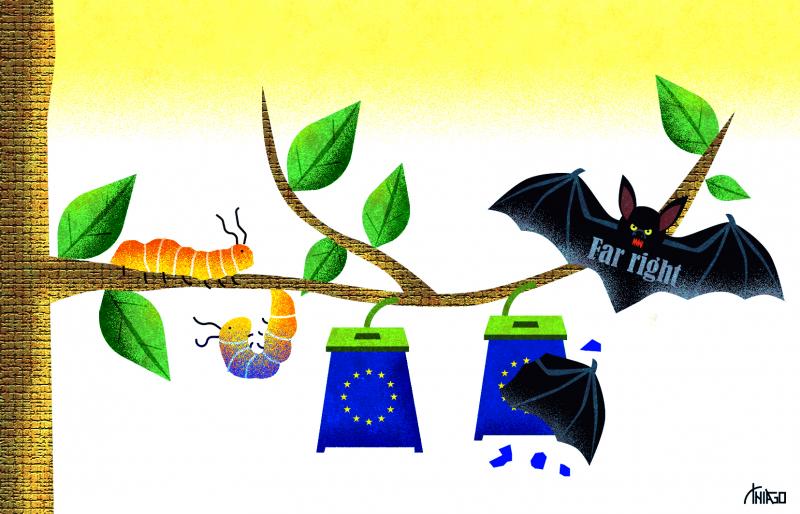
Lastly, the success of the right and the far right are partly a result of anger and distress among farmers. This has turned into resentment against the Green Deal and distrust of those who supported it, both of which have been stoked by the right.
That said, I don't think we'll be going back on the Green Deal. Even though the slowdown is real, the trajectory has been mapped out. Whether this trajectory will be altered remains to be seen, particularly in terms of targets for the next deadline, 2040. The attitude of economic actors will be decisive. In order to make medium- and long-term investments, businesses need stable and predictable rules. This fact will guarantee a measure of stability in the trajectory.
Do you like our work?
Help multilingual European journalism to thrive, without ads or paywalls. Your one-off or regular support will keep our newsroom independent. Thank you!


