











Select a language
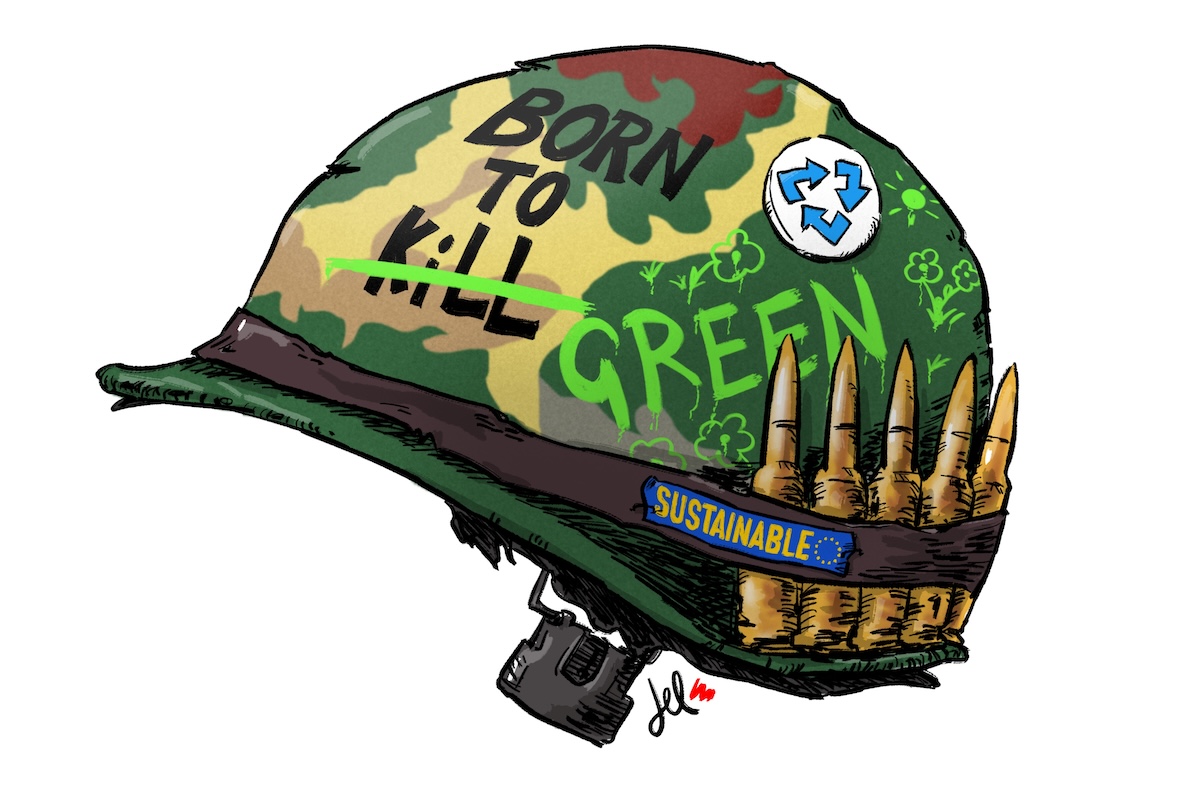
“War is peace, peace is war.” In chorus with big arms manufacturers, the European Commission seems to have adopted the famous dictum from George Orwell’s dystopian novel Nineteen eighty-four. Both are trying to persuade financial markets that arms production can be considered sustainable.
The defence sector is seeking access to the growing pool of capital held as “green” or “ESG” investments (which are intended to promote environmental, social, or good-governance activities). The European part of this market is worth €7 trillion, according to the latest Morningstar data.
Through careful use of language, strategically crafted documents, and a series of meetings, the European Union has gradually expanded the concept of “sustainability”. The label now embraces sectors that might once have seemed intrinsically alien to it, such as defence and security.
As is revealed in this investigation coordinated by Voxeurop, the European Commission's evangelism has given a veneer of legitimacy to the surge in defence investments within the green portfolios of the big asset managers. Drone makers such as France's Safran, bomb producers such as Germany's Rheinmetall, and tank manufacturers such as Britain's BAE Systems are all present in the portfolio of green funds worth billions. Much of that money comes from the major global asset-management firms, which are authorised to operate in European markets.
For instance, the stock of Elbit Systems, Israel's leading arms manufacturer – and a direct participant in the Gaza war, including the destruction of farmland there – is now included in funds labelled as serving “climate transition” or “ESG”. Thus, smalltime European savers may have unwittingly financed what a United Nations commission has termed a genocide.
€50 billion in green funds ended up in tanks and military drones
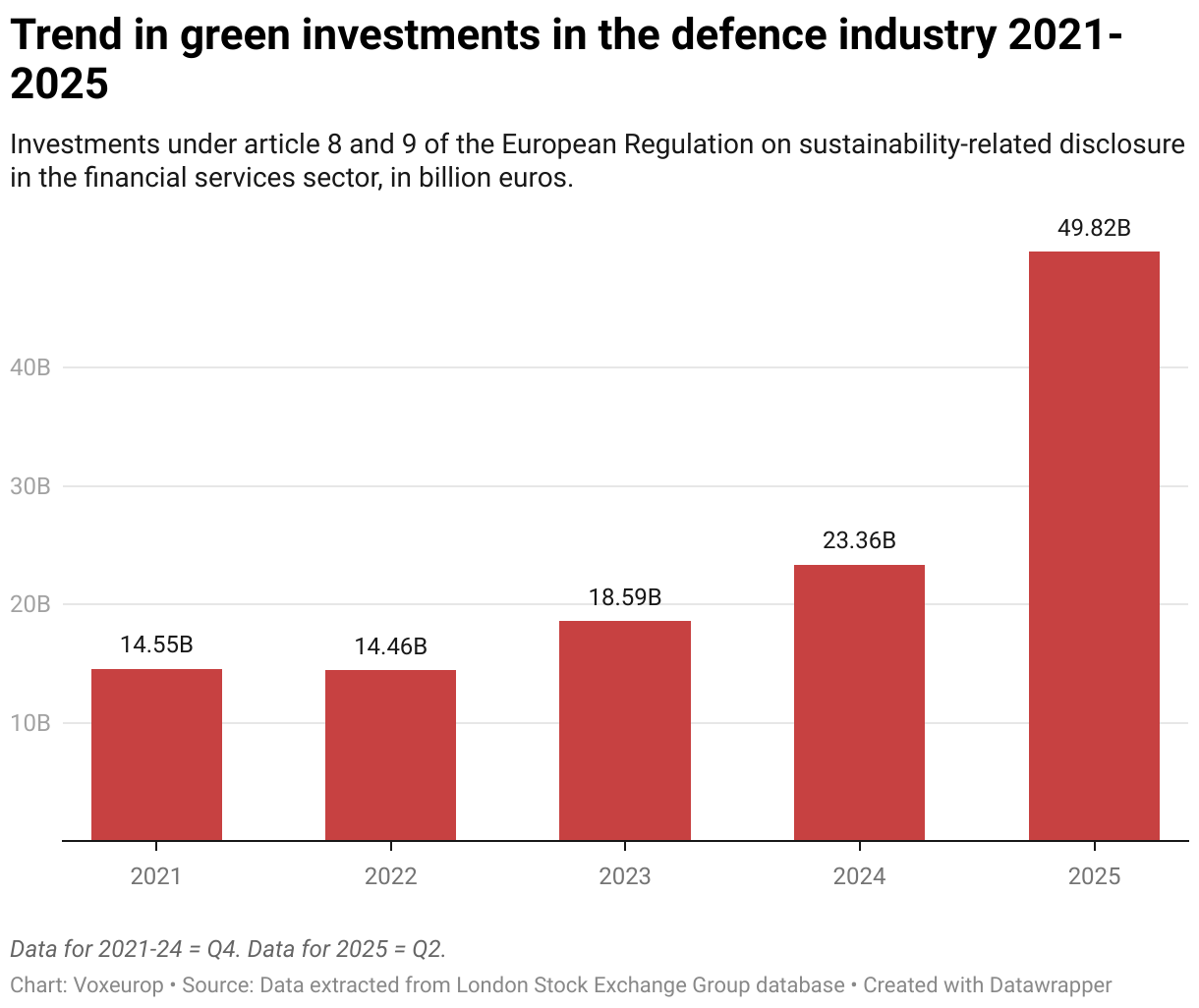
In the four years since 2021, “green” investments in the arms industry have more than tripled, from €14.5 billion to €49.8 billion. The share of investments in the sector doubled in 2025 alone, according to data we extracted from the London Stock Exchange Group, an international financial-data platform. We examined the figures on green investments in 118 of the world's largest publicly traded defence companies (by market capitalisation), and we looked at 3,037 funds that included defence-sector stocks in their green portfolios from 2021 to 2025.
Green investments are those governed by the European Regulation on sustainability-related disclosure in the financial services sector (known as SFDR). In force since 2021, this sets the rules for investments that promote “environmental and/or social characteristics” (Article 8) and those that must be properly “sustainable” (Article 9). It applies to all financial institutions operating in the EU, the largest market in the world.
From 2021 to 2025, the market value of all the firms surveyed doubled to €3 trillion, equivalent to France's GDP in 2024. In 2025 alone, around 769 green funds accumulated profits of €7 billion from the sale of shares and the distribution of dividends by companies involved in defence.
"In this period these companies generated strong profits, and investing in defence was therefore convenient”, Nicola Koch, from the Sustainable Finance Observatory NGO, told Voxeurop. Still, he says, “Weapon producers cannot fall under the definition of sustainable investments because their product's ultimate function is to injure, destroy, or kill – thereby generating an adverse impact on human life and ecosystems – which is not aligned with the principles of sustainable development. It is therefore of paramount importance that positive and negative screening criteria are fully disclosed and retail investor preferences are carefully elucidated and respected in financial-advice meetings.”
“'It is very profitable to invest in arms producers nowadays. It makes it even more lucrative to invest in these companies if they are also recipients of green financing”, commented Attiya Waris, a UN Independent Expert on foreign debt, other international financial obligations, and human rights, as well as a professor of fiscal law at the University of Nairobi.
Which companies benefitted the most ?
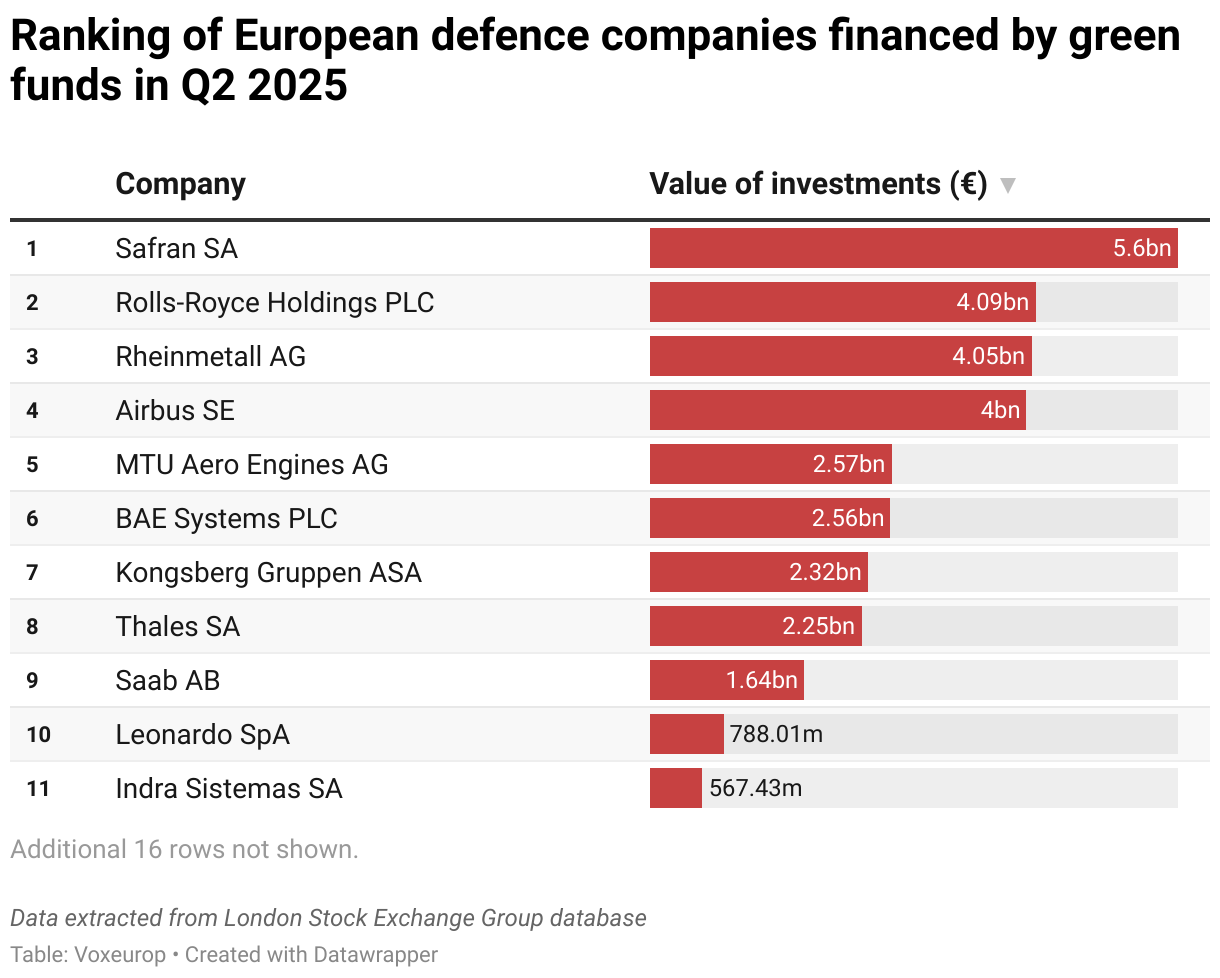
In 2025, 104 companies shared €49.8 billion in ostensibly green investments marketed by asset-management firms. Half of this amount went to 27 European companies. The biggest beneficiary, with €5.6 billion, is France's Safran, followed by the German company Rheinmetall, with €4 billion.
Among the ten firms attracting the most green capital are Germany's MTU Aero Engines, Italy's Leonardo, the Dutch subsidiary of Airbus, France's Thales, Spain's Indra, Sweden's Saab, and Britain's Rolls Royce and BAE Systems. According to recent studies, BAE Systems produces a variety of weapons used by the Israeli army in its military operations in Gaza, including the M109 Self-Propelled Howitzer, manufactured in collaboration with Rheinmetall. Rolls Royce, which controls the German subsidiary MTU, is a supplier of engineering components for Israeli tanks, including those used in Gaza.
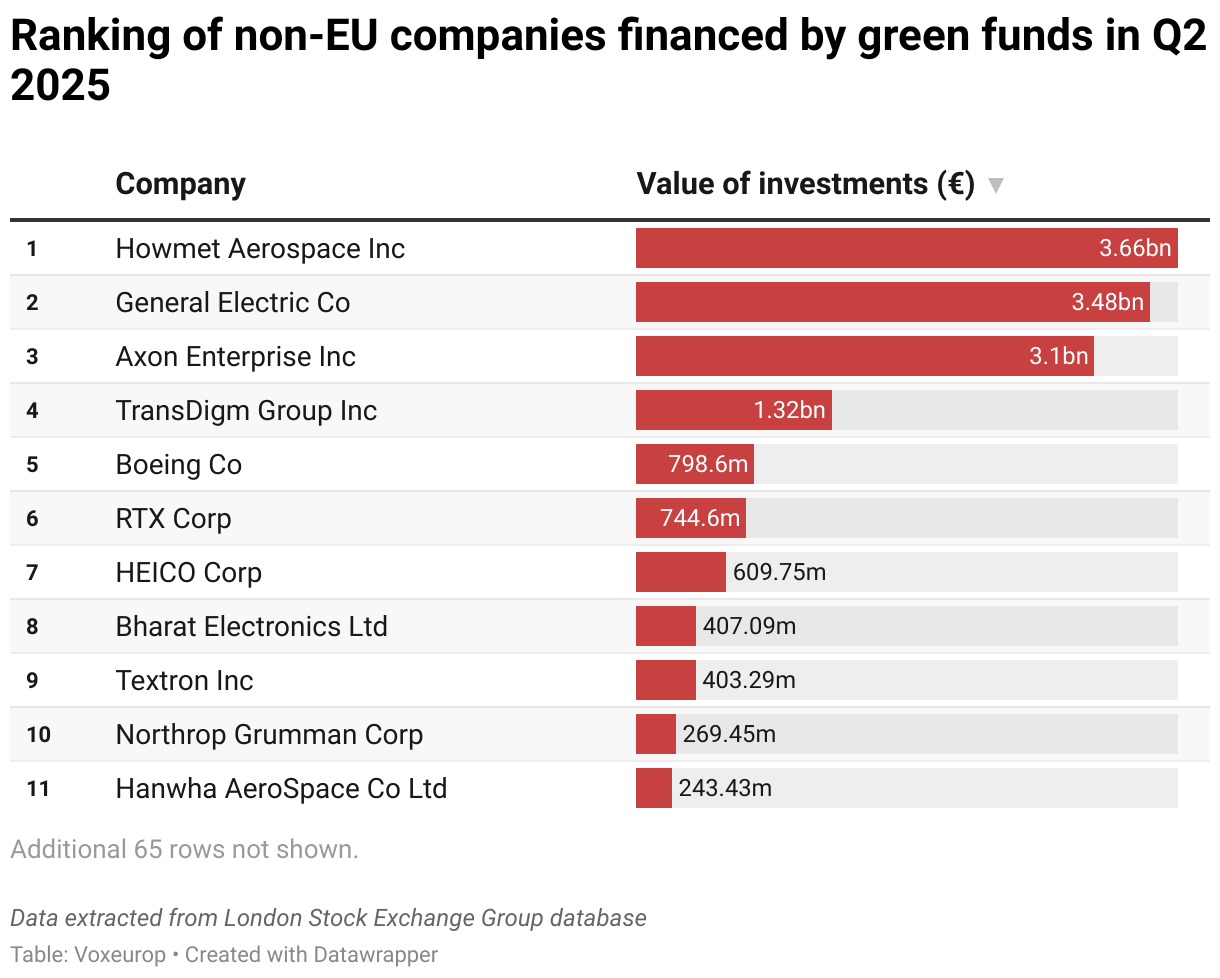
Outside Europe, US firms dominate. Topping the rankings are the defence majors Howmet Aerospace, General Electric, Axon, Boeing, TransDigm, and RTX. Together they attracted €13 billion – 70% – of the €18 billion invested outside the EU.
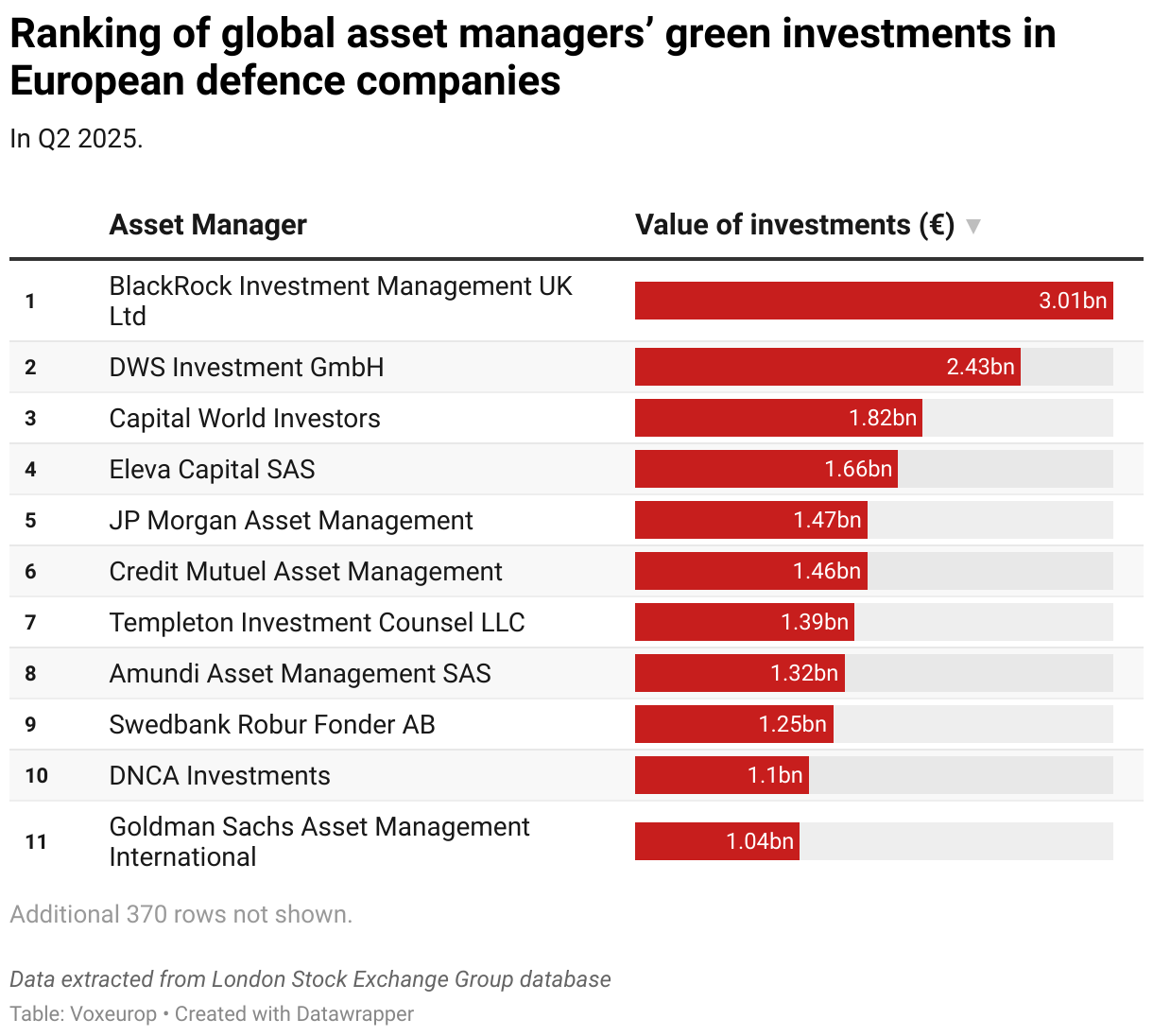
In Europe, the leading sustainable funds include the ESG Top World fund, offered by DWS in Germany (which has a €95 million stake in Canada's Bombardier), and several funds marketed by France's Montpensier Arbevel. The latter include a “Best Business Model SRI” (where SRI stands for Sustainable and Responsible Investment) among others, which together hold stakes worth €60 million in Airbus and Safran. Meanwhile US giant BlackRock is marketing (from Luxembourg) a “European Equity Transition” product. It holds €24 million in shares in MTU Aero Engines, Rolls Royce, and Thales.
“Weapon production is by definition not sustainable. These companies can already raise all the capital they need through traditional debt instruments, so securing sufficient funding should not be an issue for them”, notes Nicola Koch. “I do not believe their presence in green funds is driven by financial considerations. In my view, the attempt by the weapons industry to be classified as sustainable is motivated rather by reputation, as a way to demonstrate that the industry is responsible.”
How did we get to such levels of investment? The case of a German manager expelled from a European Commission meeting suggests what looks to be a well-coordinated, top-down process involving the defence industry itself.
A banker’s uncomfortable questions to the EU Commission
Tommy Piemonte was a manager at the German bank Pax-Bank für Kirche und Caritas (“Peace Bank for Church and Charity”). A German-Italian, he has been in the field of sustainable finance for years. On 27 November 2024, he attended a landmark meeting organised by the European Commission: the EU Defence Industrial Investment Forum, subtitled “Investing in EU Defence and Security: A New Political Priority”. The meeting brought together Commission officials, representatives of the arms industry, and financial operators. It had a specific objective: to open the wallet of “sustainable” money to the defence sector. We spoke to him in January 2025.
As a representative of an ethical bank and member of Shareholders for Change, Piemonte expected clear answers from the Commission. Instead, for his pains in questioning the arms industry's supposed “sustainability", he was expelled from the meeting. Taking part remotely, Piemonte had attempted only simple questions, including: “Why do you think it is so important for the arms industry to be labeled as sustainable?” His final contribution, according to the reconstruction he provided us, provoked his removal from the meeting: “Don't give the impression that you're not answering my questions just because they seem a little critical to you.”
“They kicked me out without warning”, he told us. ”I was shocked, it seemed like an unreal situation. I represent financiers and investors, especially those who care about sustainability, which is the sector this meeting was aimed at.” He later received an explanation by email from the event organisers: ”You were removed because you were disrupting the meeting.”
Piemonte's account is confirmed by Andrea Baranes, president of the Ethical Finance Foundation, who was also present at the meeting. ”Almost all the speakers repeated the same catchphrase: there is no sustainability without security“, he recalls, noting its Orwellian flavour. ”It was an explicit attempt to show that sustainable finance is compatible with the defence sector. It's as if I were a vegetarian and they served me a steak at a restaurant, saying that from now on all steaks are vegetarian."
An EU Commission internal report that we saw reveals what the organisers themselves believed. The meeting had, they say, generated “productive discussions on investment challenges and opportunities”, and “foster[ed] dialogue between the financial sector, the Commission, and industry on defence-investment incentivisation.”
The slides from the event, which we obtained exclusively, confirm this narrative. Several directorates-general (DGs) of the Commission, from Defence and Space to Financial Stability, claim that the arms manufacturers can be included in the green funds without violating any regulation. Anne Fort, deputy head of cabinet to the EU Commissioner for Defence and Space, Andrius Kubilius, notes that “[t]he EU sustainable finance framework imposes no limitations on the financing of the defence sector".
EU-SFF-1Joanna Sikora-Wittnebel, head of sustainable finance in the DG for Financial Stability, agrees: “the EU sustainable finance framework is compatible with investing in defence.” Her slide stressed that “the SFDR is sector-neutral”, meaning that it doesn't automatically exclude or include entire economic sectors (like the defense industry).
Weapons that “do not cause significant harm”
To be considered sustainable, a European investment must not cause significant harm to sustainability objectives. The Commission has provided a list of indicators called “Principal adverse impacts of investment decisions on sustainability factors”.
The only mention of the military sector in these indicators is exposure to controversial weapons (anti-personnel mines; cluster munitions; chemical and biological weapons). According to the legislation, other military hardware does not cause significant harm. These include tanks, armed drones, ammunition, firearms. and even nuclear weapons.
“Our Article 8 funds may invest in companies within the defence industry, depending on if the fund follows our Exclusion strategy or our level of extended exclusion strategy”, a spokesperson for Swedbank Robur, which invested 1.25 billion euro in the defence sector in the first quarter of 2025, told us. “We invest in companies that we believe will give our customers a sustainable long-term return. We perform an in-depth analysis of all investments in the defence industry before investing”. Other asset managers we contacted, including BlackRock, DWS and Franklin Templeton, refused to comment.
The case of the EU Defence Industrial Investment Forum is just the tip of the iceberg of what appears to be a joint effort between the EU Commission and the defence industry. This is evidenced by internal reports, meetings with lobbyists, and policy recommendations from the military sector.
How weapons became sustainable in Europe
The campaign to rebrand the defence industry as sustainable took off in 2021, the year the SFDR came into force. In October of that year, the European Association of Aerospace, Security and Defence Industries (ASD) – which includes the major firms at the centre of this investigation, including Safran, Airbus, Rheinmetall, Leonardo, and BAE Systems – published a position paper that set the tone for the inclusion of war production in green investments.
“Defence is a crucial component of security, and security is a prerequisite for peace, prosperity, international cooperation, and economic and social development”, wrote ASD’s then-Secretary-General Jan Pie. “By helping to ensure security, European defence manufacturers de facto make a vital contribution to a more sustainable world.”
The paper decried the restrictions that banks' green funds imposed on military companies. It urged the EU institutions to spread the message that defence has ESG credibility, while simplifying the exclusion criteria used by the European Investment Bank.
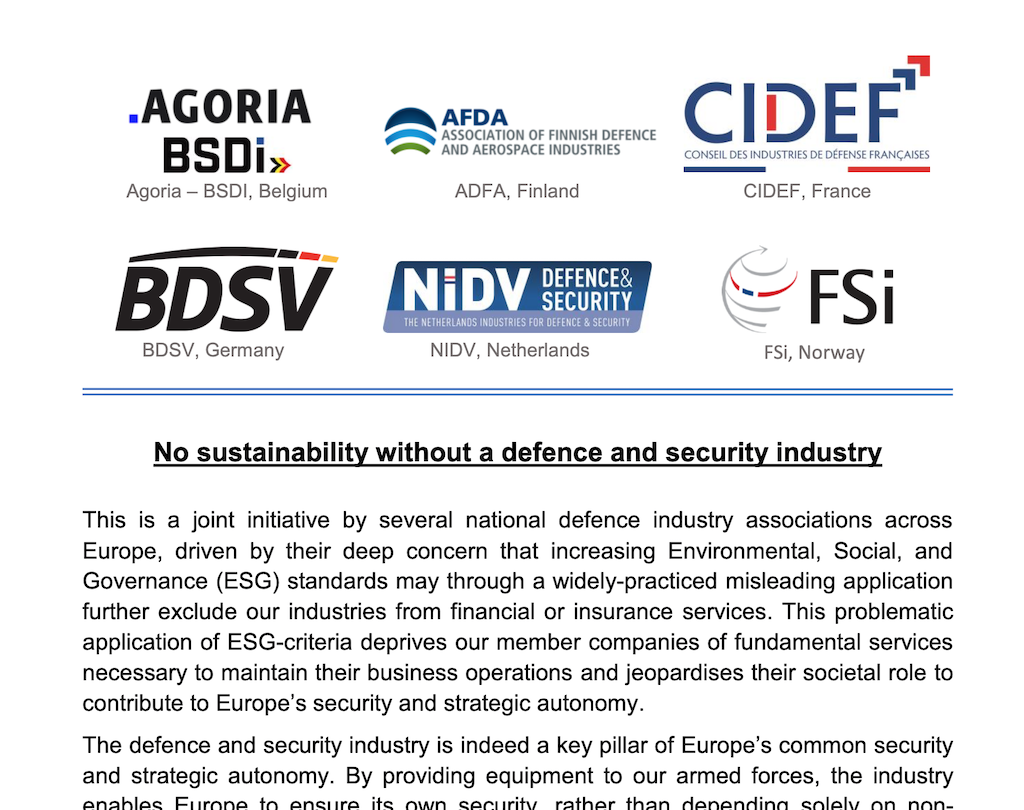
This narrative has also been spread through national initiatives. In March 2021, a group of defence-industry representatives from Germany, Finland, France, Belgium, the Netherlands, and Norway published a statement entitled “There is no sustainability without a defence and security industry”, which echoed the language of ASD. Deborah Allen, director of climate, environment, and infrastructure at BAE Systems, deployed the same argument in an interview: “Without security, there is no sustainability.”
The industry’s rush to get into the green investment market is also clear from its internal documents. Minutes from meetings between defence lobbyists and the European Commission – which we obtained after a long and complex Freedom of Information request – clearly show the pressure being applied.
At one such gathering, in March 2021, the ASD complained that “an increasing problem is green financial products that exclude defence more and more and cut access to finance.”
ASD_MinutesIn November of the same year, Alessandro Profumo, CEO of Leonardo – an Italian company that manufactures, among other things, long-range artillery ammunition and innovative naval artillery systems – met with Timo Pesonen, Director-General for Defence and Space at the EU Commission. At that meeting, Profumo “expressed worries about the fact that the defence industry is excluded from the EU taxonomy for sustainable activities.”
ASD_Minutes-PT2This coordinated front has gradually found wider support in Brussels. Russia's full-scale invasion of Ukraine gave it a boost.
On 15 February 2022, a week before Moscow launched its “Special military operation”, a communication from the Commission to the European Parliament urgently requested more funds for the defence sector, saying that “It is equally important to ensure that other horizontal policies, such as initiatives on sustainable finance, remain consistent with the European Union efforts to facilitate the European defence industry’s sufficient access to finance and investment.”
The Ukraine war has bolstered the industry's arguments, including in the financial arena. “Since the Russian invasion of Ukraine, the formerly depressed share prices of European defence companies have recovered considerably”, wrote ASD in October 2022. In its note, it suggested that the Commission and the relevant European authorities issue guidelines to clarify that asset managers should not disclose the negative impacts of investments in European defence companies uninvolved in the four categories of controversial weapons.
ASD’s text also seems to acknowledge the aversion of the public and banks to military investments: “Until and even when regulatory bias is removed, ASD is concerned that asset managers may continue to implement defence industry exclusions, notably because of pressure from public opinion or dedicated investor requirements.” It then calls for stronger political support from European institutions, urging them to “step up actions to convince asset managers that the Union and its member states support defence companies and are determined to ensure their access to private funding.”
A year later, the Commission restated its position almost word for word in another note: “The Commission recognises the need to ensure access to financing and investment, including from the private sector, for all strategic sectors, in particular the defence industry, which contributes to the security of European citizens.”
"The rehabilitation of the defence sector in the collective imagination, and subsequently in the regulatory framework, was the result of a skilful, sophisticated and coordinated communication and lobbying strategy by national industrial leaders and trade associations", Alberto Alemanno, university professor and founder of The Good Lobby, commented to Voxeurop.
This process Alemanno describes culminated in 2024 with the European Defence Industry Strategy. In this document, the Commission points out that there are no rules against investment in the military sector, and repeats the slogan coined three years earlier: “The Union defence industry is a crucial contributor to the resilience and the security of the Union, and therefore to peace and social sustainability. Against this backdrop, the EU sustainable finance framework is fully consistent with the Union’s efforts to facilitate the European defence industry’s sufficient access to finance and investment. It does not impose any limitations on the financing of the defence sector.”
‘The distance between an ethical investment and a strike on Gaza is more direct, and more traceable, than the industry would ever like to admit’ – Iain Overton, Action on Armed Violence
Shortly after, on 27 November 2024, Tommy Piemonte was kicked out of the meeting and “steaks went vegetarian”.
“Not only has the industry been rehabilitated, it has actually been promoted through its inclusion among the categories eligible for sustainable financing”, adds Alemanno. “It's a real miracle produced by the same strategy.”
Finally, on 20 November, the Commission published a revised version of the sustainable-finance legislation which, for the first time, directly mentions the defence sector: “The SFDR review builds on the guidance from the Commission on the application of the EU sustainable finance framework regarding the defence sector.”
We asked the Commission why investments in defence could be considered green, ESG or sustainable. A financial services spokesperson reiterated that “the EU sustainable finance framework places no impediments on private investments in the defence sector”, except for controversial weapons.
“The true statement is that there is no sustainability without peace”, UN expert Attiya Warris commented. “Security does not necessarily have to result in the manufacture and use of arms, which could lead to unlawful killings. Financing and providing the means for unlawful killings through the supply of arms and financial support across the entire value chain does not correspond to security.”
For Dr Iain Overton, Executive Director of the London-based conflict research charity Action on Armed Violence, rather than an abstract ethical problem, these investments reveal" is not an abstract ethical problem but "an evidential chain of moral responsibility. The distance between an ethical investment and a strike on Gaza is more direct, and more traceable, than the industry would ever like to admit.”
Elbit Systems: from green investment to the Gaza War
Before 7 October 2023 – the day that Hamas brutally attacked Israel, leaving over 1,200 dead and triggering Israel's Operation Iron Swords, which has killed more than 69,000 in Gaza – the Elbit Systems share price hovered around €200. Today, that number has more than doubled, to €480.
Its 2024 financial report clearly describes Elbit's active role in supplying weapons to the Israeli army: “Since the commencement of the war, Elbit Systems has experienced a material increased demand for its products and solutions from the Israel Ministry of Defense (IMOD) compared to the demand levels prior to the war. The Company has also increased its support to the IMOD, mainly through deliveries of its various systems and the dedicated efforts of its employees. At the same time, the Company and its subsidiaries around the world continued to conduct their business in international markets. During 2024, the Company was awarded contracts by the IMOD totaling over $5 billion.”
As Action on Armed Violence has already demonstrated, numerous weapons produced by Elbit Systems, including bombs and bullets, have been used in Gaza during Israel's military campaign there.
The war has given Elbit the opportunity to experiment with the use of artificial intelligence and thus to improve its products. It will also have strengthened the confidence of the 25 green funds that invested a total of €23 million in the Israeli company in 2025. These include an “ESG Optimized” fund proposed by VP Bank in Liechtenstein and Germany, and the “BGF Climate Transition” fund, marketed in several EU countries by BlackRock Investment Management UK.
Other green funds with stakes in Elbit claim to use ESG investment criteria or to exclude companies that violate the principles of the United Nations Global Compact, whose Principle 1 states: “Businesses should support and respect the protection of internationally proclaimed human rights.” For this very reason, notes UN expert Attiya Warris, “products used to destroy life especially if linked to genocide cannot possibly align with the Global Compact and require serious assessment.”
✍️ Additional reporting by Futura D'Aprile
🤝 This collaborative investigation was coordinated by Voxeurop, with contributions from El País (Spain), IrpiMedia (Italy) and Mediapart (France). Its production was supported by a grant from the Investigative Journalism for Europe (IJ4EU) fund. The International Press Institute (IPI), the European Journalism Centre (EJC) and any other partners in the IJ4EU fund are not responsible for the content published and any use made out of it.

Do you like our work?
Help multilingual European journalism to thrive, without ads or paywalls. Your one-off or regular support will keep our newsroom independent. Thank you!