














Select a language
Dalia Frantz is responsible for European issues at La Cimade, a French association founded in 1939 to support migrants. The organisation advocates for human rights and also provides accommodation and legal aid to exiles. Dalia Frantz previously worked for the organisations France Terre d'Asile and Droits d'Urgence.
Voxeurop: How do you interpret the results of the European elections?
Dalia Frantz: For us it wasn't a big surprise, we had suspected for some time that the far right would win more seats. But it's not easy to make your voice heard at European level. These are elections that are ignored by the public, and that's how the far right wins. The results are very disappointing. Even if the balance of power is not much upset, we still have a very right-wing parliament, controlled by the European People's Party. Apart from the prominence of the far right, what has really alarmed us is the fact that its message has been co-opted by the other political parties, which have found themselves singing from its song-book in an attempt to win back its votes. For example, we saw the EPP make similar proposals on migration. Personally, I'm not sure that this is the most important issue for Europe, compared with climate change, for example.
But it's rarely a winning game, trying to win back the votes of the far right...
No. As we have seen in France, it creates a lot of instability and also causes other issues to be forgotten. We've also seen lots of misinformation, conflation, and so on. At La Cimade, we've tried to deconstruct these arguments, but it's hard because they're so prevalent in the media. Even if the far right was not completely victorious in these elections, it managed to instil its policy ideas.
What does this mean in terms of European policy? Should we expect a change in the migration and asylum pact?
That is difficult to say, but we're not expecting any. It's a project that took years to negotiate and was very complex. And it has not even been implemented yet! But the implementation is itself an issue, since the procedures are very cumbersome and raise questions about respect for human rights. And obviously, the far right will also be able to take action at national level.
There is also the question of the outsourcing of borders and asylum applications. This was already a wish of the European Commission before the elections. We're very worried, because we've seen a number of agreements signed recently, with Tunisia, Egypt, Mauritania and Lebanon. We are somewhat in the dark about how these agreements are negotiated. They attract little parliamentary scrutiny, and they also raise questions about respect for fundamental rights.
As you said, this was already an intention of the European Commission before the elections. Will the breakthrough of the far right change things or should we expect continuity?
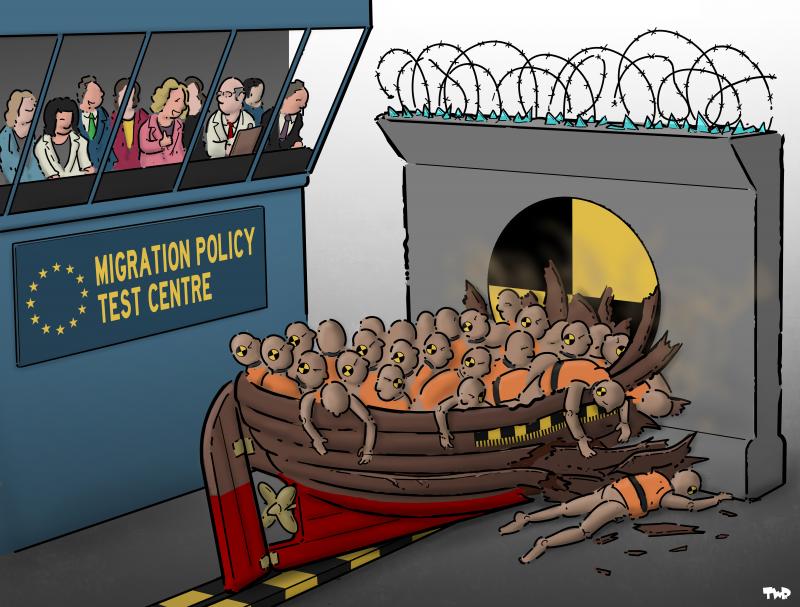
It's continuity, in the worst way. As with the Migration and Asylum Pact, we are seeing the consolidation and legalisation of a highly repressive, security-focused approach. The pact does not currently allow the outsourcing of asylum processing like the UK's Rwanda Plan (which provides for the deportation of certain asylum-seekers to the country in question while their applications are processed). But this could happen.
We often forget that these major projects, such as the Rwanda Plan, cost a staggering amount of money...
Yes, enormous human and financial resources are being made available to erect physical and legal barriers. But how many people will be prevented from entering? These are resources that could be devoted to providing a dignified welcome.
How can civil society mobilise against the far right?
It's not easy, particularly in France. We need to unite, at national level but also at European level. That is not easy because the issues are not the same everywhere. But we see in France, as in other countries, an attack on the freedom of association. In fact, we are fearful for the future of our own association. We cannot help but wonder if we are going to be dissolved.
What we can do is create links within civil society, find allies within local authorities, and stand together. In our case, we're also fighting disinformation.
It is often said that the far right is a "threat to democracy", but this is never explained in concrete terms. You talk about the danger to your association. That's exactly the kind of danger we should be reminding people of.
The far right represents a threat in two main areas. The first is racism and xenophobia. But there is also the threat to civil liberties, which must not be ignored. Even if we haven't reached that point yet in France, there are already obstacles – to the right to demonstrate and to strike, to freedom of speech. That is now a fact in France, and not only in France.
Do you like our work?
Help multilingual European journalism to thrive, without ads or paywalls. Your one-off or regular support will keep our newsroom independent. Thank you!


