















Select a language
“Does everyone deserve a second chance? Should we always forgive? Is it important to always tell the truth?” In a few words (or verses), inmates in Belgium answer these questions in the 26th issue of Oxygène. This biannual magazine is produced by inmates in collaboration with the association Adeppi (Atelier d'Education Permanente pour Personnes Incarcérées).
Between the poems and the hand-drawn illustrations by inmates, a new picture of prison emerges. It stands in stark contrast to the harsh reality of the Belgian prison system.
For years, Belgian prisoners have been producing magazines that chronicle life in prison. Often initiated by grassroots organizations, some of these publications have grown into true institutions, with names such as Le Yoyo, Libre Marche, and Hubert Mag.
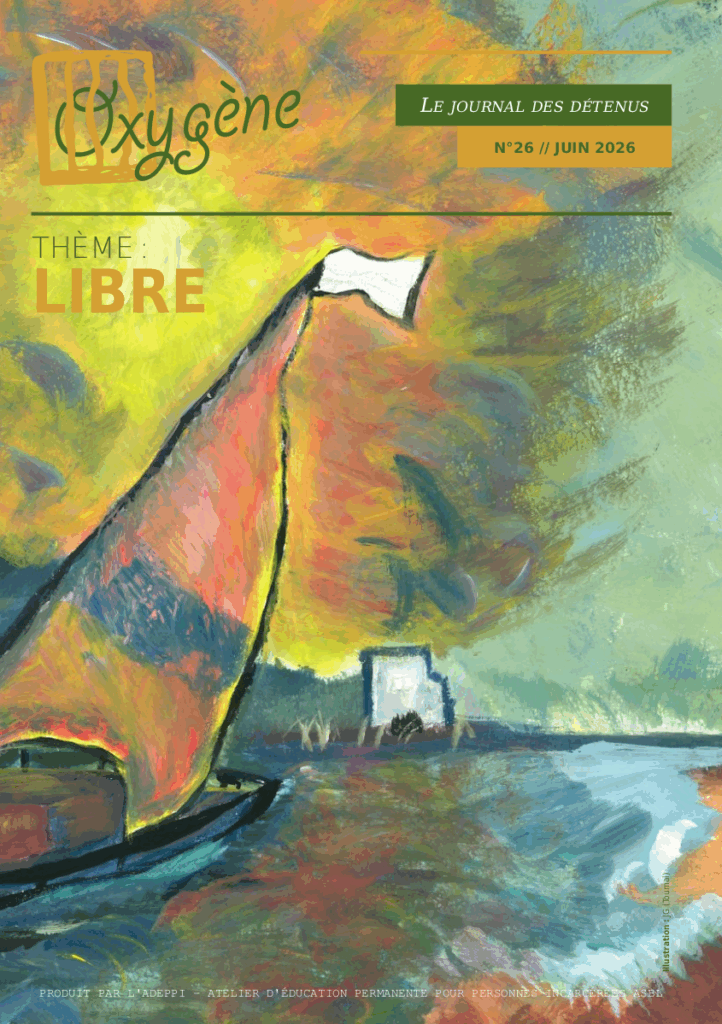
Ranging from diaries of life in detention to literary journals and cookbooks, these periodicals – with their improvised, slightly punk vibe – offer a glimpse into a world that is otherwise beset by negative stereotypes.
There are also radio programmes such as Le Cri, produced by inmates in collaboration with the nonprofit GSARA and the Fondation pour l’Assistance Morale aux Détenus. Here, too, journalism gives us a chance to see prison-related issues as they are experienced on the inside: overcrowding, healthcare, access to culture, and so on.
Access to information and the media in prisons is possible in Belgium, though carefully regulated. While inmates have the right to watch television, they must pay for the TVs and subscriptions themselves.
The same applies to print media, which is available to inmates at their own expense. Inmates may also listen to the radio. As for the internet, it is available through a system that allows access only to certain websites. All such access may be blocked for security reasons.
Camilla and François both work for the organization Adeppi and are the editors of Oxygène. In their telling, the magazine “has always been a publication by inmates, for inmates”. Created by Adeppi as part of a lifelong-learning initiative, Oxygène has gradually become more professional over time, while retaining some of the free-spirited “fanzine” ethos of its early days.
The magazine is a space for expression, whether it be poetry, in-prison reporting or recipes. But it also aims to be “a reflection on life, with a touch of protest”. This spirit of contestation is tempered by the need to respect the prison’s rules, the two editors explain. They assure us they have never had to censor anyone. “We’re not here to fuel hatred”, says François. “Our mission is rather to try to take a step back and get some perspective.”
In Italy, the magazine L’Alba, produced by inmates at Ivrea prison, has faced similar restrictions. In 2023, the prison warden imposed two conditions for the publication to continue its activities: that articles not be bylined and that they be reviewed in advance and potentially censored if deemed “inappropriate”.
Similar cases have been reported in other Italian prisons. In April 2025, more than 20 Italian prisoner-run magazines sent an open letter to the Ministry of Justice, calling for “respect for freedom of expression, authorization to use [more] digital technologies, prompt responses, and adequate recognition of the work carried out by volunteer communications staff”.
Over time, some of these publications have built up an audience inside the community of prison professionals. But such popularity brings its own dilemmas. Can – or should – a publication by and for inmates be addressing readers on the outside?
That is the approach taken by certain activist media outlets, such as l’Envolée in France, which aims to serve as a “voice for prisoners fighting against the fate imposed upon them”. This periodical, produced since 2001 by former prisoners or relatives of incarcerated individuals, publishes letters, trial reports, and analyses.
In a similar vein, the International Prison Observatory leverages its contacts with volunteers, prisoners and their families to produce the magazine Dedans-Dehors (“Inside Out”).
In Spain, La Voz del Patio is produced by inmates at Burgos prison with the assistance of media professionals. This publication demonstrates what it means to give inmates a voice that reaches beyond the prison walls. In print since 2019, La Voz is distributed in cafés, bars, and hair salons in Burgos, and throughout the Spanish prison system. Its coordinator, Víctor Cámara, sees it as a way to help people “who have made mistakes and whom society has cast aside”, and so to support their reintegration once they return to civilian life.
By contrast, for Laikauf and Marroy, Oxygène is and must remain primarily a space for inmates to express themselves. They worry that prisoners might feel less free to speak their minds if they know their writings are being read elsewhere.
Despite the benefits these publications can bring to inmates, they regularly face structural challenges, such as limited resources and time. Added to this are other constraints unique to the prison environment, such as the frequent transfers of inmates between prisons, the lack of readily available resources, and restricted internet.
These difficulties reflect a broader lack of funding for the nonprofit sector within the prison system (which is responsible, in particular, for cultural activities) and indeed for the prison system as a whole.
Belgium is currently facing an overcrowding crisis in its detention centres. In 2025, the Central Prison Oversight Council (CCSP) warned about the “increasingly critical situation” in prisons. There were 13,700 inmates competing for 11,040 available beds, an occupancy rate of 124 percent.
By positioning themselves as spaces for sharing and freedom of expression, these prison media outlets are implicitly raising questions about the mental health, solitude, and healthcare access of incarcerated individuals.
In a 2023 report, the World Health Organization estimated that one-third of prisoners in fifteen European member states suffered from mental health issues – 2.5 times more than in the general population. Worse still, 2025 figures from the Council of Europe revealed that the suicide rate in detention in Belgium was 25% higher than the European average.
🤝 This article was produced as part of the PULSE collaborative project. Francesco Berto (OBCT, Italy), Lola García-Ajofrín (El Confidencial, Spain), and Giota Tessi (Efsyn, Greece) contributed to it.
Do you like our work?
Help multilingual European journalism to thrive, without ads or paywalls. Your one-off or regular support will keep our newsroom independent. Thank you!


