







Select a language
Alain Caillé is Professor Emeritus at the University of Paris Ouest-Nanterre. He is the founder of the MAUSS review and a coordinator of the International Convivialist Association. He recently published "Extrême droite et autoritarisme partout, pourquoi" (Le Bord de l'Eau, 2023).
Voxeurop: In four countries, which together account for a third of Europe's population, we are seeing a surge in far-right extremism. Is intolerance, xenophobia and nationalism on the rise in Europe?
Alain Caillé: The fact that intolerance and xenophobic and nationalist ideas are on the rise in Europe might seem somewhat obvious, judging by the rise of the far right, which thrives precisely on the scapegoating of foreigners, and more particularly immigrants and Islam. But we need to take a closer look.
In fact, opinion polls show an ever-increasing acceptance of foreigners, for example in France, where the far right's victory in the European elections was particularly spectacular. So there are many other factors involved. In any case, there is undoubtedly a growing reluctance to accept immigration.
How did we get here?
There are many complex causes. Let's look at three of them, which are largely interdependent. The first is systemic opposition to the governments in power, whichever they may be. Since none of them can offer a credible vision of a happy future, people vote against them rather than for them. The far-right vote reflects a strong rejection of government parties. Yet when the far-right takes power or comes close to doing so, people start to vote against it (when this is still possible). We saw this in Poland a short while ago or during the last European elections in Sweden or Hungary.
But above and beyond these cyclical fluctuations, we need to take note of the fact that the rise of the far right is now a global phenomenon. Its rise in Europe is merely the effect, still somewhat muted, of a global groundswell that has yet to be fully explained.
The third reason is that the far right is proving to be far more skilful and effective than the traditional parties in its use of social networks, and knows how to tell people what they want to hear. Here, the question remains as to why.
What are the consequences for democracy? Should we fear a return to authoritarianism?
The rise of authoritarianism is a global phenomenon. It is a paradoxical reaction to the hegemony of neoliberalism and finance capitalism, which are giving rise to a type of society that is under constant pressure to accelerate, something that is ultimately untenable. Radically democratic on the surface, this kind of society has a latent yearning to break away from democracy.
The great attacks on democracy in the twentieth century were carried out by totalitarian regimes. Individuals had to be sacrificed to the collective, the race, the state and the party. Our societies, on the other hand, are becoming totalitarian in reverse: everything that is common must be sacrificed for the benefit of individuals, or rather consumers.
This fragmentation is leading to a threefold panic: ecological, economic and identity-related. The elites in power are discredited and hated because they don't know how to respond. The far right thrives on this hatred, holding out the prospect of a return to the common ground of yesteryear: family, religion, homeland, soil. But far from opposing neoliberalism, which is destroying those things, the far right is strengthening it!
Is there a democratic deficit in Europe?
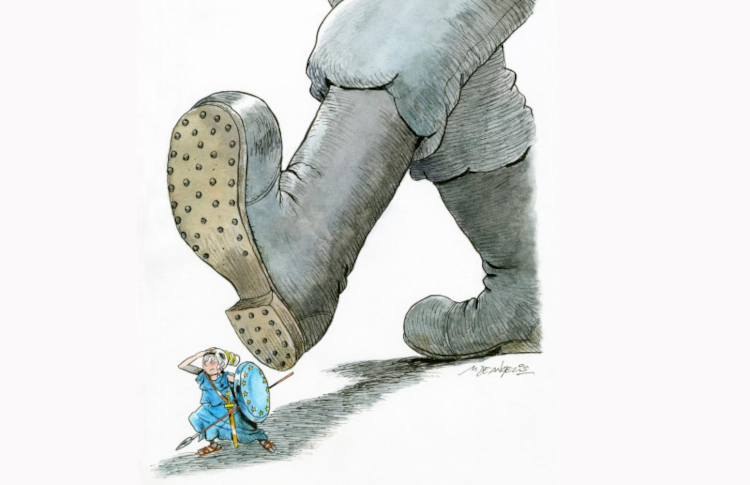
There doubtless is, but we must begin by agreeing on what democracy actually means. The reign of freedom? If so, individual or collective? People power, yes, but which people? The working classes versus the elites? The national people or the European people? Equality, but to what extent? We need to answer these questions quickly, because Europe may soon be the last bastion of democracy in the world.
The survival of the European project itself is now under threat. It no longer inspires any enthusiasm. To say that it will bring economic prosperity and peace is no longer sufficient, given that wealth is growing more elsewhere than in Europe and that even peace in Europe is not a certainty.
So let us see the rise of Europe's far right as a warning and a mandate to rethink the European project in depth. Personally, I don't see how the project could make any sense other than as a protection against the effects of neoliberalism and the ravages of tax evasion. It is an illusion to believe that democracy can regain strength and power among thirty or so countries forced to reach unanimous decisions on the most serious issues. Only a common European foreign, financial, military and economic policy might remedy the situation. Is it not time to start talking about a European Republic?
Do you like our work?
Help multilingual European journalism to thrive, without ads or paywalls. Your one-off or regular support will keep our newsroom independent. Thank you!