











Select a language
“The difficult conditions I experienced when I was homeless and looking [for housing] are now a thing of the past“, says Rose. “I've found an amazing family.” This Burundian refugee, who arrived in Belgium in 2024, is overwhelmed with emotion as she reflects on the support given to her by the Brussels family of Yvon, Nathalie, and their young daughter Charlie*.
Rose is staying in a beautiful house in a quiet neighbourhood of Brussels thanks to the association SINGA Belgium, which helps Brussels residents to temporarily host “newcomers” – a term the organisation prefers to “migrants” or “refugees". Tipped off by her cousin, Rose approached SINGA after searching unsuccessfully for a home. In August 2024 she moved in with Yvon and Nathalie, and still lives with them. Formerly a practicing nurse, Rose is now training outside Brussels as a nursing assistant. In the longer term she hopes to live in Belgium with her two sons, who still reside in Burundi.
SINGA Belgium has been offering social activities and support for newcomers since 2016. In 2019, it launched its solidarity co-living project. It has since managed to house 235 newcomers in such cohabitation arrangements, out of a total of 900 individuals – thus solving 25% of the cases.
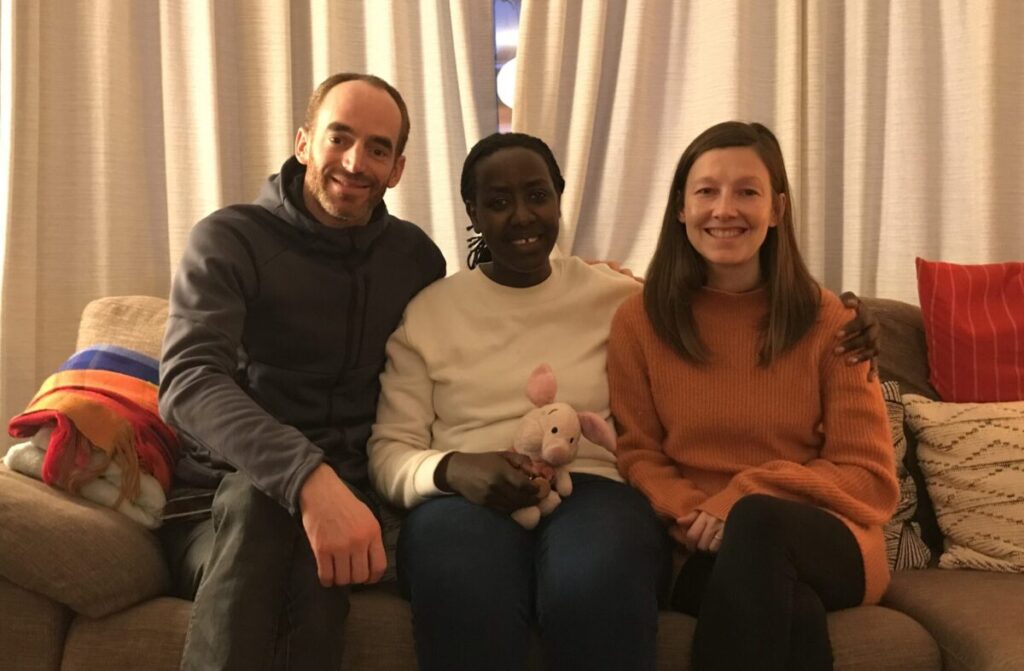
Yvon and Nathalie took in Rose through SINGA after “long consideration”, which they describe as “quite natural for us”. For Yvon, this period of consideration, involving host and guest, remains essential in order to establish expectations and boundaries. It also serves to overcome preconceptions. “I think that, overall, society needs to believe in the goodness of human beings”, he says.
“It may seem a little naive, but I believe that if you tell yourself that [the person] who is coming to live with you is very probably not going to cause any problems, then already you start off on the right foot." Believing in mutual respect between hosts and guests is also a way to help the refugees regain their autonomy.
In another ordinary house in the Belgian capital reside Metty, Milinthia, and Naomi, three young Burundian women. Aged between 20 and 35, they have lived for several months in this home, which was made available by its owner through a social rental agency (known locally as an AIS). They found it through the association Convivial, which supports refugees and other new arrivals by helping them with paperwork and offering them temporary accommodation.
For a period ranging from 12 to 18 months, the three women now have a place to stay and the support they need to deal with administrative procedures and to look for future housing and employment. “It's not just a roof over our heads”, smiles Milinthia. “It's a place to relax. [...] It's peaceful. It's great.” She says she is stressed out by bureaucracy and the search for lodgings, and has only good things to say about her temporary home. She is now studying information and communication, and dreams of becoming a journalist.
Metty, meanwhile, recently obtained refugee status. She is using the respite of her houseshare to recharge her batteries. Finding accommodation, she recalls, “was very complicated, I was really at the end of my tether”. She lacks the French words to describe her past trials and tribulations, so Milinthia, sitting beside her, translates: “Every time I pray, I include [the Convivial association] in my prayers.” Metty is attending both French classes and vocational training, and hopes eventually to work as a cleaner.
Brussels’s reception crisis
For years now, people seeking international protection in Belgium have faced a chronic lack of resources available to them. The “reception crisis” has left many asylum seekers outside the housing system, forced onto the streets in sometimes intolerable conditions. In Brussels, many remember in particular the refugee camps of winter 2023.
Fedasil, the Belgian agency responsible for processing asylum seekers, was providing 34,900 places as of 1 November 2025. The occupancy rate was 93%, meaning that 32,334 people were housed by the agency, mainly (87%) in collective accommodation. At the start of November there were 1,782 people on the waiting list.
Since 2013, Fedasil has also provided accommodation for vulnerable refugees. To date, 5,275 refugees have been welcomed to Belgium as part of this project.
In 2024, 39,615 people applied for international protection in Belgium (+11.6% compared to 2023). Among them, 6,469 were repeat applications. As reported by Doctors IWithout Borders (MSF) in early 2025, the lack of capacity affected men in particular: “The number of men on the waiting list for shelter fluctuated between 2,000 and 4,000 each month. [...] Deprived of a place in an official shelter, many of them had to sleep on the streets or in other precarious locations, for an average of four months.”
Grassroots groups typically share the same observation: several years after the reception crisis began, the government still does not provide enough places. The issue of asylum seekers has captured the attention of the media and lawmakers. The difficulties faced by those with official refugee status are less well known, but no less of a problem.
Rose sighs that her own search for housing “is really not going well”. Her stay with Nathalie and Yvon is time-limited. “I visit places, but I get negative responses. I really need to find housing for the sake of my children.” She believes the problem is not specific to the Belgian capital.
Metty’s home-hunting is not going much better. Viewings usually end in rejection when landlords ask for pay slips, which she does not currently have.
‘It requires a certain level of commitment, and it means overcoming obstacles that we sometimes put in our own minds about opening our doors and welcoming someone into our homes’ – Yvon
Initiatives such as SINGA Belgium and Convivial help to compensate for shortfalls, but they cannot replace the state. For hosts, helping remains burdensome: in Brussels, legally hosting someone in your home can affect the calculation of family allowances, unemployment benefits, and pensions, and thus reduce one's income. These issues are little known, but they may be preventing people from taking the plunge.
Then there is the unfavourable economic climate for grassroots associations. SINGA Belgium, whose small team depends on private charity and public grants, is currently waiting for the Brussels-Capital Region to release funds, which will only be possible once a government has been formed. At the time of writing, the Brussels Region is breaking records for the longest period without a fully functioning government, with more than 550 days on the clock.
| Elsewhere in Europe |
| In Ireland, the surge in asylum seekers has put a strain on the reception system. Effects of the Covid-19 pandemic are still undermining the mechanism for distributing applicants to shelters across the country. According to data from Ireland's International Protection Accommodation Services (IPAS), the number of people housed rose from 7,224 at the end of 2021 to 19,104 just a year later, and reached 32,656 people in 2025. The number of arrivals in Ireland has fallen since 2024. Since the economic crisis of 2008, Ireland has been in a housing crisis. One consequence has been an explosion in homelessness, a phenomenon that particularly affects migrants. On top of these difficulties there is growing hostility towards migrants among ordinary Irish people. In October 2025, four children and one adult had to be rescued from a reception centre following a suspected arson attack. In November, two men appeared before Portlaoise District Court on charges of possessing explosives. In a video message, they declared their intention to target mosques, reception centres, and hotels housing migrants. In Greece, meanwhile, camps are the only accommodation provided by the state for asylum seekers. Most of these are located on former military bases in industrial or rural areas, far from cities and with limited or inexistent public transport. According to the latest official data from Greece's Ministry of Migration and Asylum, published on 22 October, 22,427 asylum seekers were living in camps run by the Reception and Identification Service. The camps had a total capacity of 33,423 places in mid-2025. Asylum seekers are being denied the chance to stay in proper reception centres, says the organisation Refugee Support Aegean (RSA). In its latest updated report, published with another group, Pro Asyl, in December 2025, RSA concludes: “The current Greek reception model does not meet minimum legal standards and ultimately fails to fulfill its purpose of providing protection and dignified living conditions to people arriving in Greece and seeking refuge.” In theory, those staying in Greece’s camps are required to leave within a month of the decision on their asylum application. In practice, many of those recognised as refugees have continued to live in the camps with the tacit consent of the authorities so as not to be forced to spend their nights in the streets and parks of Greek cities. In Greece, too, there are projects to fill the gaps. One such initiative is the Helios+ programme, which offers refugees and families 12 months of housing assistance, Greek language courses, job counselling and referrals. Helios+ is a project of the Ministry of Migration and Asylum. It is supported by the EU and run by the International Organisation for Migration in cooperation with regional authorities. However, Helios+ “appears to have been designed on a scale far below the needs of the refugee population in Greece”, notes the report by RSA and Pro Asyl. The scheme will provide housing assistance to 4,323 refugees over the next four years, or about 1,000 per year. In addition, 83,895 recognized refugees have been granted a special residence permit, valid for three years. There are also 32,572 beneficiaries of subsidiary protection who have been granted a special residence permit, valid for one year. Yet in the year leading up to April 2025, more than 40,000 people were recognised as refugees. |
These initiatives, limited as they are, perhaps contain a lesson nonetheless: the spirit of solidarity is strong.
For Yvon, the priority today is to “demystify hospitality”: to show people who are potentially interested but afraid to take the plunge that living with a refugee is no different from living with a native Belgian. “It requires a certain level of commitment, and it means overcoming obstacles that we sometimes put in our own minds about opening our doors and welcoming someone into our homes.”
Will Rose take in new arrivals herself once she has settled in with her sons? She nods. “I have to do it.” she says. “I've seen what a good impression it makes. [...] I want to do it.” It would be to pass on the welcome she herself received to those who need it in turn.
*We chose not to mention their surname for privacy reasons.
🤝 This article was produced as part of the PULSE project, a European initiative supporting international journalistic collaboration. Noel Baker (The Journal Investigates (Ireland), Dimitris Angelidis (Efsyn, Greece).
Do you like our work?
Help multilingual European journalism to thrive, without ads or paywalls. Your one-off or regular support will keep our newsroom independent. Thank you!