










Select a language
In 2025, Russia attacked Ukraine's energy system more than 4,500 times. But in 2026, Russia got what it wanted – unprecedented cold. Over the past month, temperatures in Ukrainian cities have reached -20-26°C in some places.
Thermal power plants, which provide heat for millions of people in Kyiv, Kharkiv, Dnipro, and other major Ukrainian cities, have been subjected to massive targeted attacks involving strike drones, ballistic, and cruise missiles. Some facilities have been completely disabled, and it is unclear when they will be operational again. A state of emergency has been declared in the energy sector.
In Kyiv, the capital and largest city in the country, hundreds of thousands of people have been left without heating or electricity. They are forced to shelter from Russian shelling during severe frosts, and strikes also hit other civilian buildings, including residential areas, kindergartens, hospitals, and businesses. Ukrainian rescuers are working in extreme conditions, but Russia is preventing them from doing their job: medics, firefighters, and utility workers are coming under attack right during rescue operations. Read more from the Public Interest Journalism Lab.
‘This is my family’
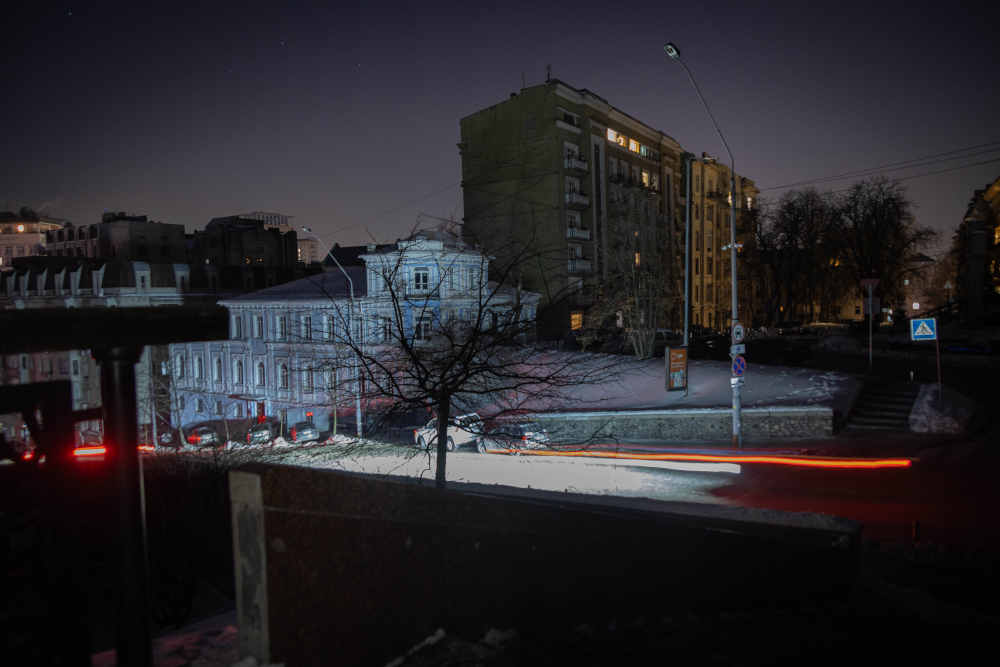
Four years after the full-scale invasion, Ukrainians were still fearing a cold winter as Russia continued to strike energy infrastructure, leading to scheduled blackouts. In order to completely knock out the thermal power plants, the Russians needed sustained cold weather – weeks of below-zero temperatures that would both strain the energy system and exacerbate the hardships faced by civilians. Until 2026, winters in Ukraine were unusually warm.
The night of 9 January 2026, can be considered a turning point. Freezing rain was pouring all day in most Ukrainian cities. Roads, sidewalks, and power lines froze before our eyes. Then, at night, Russia launched a powerful attack, using 36 missiles and 242 drones of various types across the country. The main strike was directed at the Kyiv region – that night, Russia left half a million people in the capital without electricity.
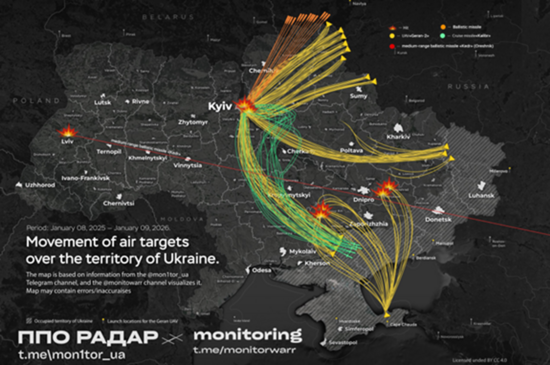
"Snizhana, here's what came this time," says the State Emergency Service worker Vitaliy Kachuro to his wife in a video, showing the distruction. In the video, a high-rise building on Mykoly Bazhana Street, 16, is burning. It is situated on on the left bank of the Dnipro River, which divides the capital. On the night of 9 January, a Russian Shahed drone hit the building. The thermal power plant that heats most of the left bank is located approximately a 20-minutes drive from the building. Now it has been completely knocked out.
Whenever he was on a call, Vitaliy would record a video for his wife, update her on the situation, and reassure her that he was okay. This time was no different. Snizhana received the video from Vitaliy at 01:55, but he stopped communicating at 02:55. Until six in the morning, Snizhana searched for videos on the internet from that address but found nothing. She called, wrote – silence. In the morning, they called from the State Emergency Service: "I only asked: is he alive?"
Snizhana's husband is one of the five rescuers and four medics who were injured ina repeat Shahed strike at this address. One medic died. All of those injured were hospitalized, and three of them, including Snizhana's husband, were in critical condition in the Intensive Care Unit.
In the Kachuro apartment, a young boy almost immediately asks to be picked up. His name is Vitaliy, named after his father. Young Vitaliy is two years old. He is the couple's middle son: the youngest, Andriy is three months old, and their eldest daughter, Emilia, is six years old.
At home, Vitaliy always spent time with the children at home. He sang them lullabies at night.
"They're all so open, just like their dad. They really miss his attention now," Snizhana explains.
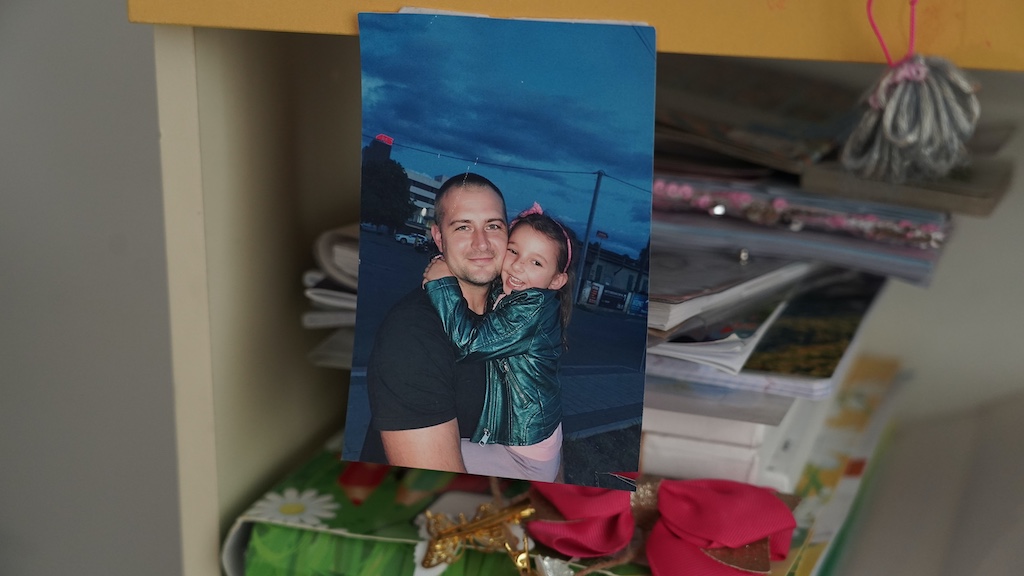
Vitaliy is still in a critical condition in the Intensive Care Unit. On the first day in the hospital, his heart stopped twice. Serious injuries were caused by shrapnel from the repeated Shahed attack: internal bleeding occurred, vertebral arches were broken, and the spine was displaced. He suffered severe injuries to his internal organs and a closed traumatic brain injury.
"He still can’t feel his legs. In the photos the doctors showed me, you can see large wounds to his body, internal organs, and lungs. These wounds are healing slowly. He lost two liters of blood and experienced two cardiac arrests," the woman recounts.
Vitaliy was the only member of the family who was working. In addition to his role in the State Emergency Service, he worked two other jobs to support the family. Together with his wife, he also ran a greenhouse on a small plot inherited from Vitaly’s grandfather, not far from the apartment. They grow tomatoes there and, in the nearby garden, apples, pears, plums, and raspberries.
"He loves everything homemade, and even wanted to get chickens. And I tell him: What chickens? We already have three children and a dog – what more chickens? " Snizhana laughs.
According to Snizhana, Vitaliy went to work as he was going "on a date": "I even got jealous," she smiles. "I love my work so much. This is my family," her husband used to say.
Vitaliy joined the State Emergency Service in 2010. He was a rescuer for eight years, and when their children were born, he moved to a driving position so that he would have a more flexible schedule: one day working, and three days at home.
"With the guys in his unit, they're good friends. They help each other. If someone builds a house, they gather together and help," Snizhana recounts.
‘I won’t abandon my work’
A few months ago, when the situation in Kyiv worsened, Snizhana suggested that Vitaliy leave with the family and go abroad. They have three children – and although Vitaliy had the right to do so, he refused: "I won't abandon my work."
After 9 January, the family's life seemed to have come to a standstill. Every day, Snizhana goes to the hospital to see her husband.
"I come alive when I go to see him. I'm glad that he's now in a more or less stable condition. The doctors saved him. He opens his eyes, reacts to my voice. When he hears his mother's voice, he starts to cry," the woman recounts.
Her daughter constantly asks “when daddy will return”: "I told her in ten days. It's good that she doesn't know how to count yet, so ten days will seem like a longer time to her." Emilia sings lullabies on video, which Snizhana plays for Vitaliy in the hospital.
"I have to hold on, otherwise there’s no way. I have three children and a husband who needs to get back on his feet. We're all waiting for him very much," she says.
Oleksandr Zibrov, a 36-year-old colleague who was working that night and was also wounded during the repeat Russian strike on 9 January, died in the hospital from severe injuries. Doctors fought for Oleksandr's life for 18 days. At the farewell on 28 January, a black hearse leaves the fire station where Oleksandr worked for the funeral. The sound of fire engine sirens could be heard from afar. They sound from all of the fire department’s vehicles in Darnytsia. All department workers stood at attention, with their heads bowed.
‘Having saved countless lives, he could not save himself’
The drone strike that wounded the rescuers and took the life of medic Serhiy Smoliak occurred just as they were already finishing their work at the scene. The medical team that had arrived was already preparing to leave when another drone hit the yard of the shelled building, literally 50 meters from the team.
"They were on duty at the strike site when a drone approached. They ran towards shelter, but they didn't have time to hide," medic Vadym Vilihovchuk, Smoliak's colleague, told Suspilne. - "There were injuries incompatible with life. And the danger continued. So the medics kept running to shelter until the shelling ended."

Fifty-syx-year-old paramedic Serhiy Smoliak died on the spot from his injuries. Four more of his colleagues were wounded.
"They reported on the fact thata medic died in Kyiv on that terrible night already at night. But I couldn't even imagine thatit would be Serhiy who would die in this huge city," says a friend of the medic and fellow countrywoman from Kakhovka, Kherson region. For security reasons, we are not naming her. She adds: "Serhiy and his wife are medics. In Kakhovka, everyone knew and respected them."
Kakhovka is now a Russian-occupied city. Before moving to Kyiv, Serhiy worked as a senior paramedic of emergency medical services for over 25 years. After the occupation, the family remained in the city for several months. Serhiy continued working on the ambulance.
The Smoliak family decided to leave the occupied city in autumn 2022. Living under constant terror had become unbearable. Added to this was the systematic persecution and kidnapping of people by the Russian occupation forces: in October 2022, the Russians illegally detained Serhiy Smoliak's nephew, a local anesthetist, as well as an operating room nurse at the city hospital, the Smoliaks' friend recounted.
"Our ambulance was destroyed there in December 2022: the Russians struck, destroyed both the building itself and the ambulances. After that, I didn't want to stay there for another day," Svitlana Kachan, a colleague of Serhiy from his work in the Kherson region, told Suspilne.
"He has a son here and two granddaughters. One is very young, she's just over a year old, the other is in first grade," says Svitlana: "He's such a good grandfather that he would definitely talk about his granddaughters every shift. Serhiy would never leave a person in a difficult situation without helping them."
A week before he died, a Russian drone damaged Serhiy Smoliak's apartment in Kakhovka. The medic's family was renting a house in Kyiv.
"Having escaped from the enemy occupation and having saved countless lives, he could not save himself," says a friend of the couple
According to the organization Physicians for Human Rights over 2,000 attacks on healthcare facilities in Ukraine have been documented since the beginning of the full-scale invasion, and over 300 medics have been killed.
Russia’s deliberate tactic
On the night of 9 January, Russia took 5 lives together with Oleksandr Zibrov and medic Serhiy Smoliak.
According to the Ukrainian Ministry of Internal Affairs, Russia has attacked Ukrainian rescue workers over 60 times in the last three months of 2025 alone. Five rescuers were killed, and over 30 were wounded.
Analyzing the 9 January attack, lawyer and international humanitarian law expert Anna Mykytenko, noted that double strikes targeting civilian emergency response services are prohibited by international humanitarian law: "A repeated attack on a civilian object while civilian emergency response services are working to overcome the consequences of the initial attack can be considered a double strike. Such actions contradict international humanitarian law, according to which parties to the conflict, among other obligations, must always distinguish between military targets and civilian objects and not strike the latter."
At the end of 2024, the Ukrainian human rights organisation Truth Hounds published a study that identified double strikes – attacks targeting primarily at medics and rescuers –as a deliberate Russian tactic. They verified 36 cases of strikes inflicted by Russia from the beginning of the full-scale invasion until 31 August 2024, pointing to an alarming escalation in the use of this tactic. For this research, the authors collaborated with the Syrian Civil Defense, known as the White Helmets, who became direct witnesses and victims of this Russian tactic during the war in Syria.
‘Parties to the conflict, among other obligations, must always distinguish between military targets and civilian objects and not strike the latter’ – Anna Mykytenko
The authors identified a clear pattern in these attacks, which typically involve an interval of several tens of minutes between strikes: in almost all cases, the second strike results in casualties predominantly among those who arrive first on the scene – rescuers, medics and police officers. Russian forces regularly launch repeat strikes based not only on calculations about the potential arrival of response services, but also by monitoring the area with reconnaissance drones. Repeat strikes are often inflicted when Russian forces can confirm the arrival of rescuers and other civilians at the strike site.
Although this tactic is nothing new to the rescuers themselves, the abnormal frosts of this winter mean they have to prepare especially carefully for calls.
"The longest I worked at a strike site in January was five or six hours. The temperature reached -18°C then. I have a habit, I'm a winter fisherman, but it's still hard," says Kyiv rescuer Ivan. He shows us his stiff gloves in a video: "I won't be able to wear these on anymore," he smiles.
According to Ivan, in such frosts, the main thing is not to get wet: one should wear thermal underwear and take extra gloves. There are also rules at work that rescuers must follow.
"The water supply must be constant, because the water in the fire hoses freezes before your eyes. If the supply stops for 5-7 minutes, ice forms in the hoses and gets stuck there. It becomes impossible to extinguish the fire," the rescuer explains.
In his 17 years of service with the State Emergency Service, he has worked in cold conditions many times. However, the frosts then didn't last as long as this winter. Most importantly, rescue operations didn't have to be conducted right during the targeted Russian shelling.
✍️ Editing by Angelina Kariakina, Gian-Paolo Accardo
O
Do you like our work?
Help multilingual European journalism to thrive, without ads or paywalls. Your one-off or regular support will keep our newsroom independent. Thank you!