










Select a language
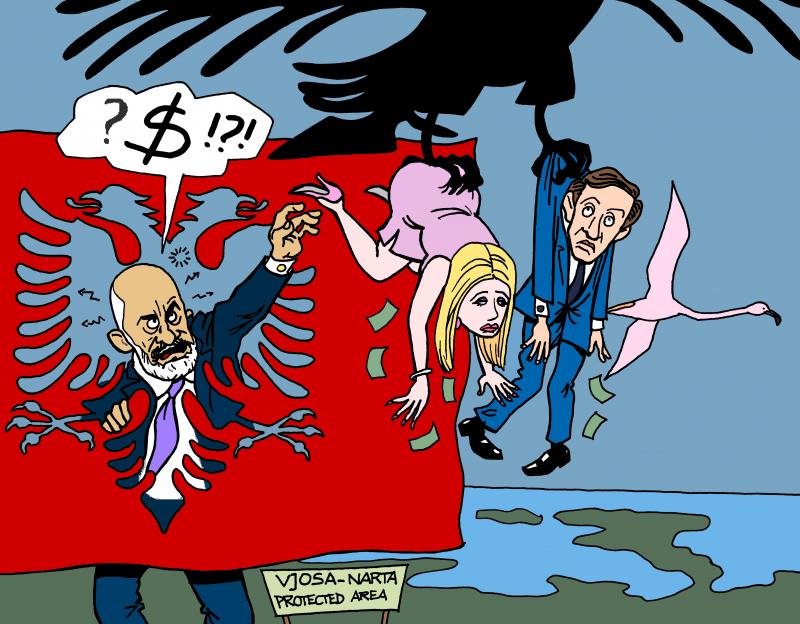
On 23 May 2026, protests broke out in Albania that would become known as the “Flamingo Revolution”, and quickly evolved into something much broader. The catalyst was the plans for the large-scale development of the uninhabited island of Sazan, as well as the ambitions regarding the Narta–Zvernets coastline. These plans were primarily backed by American investor Jared Kushner, who is the son-in-law of US President Donald Trump.
Without party involvement and driven primarily by young people born after the fall of the regime, the movement united people from different political backgrounds both inside and outside Albania around one shared conviction: that development cannot mean constant emigration, political nepotism, and decisions made without society’s input.
Without party involvement and driven primarily by young people born after the fall of the regime, the movement united people from different political backgrounds both inside and outside Albania around one shared conviction: that development cannot mean constant emigration, political nepotism, and decisions made without society’s input.
The case of the investment in Sazan serves as a summary of all the contradictions of modern Albania. On the one hand, there is the image of a country marketed as the new Adriatic Riviera. On the other, there is a society that continues to face high rates of youth emigration, a housing crisis in major urban centres, and stark regional inequalities.

Tirana is on a fine line: it has to prove that it can protect the environment, ensure public consultation, and crack down on widespread corruption, at the very same time that it is under pressure – and also eager – to open its doors unconditionally to foreign investment.
This tug-of-war between supposed European values and aggressive capitalist development with a Balkan backdrop is one of the main triggers of the political crisis brewing in the country.
Government collapse?
Ervin Goçi is an activist and a lecturer in the Department of Communication and Journalism at the University of Tirana. “The protests began as a reaction to the loss of hundreds of hectares of protected land due to the development plan, but what sustains them and fuels them is the demand for the government’s resignation,” he emphasises to Efsyn.
Referring to Albania’s EU accession process, Goçi adds: “We are at a crossroads and in a state of uncertainty, but this is not the fault of the Albanian people, who are very clear about what they want. However, certain political, economic, and criminal interests do not truly want Albania in the EU.
Or they want it as Prime Minister Edi Rama has presented it – along with his Serbian counterpart, Aleksandar Vučić – as if it were a deal that would tell the Europeans: ‘Let us join the EU, but you won’t hold us accountable for upholding European rule of law, and we won’t ask anything of you.’”
According to the professor, this wave of protests would not have begun or grown so large had there not been a structural shift from the inaction of a social minority – which had remained silent until recently – towards organised action and solidarity among mobilised citizens, which took shape far from the government’s gaze.
“The flamingo represents the internationalisation of a new Albania, but with a completely renewed, alternative, modern, and attractive image completely at odds with the way the government markets it, namely through glossy tourist posters. Through this movement,” Goçi explains, “we’re telling the world that we’re not mere spectators of the dirty deeds of the oligarchy and organised crime, but that we’re the masters of our own wealth. We don’t simply declare this with a flag, because a flag is a distinctive symbol that sets us apart from others, whereas the flamingo has a more universal form and builds bridges of social and political communication that transcend national coexistence. It is a 21st-century Albanian, in a global reality, seeking to find its place in the world.”
The people of the protests
Besiana Guri is the founder and head of the environmental organisation Lumi in Albania and has been participating in the protests since day one. We spoke with her one afternoon, shortly before she headed to yet another protest in downtown Tirana. “The ‘Flamingo Revolution’ was inspired by the citizens, and we chose flamingos because they are one of the species that would be threatened. And then it brought together people who had other concerns as well. And those who are now calling for a change in the political system, a change from the old regime.”
So what exactly do the Flamingos want? “They want to see a new way of governing. They want transparency and a say in decision-making. They want to be heard. Most of the people protesting are young. They’re students or young workers who, in recent years, have been thinking of ways to leave Albania. For many reasons. And now they’re finding hope in this protest,” continues Besiana Guri, a woman who was just three years old when the socialist regime collapsed.
‘The flamingo represents the internationalisation of a new Albania, but with a completely renewed, alternative, modern, and attractive image completely at odds with the way the government markets it, namely through glossy tourist posters’ – Ervin Goçi
For Guri, there is a real possibility that something positive and hopeful will come out of the rallies: “In general, the public wants to see new faces that aren’t associated with the corruption and crime of the past 30 years. I speak as an individual, as a citizen, not as an expert on anything, but I think there will certainly be new political forces that will emerge as a result of this protest. For now, there is common ground, a shared understanding among the protesters that we don’t need a leader or a party to lead us. The protest comes from the people and will bring about its own results,” she concludes.
| Money under the table, corruption, and tax evasion ● A study by the Global Initiative Against Transnational Organized Crime revealed that nearly six out of ten companies (59%) in Albania that obtained permits to construct high-rise buildings between 2017 and 2019 are funded by undeclared or illegal capital. ● For the same period, it is estimated that approximately €1.6 billion in undeclared money was funnelled into the real-estate sector. ● A report by the Friedrich Ebert Foundation, citing a recent study on Tirana, estimates that corruption and tax evasion may have generated over €8 billion in undeclared funds between 2015 and 2024, a large portion of which is linked to the construction sector. ● The Special Anti-Corruption Prosecutor’s Office (SPAK) in Albania, established in 2016 and highly regarded by protesters, is now investigating the case involving the investment in land north of Svernitsa. The banks have frozen the funds used for the land transactions. |
The “Flamingos” did not stay in Tirana. Within a few weeks, the symbol of a protest that began in opposition to a controversial investment in Albania’s protected areas found itself crossing borders and continents.
In Europe, Athens, Berlin, Vienna, Munich, Cologne, Stuttgart, The Hague, Strasbourg, Oslo, Odense, Bologna, Genoa, and Faenza saw members of the Albanian diaspora take to the streets, chanting the same slogan: “Albania is not for sale.”
Balkan movements put a damper on the appetite for prime real estate
In Croatia, there was a similar case involving Srđ Hill in Dubrovnik, where plans were underway to build a golf resort. The project was being promoted by Israeli investor Aaron Frenkel through his company Razvoj Golf and called for two golf courses, two hotels, 240 villas, and 400 apartments on a 310-hectare site, with a total value of approximately €1 billion.
The plan was first announced in 2006 and was ultimately abandoned following strong backlash from the local community and the involvement of national environmental organisations as part of the Srđ je naš (“Srđ is Ours”) campaign, which began in 2010. An even more striking example can be found in Serbia, in the movements opposing Rio Tinto’s plan to mine lithium. There, the struggle truly united local residents, right-wing nationalists, and environmental activists in a common cause. A similar atmosphere is often found in the movements to protect rivers in Bosnia and Herzegovina.
In Romania, a “development” project named Trump Tower in the city of Cluj-Napoca recently received zoning approvals for the second phase of its construction. The plan includes residential complexes, a hotel tower up to 30 storeys tall, and a golf course. Eric Trump is involved in the project through the Trump Organization. The New York Times noted that this development will attach the “Trump” name to luxury apartments and a golf course located near an informal settlement where Roma communities have effectively been displaced and forced to live next to toxic waste.
This particular project has reignited concerns about the social costs of large, high-profile foreign investments when they are carried out without adequate safeguards to protect vulnerable communities and the natural environment.
👉 Original article on Efsyn
🤝 This article was produced as part of the PULSE collaborative project. Contributors include Giovanni Vale, Nicola Pedrazzi, Ines Martinez Velasco, and Jackie Berger (OBCT-Italy)
.
Do you like our work?
Help multilingual European journalism to thrive, without ads or paywalls. Your one-off or regular support will keep our newsroom independent. Thank you!