














Select a language
On the night of 31 July, a 4.7-magnitude earthquake struck the Campi Flegrei area, near Naples, damaging homes, cutting power injuring around twenty people. In the town of Pozzuoli, where a building collapsed, residents spent the night on the street rather thank risking returning indoors.
Some 1,400 kilometres away, on 2 August, two earthquakes measuring 3.9 and 2.5 were felt in the Murcia region of Spain – a reminder that southeastern Spain sits in a seismically active zone. No material damage was reported, but the tremors revived uncomfortable memories of the 2011 Lorca earthquake, which killed nine people, injured more than 300, and caused €462 million in direct economic losses.
A more recent catastrophe has also concentrated minds. A pair of earthquakes in Venezuela left more than 6,000 dead – and the scale of that disaster has prompted uncomfortable questions closer to home. Europe is home to regions with a seismic risk “comparable to or greater than that of northern Venezuela”, Juan Vicente Cantavella, director of the National Seismic Network at Spain’s National Geographic Institute (IGN), says. Turkey, Greece, Romania, Italy, Albania and North Macedonia are the countries most at risk. Spain is in less danger, but the country does have a history of earthquakes that have claimed hundreds of lives.
Italy: beauty versus resilience
Italy has some of Europe's most intense seismic activity, a consequence of its position on the boundary between the Eurasian and African tectonic plates. Movement along this fault line regularly triggers earthquakes and volcanic eruptions — at Mount Etna, Stromboli and Vesuvius. A network of faults running through the Apennines makes that mountain range the country's most seismically hazardous area. Since 1905, fifteen major earthquakes have been recorded in Italy.
The last major earthquake in Italy was the Amatrice earthquake, which had a magnitude of 6.2 and struck on 24 August 2016. It claimed the lives of nearly 300 people and left some 4,000 homeless. The tragedy reignited the debate on the vulnerability of Italy’s building stock: it was estimated that nearly 70 percent of buildings did not meet earthquake-resistance standards. Even relatively recent constructions had collapsed in previous earthquakes. 2009 saw the collapse of the university hall of residence in L’Aquila. Back in 2002 a school collapsed in San Giuliano di Puglia.
Due to its population density and unique architectural heritage, Italy combines “medium-high seismic hazard, very high vulnerability and extremely high exposure”, as Dr Carmine Galasso, professor of seismic engineering at University College London, describes it in the magazine Time. In some municipalities in the Apennines, buildings that date back 2,000 or 3,000 years are still inhabited. Adapting structures of that age to modern seismic standards is technically complex and extraordinarily costly.
In the years following the Amatrice earthquake, Italy has made progress on several fronts. The government launched Casa Italia, a long-term nationwide programme aimed at bringing the country’s building stock into line with international safety standards. Schools have been a priority, with an investment of €4 billion over two years and 850 new seismic safety standards, in addition to the construction of new buildings.
Italy now has some of the most advanced earthquake-ready standards for new buildings. In the longer term, the major challenge is to adapt the vast stock of older buildings without compromising the country’s unique architectural heritage.
Lorca, the Spanish town that rose from the rubble
When, at 17:05 on 11 May 2011, a 4.6-magnitude earthquake struck Lorca in Spain, no one imagined that it would be a mere foretaste of the horror that was to follow less than two hours later. A second earthquake, measuring 5.2 and occurring at a depth of just one kilometre, thoroughly shook the Murcian town. “It was like a punch, like a gunshot”, Emilio Trigueros, principal researcher in geotechnics and mining at the Polytechnic University of Cartagena, says. He later co-ordinated studies into the earthquake. In Trigueros's account, the quake's proximity to the surface caused all the energy to be concentrated into a single brutal shockwave. “The other aggravating factor was the seismic site effect, a phenomenon whereby the shockwave is amplified in layers of soft ground“, he adds. This affected many buildings.
In the early days, architects, engineers and surveyors marked up the area known as Ciudad del Sol with a colour-coded system. A green cross was for buildings at no risk, yellow for superficial damage and potential rockfalls, red for high risk of collapse, and black for extreme danger. The markings can still be seen on some facades today. Eighty percent of Lorca’s housing stock was affected. 1,798 homes were demolished and more than 1,200 had to be rebuilt. Even its iconic castle lost a tower. However, during the earthquake, only one building collapsed outright. “In general, the performance of buildings in Lorca was very good”, notes Trigueros. “Most of the casualties were not caused by structural collapse, but by secondary factors or falling rubble.”
For this reason, current protocols emphasise that the safest course of action is to remain indoors until the earthquake has stopped. "The aim is for buildings to remain standing so to protect the population, even if some subsequently have to be demolished”, explains Fulgencio Gil, the current mayor of Lorca. He was not in office when the disaster struck, but he tells us that improvements were introduced during the reconstruction. “The vulnerability of short or ‘dwarf’ pillars was identified, so the building code was amended to eliminate them, and construction techniques were improved”, explains Gil. Lorca’s experience also led to the organisation of international forums to share the lessons learnt.
In terms of preparedness, Spain now has both prevention and response plans in place. They include the Sismilor plan in Lorca and the Sismimur plan in the Region of Murcia. The plans set out protocols for early warning, evacuation and self-protection. Emergency readiness has been “substantially improved”, says Gil. “The public is very aware and prepared in case it happens again. Drills and campaigns to remind people of the protocols are also carried out.”
The Region of Murcia is the most seismically active area in Spain. The Guadalentín Valley, which stretches from Lorca to Orihuela and Torrevieja, has a long history of earthquakes. The last two, although mild, might have disturbed the Alhama Fault, the same one responsible for the 2011 earthquake. Both Gil and Trigueros are adamant that Lorca is now better prepared than it was fifteen years ago.
Bucharest’s houses of cards
Where Lorca has red crosses, Bucharest has circular warning signs. A round metal plaque on a block of flats opposite Cişmigiu Park in the Romanian capital alerts residents that the building could collapse in the event of a major earthquake. The same red markings can be seen on several neighbouring streets, among windows and graffiti. At least 413 buildings in Bucharest are classified as Seismic Risk Class I (RS1), the highest level of vulnerability. The actual number of vulnerable buildings is much higher, according to ReRise, Romania’s first organisation dedicated to seismic risk reduction.
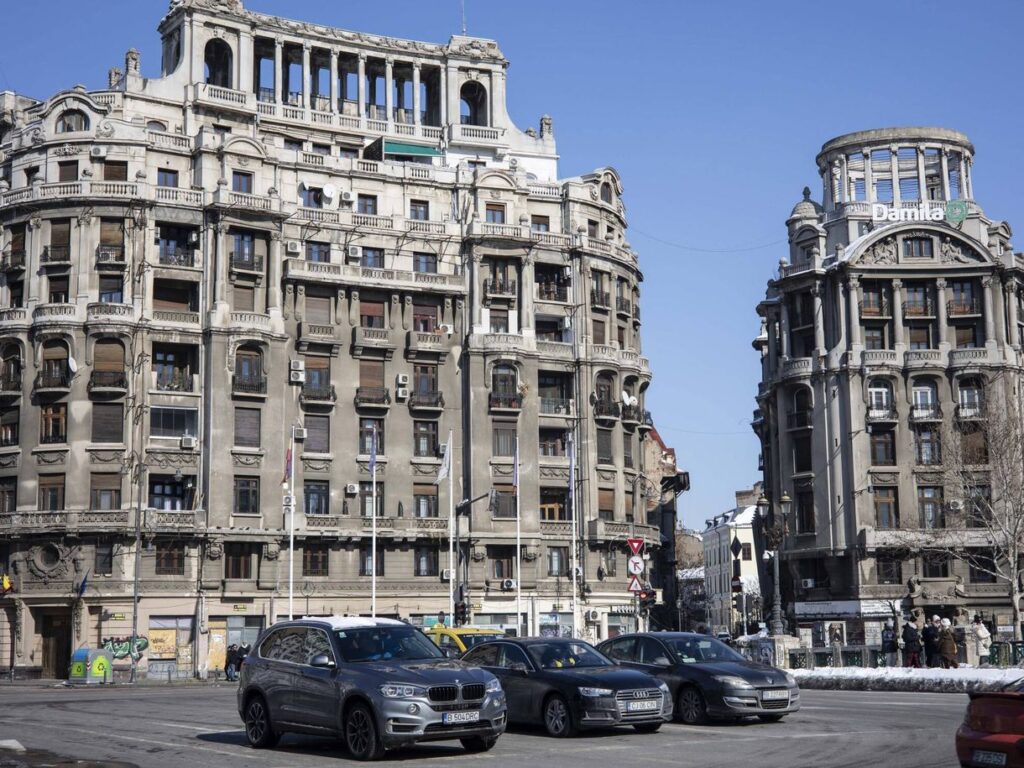
The current classification, ranging from RS1 to RS4, determines the probability of collapse or the expected damage, explains Răzvan Munteanu, director of the Municipal Administration for the Reinforcement of Seismically Vulnerable Buildings (AMCCRS). Before 1997, buildings were categorised according to the urgency of their structural reinforcement. When that system was replaced, “thousands of buildings that had previously been classified by urgency were simply forgotten”, says Matei Sumbasacu, an engineer and founder of ReRise. Bucharest is one of the urban areas in Europe with the highest seismic risk, alongside Catania and Naples in Italy; Athens in Greece; and Istanbul and Izmir in Turkey.
In Romania, people still remember the date. On 4 March 1977, at 21:22, the country was rocked by an earthquake measuring 7.2 on the Richter scale. Although not the strongest in Romania's history, it was the deadliest and most destructive.
In 1940 there had been one measuring 7.4. The epicentre was located in the Vrancea seismic zone, at a depth of 100 kilometres. The seismic waves were felt across almost the entire Balkan region. 1,578 people died, 1,424 of whom were in Bucharest. There were 11,300 injured and some 35,000 homes were destroyed. In the capital, 33 buildings collapsed completely.
According to Sumbasacu, the lack of action following the earthquakes of 1940 and 1977 explains why thousands of buildings could still collapse today “in a matter of seconds”. Of the 33 buildings that collapsed in 1977, 30 had already sustained damage in 1940 and were never properly repaired. Added to this is the general vulnerability of the 20th-century building stock constructed before 1977. Knowledge about the Vrancea earthquake was limited. Before 1965, “the priority was the building’s appearance, not its structural behaviour”, says Răzvan Munteanu of the municipal agency AMCCRS.
Athens: before and after 1999
Four minutes before three in the afternoon on 7 September 1999, a magnitude 6.0 earthquake took Greek seismologists by surprise. It originated on a previously unknown fault in an area considered to have low seismic activity. More than 100 buildings, including three factories, collapsed. 143 people died and 1,600 were injured. It was Greece’s deadliest natural disaster in almost half a century.
The proximity of the epicentre to Athens, the shallow depth of the earthquake and the tremor’s intensity exacerbated the damage. Added to this were the structural deficiencies of many reinforced concrete buildings. Engineers identified several main causes of the collapses: open-plan ground floors (pilotis); short columns; weak infill walls; and extensions carried out without engineering studies.
The earthquake marked a turning point in seismic risk management in Greece. According to researcher Efthymios Lekkas, reforms were introduced to building codes, seismic monitoring, and response systems. Although the country already had earthquake regulations in place, the disaster accelerated the implementation of European standards. Public buildings, particularly schools, were upgraded. The national monitoring network was expanded with new accelerometers.
A 2018 study by Professor Ioannis Doudoumis of Thessaloniki's Aristotle University described Greek seismic regulations as among the most advanced in the world. According to Doudoumis, buildings designed in accordance with the post-1984 codes (reinforced by 1995 revisions) offer far greater resistance than older structures. He also points out that Greece has moved away from the practice of simply amending laws in response to disasters, towards an approach grounded in ongoing scientific research and systematic risk assessment.
A protocol for tourists too
Despite these advances, the large number of older buildings remains a major challenge in Greece. Many were built before 1950 and it is not known whether they meet the modern criteria for safety. Furthermore, earthquakes in tourist destinations may result in mass evacuations and so disrupt essential infrastructure such as roads, ports, airports and hotels. One example was the 2017 Aegean Sea earthquake, when the island of Kos had to be partially evacuated. Two people there died and 120 were injured. In 2025, a prolonged sequence of some 25,000 tremors in Santorini led to the evacuation of more than 10,000 residents. There were thousands of tourist cancellations and severe impacts on the local economy.
For one of Europe’s most seismically active countries, preparedness and public awareness are non-negotiable. Greece has put in place emergency-response procedures and awareness-raising campaigns. But it still lacks a proper protocol specifically designed for tourists, despite welcoming millions of visitors every year.
The same is true in Romania, despite its progress. Hundreds of buildings in Bucharest might be reduced to rubble if past disasters were to repeat themselves. They could include blocks of flats and holiday apartments in buildings marked with a “red plaque”.
Moving forward into the unknown
Every major earthquake “boosts our understanding of this phenomenon and the measures of risk reduction”, Luis Cabañas, a seismologist at Spain’s National Geographic Institute (IGN), tells El Confidencial. The Lorca earthquake, for example, has led to a significant improvement in seismic monitoring in that region, mainly through the installation of sensors. Another technology that the National Seismic Network is implementing, and which Trigueros describes as “quite promising”, is distributed acoustic sensing (DAS). This uses fibre-optic cables to detect earthquakes and tsunamis in real time, and can aid monitoring in unsafe or hard-to-reach environments. “It allows us to monitor movements not only at the point where the geophone is located, but along the entire length of the cable”, explains the researcher, who is from Cartagena.
Furthermore, adds Cabañas, we now have a better understanding of the geological processes that caused the Lorca earthquake, and the structural defects that contributed to the damage. “It is essential that this knowledge continues to be incorporated into Spanish regulations and that compliance is enforced in order to reduce the seismic vulnerability of buildings."
Even if the seismic code is updated, this will not apply retroactively to existing buildings. Instead, the authorities should introduce a regime of “building inspection in the areas of greatest vulnerability identified by seismic microzonation”, argues Trigueros. This would involve dividing a city according to how the ground reacts to an earthquake. He points out that there is no such thing as zero risk, but the more that is invested in “preventive structural reinforcements and modifications to vulnerable buildings", the less likelihood there is of collapses.
Today, Romania also has better scientific information. Its earthquake early-warning system issues alerts to the public within seconds if an earthquake reaches 4.5 on the Richter scale. “These systems are particularly useful when major earthquakes occur some distance from population centres”, explains Juan Vicente Cantavella, of Spain’s National Seismic Network. “They are not effective in the case of moderate earthquakes occurring very close to population centres, because in such cases the destructive waves arrive practically at the same time as the warning.”
Predicting an earthquake with certainty is a challenge that remains as out of reach as ever.
👉 Original article on El Confidencial.
🤝 This article was produced as part of the PULSE collaborative project. Silvia Martelli (Il Sole 24 Ore, Italy), Jackie Berger (OBCT. Italy), Ștefania Gheorghe (HotNews. Romania) and Mike Konstantopoulos (Efsyn. Greece) have contributed to it.
O
Do you like our work?
Help multilingual European journalism to thrive, without ads or paywalls. Your one-off or regular support will keep our newsroom independent. Thank you!