










Select a language
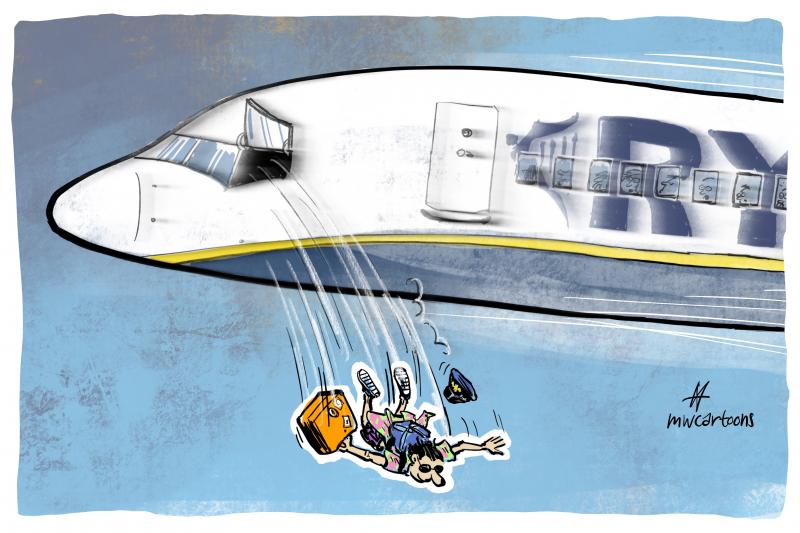
“We have hot and cold drinks available.” “For just two euros, you can buy a scratch card, support a charity and become a millionaire.” You’ll be familiar with this mood music if you’ve ever tried to sleep on a Ryanair flight. Yet a potential annoyance for passengers is a source of extra income for cabin crew. Numerous flight attendants confirm that Ryanair staff receive a 10% commission on onboard sales, ranging from snacks and perfumes to lottery tickets.
“It’s a market on wheels”, jokes Andrzej, a Ryanair employee in Poland since 2023. “If anything goes missing during the stock-take, the value of that item is deducted from our commission.” He cites an example: if two bottles of water are missing, seven euros are deducted. And that’s not the only unusual feature of Andrzej’s contract.
In Poland, some of Ryanair’s cabin crew work under B2B (business-to-business) contracts. This means that they are self-employed and must pay their own taxes. It is the case for Andrzej, and explains the complaint made by the company's Poland-based staff to the labour inspectorate.
Each new member of the Polish cabin crew earns around €24 gross per flight hour, according to those interviewed. Those with more experience can earn between €28 and €34 an hour. Under the B2B system, they pay their own taxes and social-security contributions and handle their own accounts. The gross monthly earnings for these workers – between €1,600 and €2,000 – are reduced to around €1,200 net after the various deductions. Currently, the recruitment of Ryanair’s Polish cabin crew is managed by Warsaw Aviation, a subsidiary of Ryanair Sun (Buzz).
The uberization of 2018
Until 2018, Ryanair’s Polish employees worked under job contracts signed directly with the airline. But Ryanair apparently noticed the potential benefits of hiring staff on service-provision contracts, which entail no extra costs for the employer. In that year the Irish firm made a radical change: it terminated its Poland staff’s contracts and told them that they would be rehired on B2B contracts.
In 2019, the company’s practices came to the attention of Poland's ombudsman, Adam Bodnar, who ordered the National Labour Inspectorate to investigate Ryanair Sun. The inspectors concluded that the change in contract type had taken place “against the workers’ will”, and that the flight attendants' jobs “predominantly exhibited characteristics typical of an employment relationship”.
They recommended that Ryanair change the contracts, but at that time lacked the authority to take the matter further. This changed in 2026, when a reform allowed inspectors to order a change of contract if a freelance job resembles a typical employer-employee relationship.
No fixed wage
The new contracts of Ryanair's Polish employees have weakened their job security. The airline does not guarantee a specific number of flights, which means no fixed income for cabin crew. It reserves the right to reduce the number of flights allocated to contractors and replace them with staff on permanent contracts from other bases.
“Fewer flights mean less money”, says Magda, who is based at Modlin Airport, 40 km from Warsaw. She says that sometimes she would like to work additional hours, but none are on offer. She earns more in high season, with up to 100 flight hours per month. In autumn and winter, the figure is closer to 50 hours.
Andrzej describes a similar situation. His day starts 45 minutes before departure, when the crew attend a briefing and check the aircraft’s equipment. During a single shift, the cabin crew operate four flights: two outbound and two return. They are only paid for the time they spend in the air. “I might spend 11 hours at work, but I’m only paid for six hours because that’s how long we were in the air”, he explains. Everything that happens on the ground – such as clearing the aircraft, cleaning the cabin and welcoming the next group of passengers – is technically unpaid.
On 17 August, the trade union Związkowa Alternatywa (ZA) submitted a complaint to Poland’s labour inspectorate concerning Ryanair Sun. ZA had already filed a similar claim concerning the Polish airline LOT. Piotr Szumlewicz, the union’s president, explains the reasoning: “If an employee cannot refuse to fly a particular route or send someone else in their place, then in my view the characteristics of an employment relationship are clear." The labour inspectorate is set to issue its findings on Ryanair Sun before the end of 2026.
Freelance flight attendants
The complaints raised by Polish flight attendants are part of a wider picture. How should labour laws be enforced across European borders? In a July 2026 report by the European Labour Authority, based on surveys of public authorities in 23 EU countries, 46% of cases cited by respondents concerned violations of social-security regulations, 38% concerned breaches of national labour law, and 34% the incorrect classification of employees (for example, as self-employed).
Going by the current situation of job advertisements for flight attendants, at least three EU countries are particularly concerned: Poland, Hungary and Czechia.
In a job ad dated 17 September 2026, Ryanair was recruiting cabin crew for Budapest via its subsidiary Buzz, on B2B contracts offering schedules of five days’ work followed by three days off. The same arrangement features in the ads for Warsaw and Prague.
In the UK, an investigation by The Sunday Times shed light on the precarious working conditions of the airline’s British staff. Payslips showed a “gate bag bonus” of €1.50 for each penalty that staff issued for hand luggage exceeding the permitted weight or size, up to a maximum of €80 per month.
‘I might spend 11 hours at work, but I’m only paid for six hours because that’s how long we were in the air’ – Andrzej
In other countries including Austria, in addition to the basic wage there are variable payments based on the number of flights worked. This was the case of a contract obtained for this report, signed by a person who worked for Laudamotion (a Ryanair subsidiary in Austria) as a flight attendant based in Vienna in 2024.
In Ireland, where Ryanair is headquartered, a trade-union source states that this pay model applies across the entire company. They explain that the hourly remuneration for cabin crew applies from the moment the aircraft begins to taxi away from the boarding gate. In summary, there is a basic wage, plus a flight-time payment, plus commissions.
In practice, this arrangement passes a substantial part of the business risk on to employees. That is possible because the industry has no collective agreement establishing minimum conditions. This fact is particularly striking in Austria, a country where 98% of workers are covered by collective agreements.
Among the most controversial clauses in the standard contract is an unlimited transfer clause, which allows employees to be relocated to any of the company’s overseas bases. The contract also includes a clause restricting workers’ freedom of expression on company-related matters (which expressly includes statements to the media), as well as a provision allowing the company to monitor employees.
In Spain, calls for professional recognition
Mario (name changed) has worked for Ryanair for 10 years: nine from Spain and one from the UK. He confirms that cabin crew in Spain receive a 10% commission on in-flight sales, just like the airline’s staff in other countries. Alluding to this is a job advert currently running in Mallorca, which offers an “unlimited sales bonus”.
Mario sees both similarities and differences with the situation of the Polish cabin crew. He believes that self-employment is not practised at Ryanair in Spain. “All staff in Spain are employed directly by Ryanair.” Hourly pay varies depending on whether the role is classed Junior or Purser. This is set out in an agreement with the Comisiones Obreras (CCOO) trade union, and includes several pay grades based on length of service. The basic hourly wage ranges from €8 to €12.
Mario admits that staff are paid only for the duration of the flights, as in Poland. “Time spent on the ground between flights and delays is unpaid.” On a given shift, staff may fly two flights (a return journey) or four.
The Spanish collective agreement for Ryanair cabin crew does not guarantee a fixed number of hours per month, but it does guarantee a minimum number per year. “You can be called on standby to fly to another base or even to sleep there.” The schedule can be viewed a month in advance, and a new week is added to it every Friday.
'Time spent on the ground between flights and delays is unpaid' - Mario
“In aviation, there’s no such thing as normal”, Mario says. Depending on when a flight is, staff might have to get up at very different hours. The minimum rest period between flights is 12 hours. If a working day ends at 5 pm, the cabin crew will not be able to work until at least 5 am the following day. “You might have a week where you only have two-sector days – one outbound and one return – or long days with four flights. It all depends on the schedule, and you adapt your routine accordingly.”
As for his salary, there is a fixed component, consisting of the basic remuneration, plus a seniority premium and a clothing allowance. And there’s a variable component, based on flight hours, sales bonuses, and allowances for training courses or nights spent away from the base. Mario, who works from Ibiza, is on a fixed-term contract with intermittent work, “as my base is temporary". At other bases, contracts are generally permanent throughout the year, he says. “In my case, as a cabin manager, it ranges between €2,300 and €2,800 net.” That monthly figure also depends on the applicable income tax.
Mario's main complaint concerns the industry as a whole. It is that in Spain the profession of flight attendant is not officially recognised, despite years of lobbying.
“It's important to make progress towards such recognition”, argues Mario. “We are a group that requires specific training, official certification to practise our profession, and ongoing training throughout our careers. However, in Spain we still do not have our own professional category that truly recognises our profession and the responsibilities we assume on board.”
In France, unionisation
Over in France, Ryanair’s working conditions have been brought into line with the law. A series of labour disputes began in 2019 after complaints by staff about poor conditions. In a hard-hitting article in Le Monde, employees reported having to “choose between eating and paying the rent”.
In 2022, the trade union SNPNC-FO accused Ryanair of paying wages below the minimum wage; of failing to pay for overtime; of not paying the legal minimum for annual leave; and of failing to provide sufficient rest periods. An agreement was eventually reached with the company in October 2022.
A spokesperson for the Irish Aviation Authority (IAA) explains that the Ryanair Group comprises five airlines, each with its own Air Operator’s Certificate, issued by the competent authorities in Ireland, Poland, Malta and the UK.
Ryanair Sun is a Polish airline supervised by the Polish Civil Aviation Authority. Ryanair DAC, based in Dublin, is supervised by the IAA and has bases across Europe. Ryanair’s operations in Spain are managed by Ryanair DAC.
According to the IAA spokesperson, the regulations require that staff be “under the direct control of the operator (the airline)”, but do not regulate "the details of a contract”.
We reached out to Ryanair's Irish office for comment but did not receive a response by the time of publication.
👉 Original article on El Confidencial.
🤝 This article was produced within the PULSE collaborative network. Contributors included Rafał Górski (Gazeta Wyborcza, Poland), Natascha Ickert (Der Standard, Austria), Noel Baker (The Journal, Ireland), György Folk (EUrologus/HVG, Brussels) and Francesca Barca (Voxeurop). Paris) contributed to it.
Do you like our work?
Help multilingual European journalism to thrive, without ads or paywalls. Your one-off or regular support will keep our newsroom independent. Thank you!