











Select a language
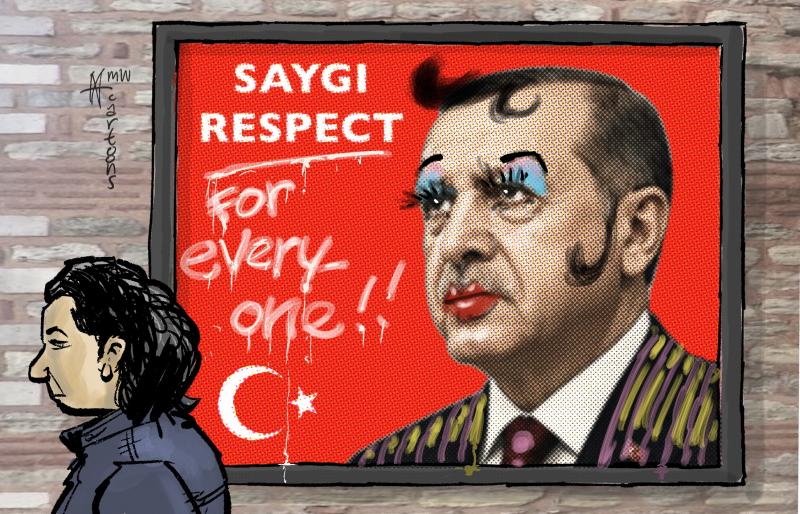
From 12 to 14 September, the Turkish police carried out a series of coordinated raids targeting LGBT+ community centres, organisations and activists. The operation, dubbed Ailem Güvende (“My Family Is Safe”), resulted in the arrest of more than a hundred people. At least 83 were subsequently remanded in custody, and more than 160 were placed under criminal investigation.
The authorities justified the arrests on grounds of obscenity, sex work and drug-related offences. The crackdown was accompanied by widespread censorship of media outlets, websites and social-media accounts belonging to organisations and individuals defending human rights and LGBT+ rights. This censorship echoes the ongoing silencing of LGBT+ people in Turkey's media, culture and public spaces.
Additionally, more than 100 people were arrested for protesting against the police operations, though they were subsequently released.
This latest anti-LGBT drive, the most severe in recent years in Turkey, has drawn criticism abroad. A European Union spokesperson said the bloc has made its position “unambiguously” clear. “The recent wave of repression is extremely worrying, and Turkey must respect fundamental rights, in particular freedom of expression, association and peaceful assembly, including for the LGTBIQ+ community.”
The spokesperson said this message had been conveyed to the Turkish authorities through both public and diplomatic channels. “The EU is monitoring the situation closely. It has stressed that the Turkish authorities must ensure that due process is upheld, that anyone detained arbitrarily is released, and that unfounded charges are dropped.”
International indignation
Across the world, civil-society groups have also spoken out. In a joint statement, 450 organisations called for an end to the criminalisation of LGBT+ movements and appealed to international organisations to take action. The signatories demand the release of those still in detention and an end to raids and censorship, and to “the exploitation of women, children and ‘the family’ to legitimise discrimination against LGBTI+ people”. They ask for guarantees that LGBTI+ organisations might operate “freely, safely and without intimidation”.
“‘A round-up’. There are no other words to describe what is happening”, says the LGBTI+ Federation in France in a statement. “When people are arrested for who they are or who they love, when they are convicted for it, freedom is being eroded. Silence today means fear will take root tomorrow. We must refuse to bow to intimidation, silence and indifference.”
The Federation calls on France to clarify its position, and specifically "to publicly condemn this round-up, to demand explanations from the Turkish authorities and to support LGBTI+ organisations and human-rights defenders who are continuing their work despite the pressure.”
Ümit Metin, general coordinator of the Citizens’ Assembly of People of Turkish Origin (ACORT), an organisation representing the Turkish community in France, is concerned about the repression. “Since [the 2013 protest movement], we see a determination to step up repression, to intimidate and silence the population”, he says. “That is why Istanbul Pride has been banned since 2015, and why [demonstrations on 8 March, Women’s Day] are banned.”
ACORT is troubled by Europe’s silence, and France's in particular. Metin believes it can be explained by economic and political considerations. Indeed it is “nothing new", he says, given the 2015 EU-Turkey migration agreement. Today, ACORT is calling on the French government to formulate an appropriate migration policy, given the potential exodus that Turkey’s repressive climate might trigger.
Slide into authoritarianism
The Turkish government’s suspicion of the LGBT+ minority is longstanding. The spectre of a “normalisation of homosexuality” – seen as a threat to society and family values – already served as a pretext for the authorities when the country withdrew from the Istanbul Convention in 2021. Pride marches have been banned since 2015, and Turkish society remains rife with anti-LGBT+ discrimination. President Recep Tayyip Erdoğan is determined to pursue this agenda and has stepped up his attacks on sexual and gender minorities.
All over the world, political instability goes hand in hand with persecution of LGBT+ people. Turkey is no exception. “When the government faces pressure from the opposition and society on certain issues, it uses anti-LGBTQ+ sentiment as a smokescreen to obscure those problems, or just as a way to change the subject or win public support”, argues journalist Yildiz Tar in an interview with the Turkish outlet The Amargi. Among other roles, Tar edits the magazine of Kaos Gl, a longstanding Turkish LGBT+ rights organisation, which has been a frequent target in the arrests.
“The fact that the 12 September operation was labelled ‘My Family Is Safe’ is a particularly obvious example of this”, says Tar. “There is no data, no evidence whatsoever, to suggest that LGBTQ+ people pose a threat to the family.”
For Tar, the real threats to Turkish families are rather from “massive impoverishment” and the prevailing “system of exploitation”, and are felt most acutely by women and children.
“Repression that only targeted the Kurds a few years ago has now been extended to the rest of society” - Ümit Metin
“I think [Recep Tayyip Erdoğan] has chosen his timing and is preparing for his re-election”, suggests Ümit Metin, referring to the 2028 presidential election. Contrary to his past promises, the man who has led Turkey for more than twenty years is reportedly considering running for a fourth term, according to one of his advisers.
Starting in 2003, Erdoğan governed first as prime minister, then president. He has put his country on a firmly authoritarian path. Examples include the crackdown on the 2013 protest movement (during which the police fired live rounds at demonstrators) and the massive purge that followed the failed coup of 2016.
“Repression that only targeted the Kurds a few years ago has now been extended to the rest of society”, says Metin. The ACORT coordinator believes the anti-LGBT+ rhetoric is primarily aimed at firing up a conservative electorate in the face of Turkey's economic malaise. He is pessimistic. “This repression is set to escalate.”
The government’s attacks have not stopped at LGBT+ people. The journalist Tuğba Tekerek was also arrested, along with seven members of Kaos GL, and placed in pre-trial detention. At cause was an article she wrote. As she explains in an open letter, the authorities accuse her (without evidence) of being the administrator of the organisation’s Instagram account.
Turkey's media crackdown has been ramping up in recent years. Before Operation “My Family Is Safe”, there were arrests during the anti-government protests of 2025. Between 2016 and 2026, Reporters Without Borders (RSF) recorded 174 imprisonments of journalists in Turkey.
Also as part of September's operation, Turkish courts blocked access to the opposition media outlet T24. The pretext: 118 articles it published over the past year might constitute “LGBT propaganda”.
The LGBT+ crackdown mirrors the governing AKP party's ongoing assault on Turkey's political opposition. The mayor of Istanbul, Ekrem İmamoğlu, widely regarded as Erdoğan’s main rival, has been in prison since March 2025. His initial sentence was 25 months, for making insulting remarks. New charges were subsequently brought, this time for espionage. He is now looking at 15 to 20 years.
🤝 This article was produced as part of the collaborative project PULSE. György Folk (EUrologus/HVG, Hungary) and Lorenzo Ferrari (OBCT, Italy) contributed to it.
🗣️ Have a question, comment or suggestion? Share it with us through the PULSE reader form – we read and reply to every message. Be part of Europe’s conversation. Your experiences and ideas can inspire the next stories we tell. Join the PULSE readers’ community by filling in this short form.
Do you like our work?
Help multilingual European journalism to thrive, without ads or paywalls. Your one-off or regular support will keep our newsroom independent. Thank you!