











Select a language
There was little doubt that 2025 was going to be a bad year for democracy. It turned out much worse than many of us had expected. Not only did Donald Trump return with a vengeance, the U.S. and international establishments have largely chosen appeasement over confrontation, with little to show for so far. The new year will keep the focus on the United States, for both the FIFA Men World Cup in June and July – organised jointly with Canada and Mexico, which have been largely marginalised by the “MAGA World Cup” by Trump and FIFA President Gianni Infantino – and the crucial Midterm elections of November. The results of the latter will have major political consequences far beyond the U.S., not in the least for Europe, as the recently published 2025 National Security Strategy has made abundantly clear.
Although it has become common to refer to the U.S. as an “authoritarian” or even “fascist” state under Trump, the situation is still complex and evolving. This could be seen, for example, in the fact that the No Kings protests were among the biggest demonstrations in U.S. history, yet faced no state repression or violence.
Despite all the attempts of the Trump administration, the U.S. is still an imperfect and struggling liberal democracy but with a clearly authoritarian government. While the Midterms cannot fundamentally change this, they can significantly weaken the power of the Trump administration and, hopefully, inspire some courage within the academic, economic, media, and political establishment.
Up until now, Trump has been mainly governing by executive order, helped by the Republican majority in Congress, which has voluntarily abdicated its constitutional powers – out of fear of a primary threat by Trump or violence by his supporters. If the Democrats win the majority in the House and/or Senate, they can overrule, and at least slow down, the executive orders and make Trump a much weaker president for the rest of his second term.
Most importantly, regaining hold of Congress will provide the Democratic Party with a better opportunity to ensure that the 2028 elections will still be largely free and fair. And it will hopefully send a clear signal to the various elites that Trump is not the voice of the American people and can be successfully opposed and resisted.
Of course, they should know this already, as poll after poll shows that Trump and his policies are extremely unpopular in the U.S. (and beyond). Trump’s approval ratings have been dismal for months and are at a mere 36% – although it has not dropped that much among Republicans (from 91% in January to 84% in November).
His unprecedented number of executive orders are also mostly unpopular – and only modestly popular among Republicans. Strikingly, even on his signature policy, immigration, his approval ratings are low. Particularly important for the Midterm elections, Trump’s numbers on handling the economy have recently dropped to an all-time low.
This unpopularity has been on display in elections for all offices across the country this year. Despite the mind-blowing fact that the Democratic Party is even less popular than the Republican Party, its candidates performed very well on the most important election day, 4 November, with high-profile wins in, among others, New Jersey, New York, and Virginia. And the victories are not limited to the more liberal Coasts.
Earlier this month, a Democrat won a seat for the state legislature in my heavily gerrymandered hometown of Athens, Georgia. It was the 25th seat nationwide that the Democrats picked up this year. Moreover, in the 64 state elections that were held this year, the average swing towards to the Democratic candidate was 13% compared to the 2024 presidential election.
Obviously, the Midterm elections are crucial to U.S. democracy – they will probably determine whether the country will remain democratic in the near future – but the ramifications will be felt across the globe, not in the least in Europe. This was made abundantly clear with the publication of the 2025 National Security Strategy, whose section on Europe is a frontal attack on the EU, liberal democracy, and multiculturalism on the continent.
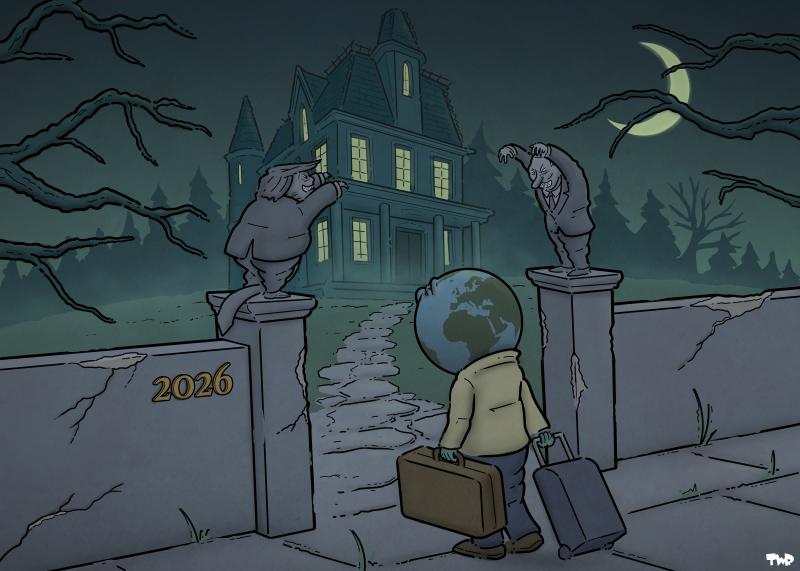
So, if 2026 is to become a better year for (European) democracy, it will have to come from the people in Hungary and the U.S., who have a chance to deal a serious blow to their anti-democratic leaders
Steeped in far-right ideology and conspiracy theories (Great Replacement), the Trump administration sets itself the goal of “Promoting European Greatness” by “cultivating resistance to Europe’s current trajectory within European Nations” and “building up the healthy nations [sic] of Central, Eastern, and Southern Europe.” Given that the document states that “the growing influence of patriotic European parties indeed gives cause for great optimism”, there is little doubt where the Trump administration sees its European allies.
The first, and biggest, test of this new activist U.S. foreign policy will be the Hungarian parliamentary election of 12 April. For the first time since regaining power and turning the country into a comparative authoritarian regime, Viktor Orbán is facing a true challenge to his power. Tisza, the new party of former Fidesz-insider Péter Magyar, has a double-digit lead in the polls and this is making Orbán clearly very nervous. His vast propaganda network is running an elaborate smear campaign, while his government has (unsuccessfully) asked the European Parliament to lift Magyar’s parliamentary immunity.
There is little doubt that Trump wants Orbán to stay in power. In fact, a leaked draft version of the 2025 National Security Strategy mentions Hungary explicitly as one of four countries to “work more with … with the goal of pulling them away” from the European Union (the other three are Austria, Italy, and Poland). Although the document remains vague on how it wants to achieve that, we can expect at least some level of U.S. interference in the Hungarian elections – perhaps another financial bailout, as was offered to Javier Milei in Argentina. In addition, we should expect Russian interference in favor of Orbán, its most loyal voice within the EU, probably through online disinformation campaigns. Magyar has already accused Russia of interference, a fear shared by a majority of the Hungarian population.
How will the EU respond this time? In the past decade, it has merely acknowledged that the elections were “free but unfair”, but considered itself incapable of doing anything about it. In the previous elections, Orbán mainly profited from an unlevel playing field. That might change now that Magyar threatens the kleptocracy of Orbán and his cronies (including his family).
There are rumors that Orbán wants to move into the presidency, after transforming the country into a presidential system (as Recep Tayyip Erdogan has done in Turkey). The Hungarian government has denied these rumors, but the parliament just passed a bill to “reinforce” the presidency, requiring a two-third (rather than normal) majority to oust the president.
But even if Fidesz would lose the election, and Orbán would accept defeat – two big ifs, given his response to his 2002 electoral setback – they will retain significant power within the country (much more so than Law and Justice in Poland). Over the past fifteen years, Orbán has appointed loyalists in almost all the key state institutions, who can often only be removed by qualified majority (from the Supreme Court to the tax office).
Moreover, the EU has several mini-Orbáns in power in other countries, such as Slovak prime minister Robert Fico, Czech prime minister Andrej Babiš, and Polish president Karol Nawrocki – all were openly supported by Orbán during their election campaigns. None of these leaders are as strongly Eurosceptic and pro-Russian as Orbán, or have the same domestic power position, but they will continue to slow down and soften important EU policies on foreign affairs (notably Russia and Ukraine), minority rights, and rule of law.
During hard times, the “Brussels bubble” always returns to Jean Monet’s famous statement that “Europe will be forged in crises.” This explains its underestimation of Trump, where the most fanatic inhabitants even hoped for a Trump victory, while others “merely” saw a “silver lining” for Europe in his victory. But in a year that the NATO Secretary General openly warns Europe for a Russian attack within five years, and the U.S. has turned from a key ally into a major adversary, the EU has been more internally divided than empowered.
The allegedly most powerful woman in the world, Ursula von der Leyen, has been preoccupied with fighting off challenges from other European heavyweights, corruption scandals, and votes of no confidence in the European Parliament. Within one year, she has changed from “Queen Ursula” into “the face of the EU’s weakness.”
In short, despite perhaps the most hostile international environment in its existence, Europe has not learned “to stand on its own two feet.” Instead, it has mostly stalled and sucked up to Trump – an approach taken to the extreme by NATO Secretary General Mark Rutte, who infamously called Trump “daddy”, to the great delight of the U.S. president.
But stalling is a useless strategy if you do not have a plan for the future. It mainly postpones the inevitable, which we see most painfully in the case of Ukraine, which is increasingly confronted with a pro-Russian U.S. proposal that completely ignores and sidelines Europe.
It is probably around here that you expect the optimistic final point of this essay. The argument that Europe has finally learned its lesson and will turn it all around. Unfortunately, I see no indications for such a turn. Leaving aside that there is at best mixed empirical support for Monet’s statement that Europe thrives in crisis, the continent is more divided and isolated than ever before.
Not only is the far right an important force in most European countries and at all levels of the European Union, the European People’s Party (EPP) is increasingly siding with them in the European Parliament – or using collaboration as a threat to pull the mainstream groups to the right.
Moreover, all the major European countries have weak governments, which are primarily concerned with surviving the domestic political struggle (e.g. France, Germany, Poland, UK). On top of that, the EU is dealing with the so-called “diplomatic fraud scandal”, which could lead to von der Leyen’s downfall and thereby throw the EU in a full-blown crisis.
So, if 2026 is to become a better year for (European) democracy, it will have to come from the people in Hungary and the U.S., who have a chance to deal a serious blow to their anti-democratic leaders. And perhaps then the political leaders in Europe and the U.S. can finally and truly join in the struggle against the far right, not just in words but also in deeds.
Do you like our work?
Help multilingual European journalism to thrive, without ads or paywalls. Your one-off or regular support will keep our newsroom independent. Thank you!