













Select a language
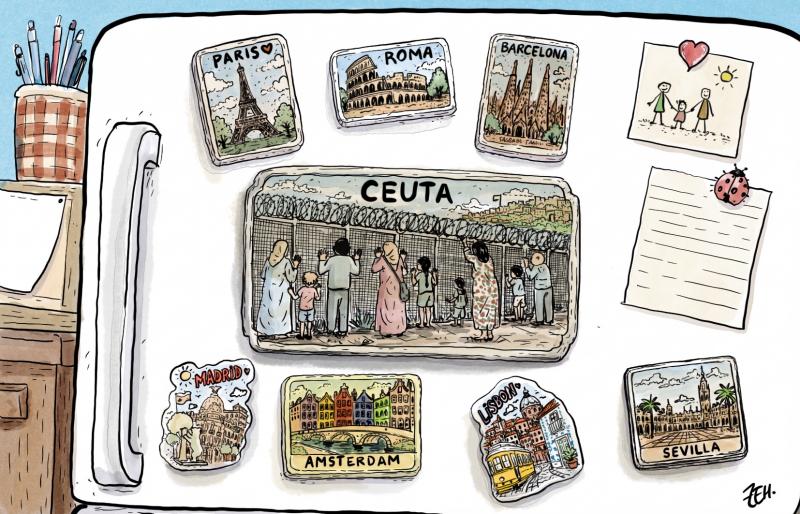
For the notorious loudmouths, the images of Ceuta's overcrowded beaches became a metaphorical whip to be cracked over Spanish prime minister Pedro Sánchez, Brussels and all the “welcomers”. US President Donald Trump described the situation as an invasion. His statement brought to mind the words of former top European diplomat Josep Borrell from a few years ago.
On the occasion of the opening of the European Academy of Diplomacy, he shared with aspiring Eurocrats a parable about Europe as a picturesque garden that needs to be tended. A garden that, whilst flourishing with freedom, prosperity and social cohesion, has a jungle lurking beyond its horizon, attempting to penetrate ‘our’ paradise.
Although the situation on the Moroccan-Spanish border lasted only a few days, it laid bare the unflattering state of European migration and foreign policy. The Union is not facing a supposed invasion, but its policies have been steadily decaying for several years.
An invitation via TikTok
In the first six months of this year, Frontex recorded 49,000 attempts to cross European borders, representing a 37% decrease compared with the same period last year. How, then, can we explain the events of late July?
At present, it is still not possible to pinpoint a single driving force behind the mass crossing. Many of Sánchez’s critics point the finger at Spain’s migration policy, which they view as lax. In April, the Prime Minister’s cabinet brought into force a regulation aimed at regularising the status of irregular migrants who are already living and working in the country – but without the necessary documentation.
Almost one million people have applied for temporary residence, a figure that has far exceeded expectations. Applicants are currently undergoing rigorous checks. The decree does not apply to people who entered the country after the end of 2025.
A ruling by the Spanish Constitutional court also appears to have played a role in relation to Ceuta. The Court ruled that people detained by border guards whilst crossing the Mediterranean Sea cannot be deported automatically, immediately and without a proper asylum process. It was precisely this ruling that formed the basis of a disinformation campaign which began to spread not only in Morocco, but also in Algeria and Tunisia.
Videos from anonymous accounts on TikTok and Instagram promised open doors to Spain and the fulfilment of the dream of working and living in Europe. Groups began to form on Facebook and WhatsApp to organise the logistics of crossing the border.
From the outset, the lack of clarity surrounding the situation fuelled speculation about the influence of foreign powers or intelligence games behind the scenes. To date, however, there is no evidence of third-party involvement.
United in hatred
Italian prime minister Giorgia Meloni, for her part, indignantly called for Spain’s temporary exclusion from the Schengen Area. However, this form of punishment is not legally enforceable. The only step that the individual governments of EU Member states can take is to temporarily reintroduce border controls at their own borders.
The leader of the far-right Brothers of Italy party was gradually joined by government representatives from other countries. This is despite the fact that the Spanish territories beyond Gibraltar are not part of the Schengen Area, and passport checks have always been a necessary condition for crossing from Ceuta to mainland Europe.
Twenty-two European leaders sent an open letter to leading EU figures. They appealed for a shared commitment to strengthening the protection of the Union’s external borders and to avoiding policies that might ‘attract’ people to Europe.
Unfortunately, the co-opting of the far right does not end with mere rhetoric and open letters. The long-standing acceptance by the European political centre of the ‘clash of civilisations’ narrative has, in recent years, been translated into specific policies that are in stark contradiction not only with declared European values, but also with basic humanity. The author cannot resist modestly pointing out that he had already drawn attention to the deepening of cooperation with the far right at European level following the European Parliament elections in the summer of 2024.
A new majority
The trends mentioned above are also supported by a number of European documents. In June, the Pact on Migration and Asylum came into force. It is the sad result of a decade-long failure to update European legislation to meet the needs of migration driven by armed conflicts, climate change and humanitarian crises. Despite some positive changes, the Pact has introduced measures which, according to the human rights organisation Human Rights Watch, will expose people arriving in Europe to serious risks.
The EU plans to maximise the number of asylum procedures conducted directly at the borders, raising concerns about the return of so-called ‘hotspots’, where asylum seekers live in inadequate conditions. Member states have also been granted the right to further prolong the entire process in the event of a ‘crisis caused by a mass influx’.
The legal definition of this term is vague, leaving ample scope for (mis)interpretation. The rights of asylum seekers, by contrast, are restricted, particularly by the problematic status of legal fiction of non-entry. In practice, this means that although a person is physically present on the territory of a state, from a legal perspective they are treated as if they had not yet entered it.
We are merely shifting the responsibility onto other states that lack the capacity to deal with the situation effectively
The second key piece of European legislation is the Return Regulation. This was passed by a comfortable majority in the European Parliament, with not only the centre-right European People’s Party but also part of the liberal Renew Europe group joining forces with the far right.
It has set itself the aim of creating so-called return hubs. Until now, an undocumented person could only be deported to the country of which they are a citizen; deportation to another country was only permitted with the consent of the person being deported and the certainty that the receiving country would accept them. Under the new rules, a legally non-binding agreement between a Member State and any third country will suffice for deportation. An undocumented person may thus find themselves, from one day to the next, in a place they have never set foot in before.
In many respects, the controversial regulation was inspired by Trump’s brutal migration policy. Security forces have been given a freer hand in restricting personal freedoms for the purpose of identifying and detaining irregular migrants. Raids on homes and overt violence on the streets may therefore soon become common practice in Europe.
Externalisation of migration, inevitability of violence
Deportations, the processing of asylum claims at borders and return hubs are part of a broader agenda that seeks to externalise migration and asylum policy. Its fundamental premise is based on the view that problems associated with migration should primarily be addressed where we – white Europeans – cannot see them.
Migrant externalisation really became a key part of the EU's migration policies as early as 2016, when the EU signed a readmission agreement with Turkey. In exchange for accomodating more than three million asylum seekers, the EU paid Ankara nearly ten billion euros over the course of ten years. The EU has also concluded similar agreements with other countries in North Africa and the Middle East.
At first glance, this may seem like a pragmatic solution. If refugees do not reach Europe, the problem does not concern us. In reality, however, we are merely shifting the responsibility onto other states that lack the capacity to deal with the situation effectively.
Third countries are often unable or unwilling to provide adequate conditions for refugees and migrants. They thus become victims of forced labour, sexual violence, torture or trafficking at the hands of local authorities or criminal groups. The lack of legal ways to reach safety forces migrants to seek alternative routes. According to estimates, around a hundred people have died whilst attempting to swim to Ceuta. Several thousand lose their lives in the Mediterranean Sea every year.
The desire to keep migrants out of Europe also leads to the securitisation of migratory movements. In international relations theory, securitisation is the process by which one of the actors redefines a political issue as an existential threat. Migration thus ceases to be a matter of human rights or the economy, but shifts to the realm of defence and security. The EU is, in effect, relying on its neighbours to prevent people from crossing the borders, even through the use of brute force.
In the case of Ceuta, there is nothing to suggest that the Moroccan government deliberately forced tens of thousands of people to cross. At the same time, it is true that it made no effort to prevent the situation from arising. Ceuta had already experienced a similar crisis in 2021, when Moroccan border guards opened the crossing.
The pretext for “punishing” Spain was a diplomatic dispute concerning Morocco’s claims to Western Sahara. We have also seen similar situations in the past on the Belarusian-Polish and Turkish-Greek borders. There is a danger, however, that if we label something as an existential threat, we will begin to regard as legitimate even measures that would otherwise be unacceptable – including the use of firearms. People fleeing war, poverty and hunger thus become mere pawns in a cynical geopolitical game.
Second-class neighbours
Borders are not just barbed-wire fences or customs officers with submachine guns. Even after being granted the right of residence or temporary refuge, many people remain in a state of constant uncertainty and anxiety. Access to the labour market and the availability of social benefits depend on the legal status a person is granted.
The European legal framework does not fully address the issue of ensuring equality between different population groups. Together with differences in national legislation, this creates a fragmented system in which third-country nationals are treated as less equal and their rights are directly dependent on their status.
The existence of legal and, above all, safe routes, together with transparent asylum procedures in accordance with international law, will help prevent avoidable deaths and provide safety for the most vulnerable
A separate challenge is the administrative maze they face when attempting to extend their stay or reunite with a family member. It often requires considerable financial resources, a mountain of documentation, and legal – and frequently interpreters’ – assistance when communicating with local authorities. The most marginalised, who lost everything whilst fleeing, face the threat of deportation for failing to comply with the authorities’ arbitrary demands.
The struggle for a life of dignity does not end with the legalisation of their residence. Despite the fact that these people are residing in Europe lawfully or even hold full citizenship, they themselves or their descendants face persistent social othering from the majority. In the area of housing, they are regularly subjected to direct discrimination. If a property owner does not like the skin colour or name of a prospective tenant, they will turn them down. The result is segregated communities that lead parallel working and social lives.
More powers are not enough
For at least the last ten years, we have been witnessing the failure of European migration and foreign policy. A dysfunctional asylum system, tens of thousands of deaths and millions of people in marginalised communities on both sides of the Mediterranean cannot be attributed solely to a lack of solidarity on the part of “bad member states”. The aforementioned Pact on Migration and Asylum and the Return Regulation represent a comprehensive codification of a policy based on fear, hatred and violence at European level, and one that enjoys broad consensus. The solution cannot simply be to transfer further powers to Brussels under the pretext that those at headquarters know better, after all.
The current situation should serve as an impetus to seek an alternative framework. Inspiration can be drawn, for example, from a human rights-based approach to migration. This approach has a long tradition not only in academic circles but is also part of the strategic recommendations of the International Organisation for Migration (IOM).
Based on this approach, the protection of the individual’s integrity should be the cornerstone of any migration policy. The existence of legal and, above all, safe routes, together with transparent asylum procedures in accordance with international law, will help prevent avoidable deaths and provide safety for the most vulnerable.
At the same time, we must seek ways to better integrate those who are already in Europe into society. Of course, this requires willingness on both sides. However, to pretend that an individual’s unwillingness has consequences comparable to the systematic marginalisation of entire communities is a sign of crass arrogance.
Last but not least, we must focus on the root causes of migration. War, famine and the worsening climate crisis are an everyday reality in the world, one with which we in Europe do not wish to be troubled. Foreign and defence policy play a key role in addressing these problems.
Ceuta was not an attempted invasion, as many people are trying to convince us. However, with growing pressure driving large sections of the population to move, it will not be an isolated incident either. The European Union would like to become a model for the rest of the world. Yet this ‘Garden of Eden’ is a self-delusion. It is more reminiscent of a wasteland which, for the time being, we are persistently fertilising with salt.
“Rwanda Platform” for forced returns
Five EU countries – Germany, Austria, Denmark, Greece and the Netherlands – announced in Vienna on 16 November the creation of a “return platform” in Rwanda for rejected asylum seekers.
The pilot project involves an open centre for around 100 unaccompanied adults – approximately 20 per country – who will be granted Rwandan residence permits and training. The initiative is based on the Return Regulation adopted in mid-October, which allows for the creation of such centres for people who cannot or do not wish to return to their own country. Negotiations with Kigali are expected to be concluded in early 2027.
France has refused to join, whilst Italy has been excluded for failing to comply with the EU migration pact. The UK’s programme in Rwanda has failed after costing around 715 million pounds, with at most five people transferred to Rwanda, all on a voluntary basis.
The five countries are expecting legal challenges, but are already talking about replicating the model in Uganda or Uzbekistan.
👉 The original article on Kapitál.
🤝 This article is published in partnership with Perspectives, a project and label co-funded by the European Union that stands for authentic, trustworthy, independent, and multi-perspective journalism. Led by the Goethe-Institute and implemented together with newsrooms from Central and Eastern Europe, Perspectives is committed to credible content that reflects Europe’s complex realities through diverse voices and viewpoints. Views and opinions expressed are those of the author(s) only and do not necessarily reflect those of the European Union or the European Commission. Neither the European Union nor the granting authority can be held responsible.

Do you like our work?
Help multilingual European journalism to thrive, without ads or paywalls. Your one-off or regular support will keep our newsroom independent. Thank you!