











Select a language
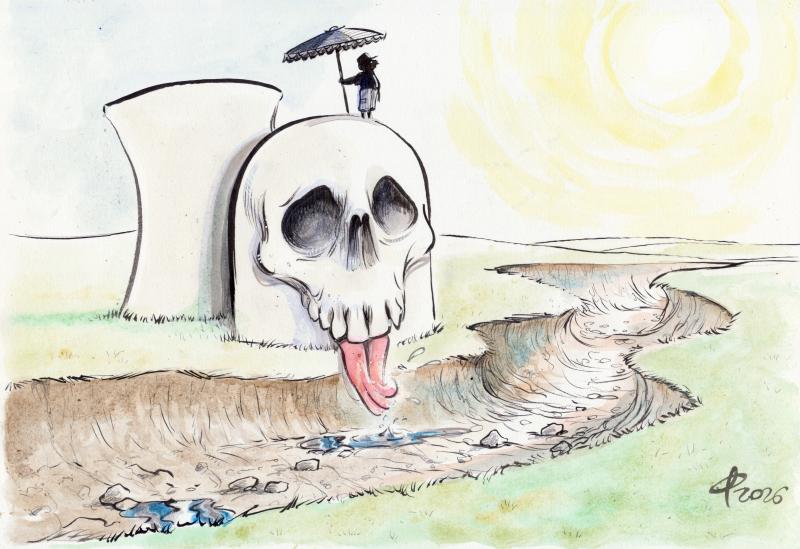
Every summer, Europe's rivers do quiet but essential work: cooling nuclear reactors, turning turbine blades, carrying millions of tonnes of freight. This summer, the Danube has largely stopped doing any of it. A drought of historic severity has pushed water levels to record lows across much of central and southeastern Europe, forcing nuclear shutdowns, threatening Germany with recession, and exposing the fragility of energy systems that were never designed for a climate that is rapidly changing. The consequences are being felt differently in each country – but nowhere is immune.
What helped Austria’s lights on
The river has reached a historically low level in Austria. And hydroelectric power generation has fallen significantly, roughly by 30% compared with the usual time of year. The Danube is carrying only a third of its usual volume of water.
"No one here has ever experienced conditions like these," says Florian Seidl, spokesperson for Verbund, a major hydropower company. The shortfall, he says, is roughly equivalent to losing the output of three Danube power stations.
The situation reflects what climate projections have long predicted: less snowmelt in summer means lower river flows, while winter brings more rainfall that feeds rivers directly. "In itself, this is not necessarily bad news for the energy system – solar power generates more in summer, while hydropower can help balance the system in winter. But we also expect much greater volatility: years with above-average water availability and years that remain very dry," says Seidl.
Extreme weather creates difficulties in both directions. Electricity generation falls not only when water levels are low, but also during heavy rainfall, when volumes are too large to be fully converted into power. Small hydropower plants have been especially hard hit: in the state of Salzburg, output at some installations has fallen by up to 50%.
Low water levels affect not only agriculture and hydropower, but also industry. Strong photovoltaic output helped Austria return to a positive electricity balance in June, producing a net export surplus – reversing nine consecutive months in which imports had exceeded exports.
"Our diversified energy mix ensures supply security is not at risk. But to keep it that way, we must fully develop available potential and continue expanding renewables, storage and the grid," says Barbara Schmidt, Secretary General of Oesterreichs Energie.
Christoph Dolna-Gruber of the Austrian Energy Agency adds that this is equally important for prices. "When nuclear power stations reduce output or shut down due to extreme temperatures, and hydropower also underperforms, cheap electricity disappears — and prices rise. It is in the interest of the whole of Europe to build a far more extensive and diversified energy mix in every country."
Germany: drought threatens recession
The German Economic Institute has warned that low water levels across all major rivers could push the country into recession. According to economist Thilo Schäfer, GDP growth could fall 0.4 percentage points below forecasts. "A prolonged disruption to navigation on the Rhine could completely stifle the small amount of economic growth we still have." The Institute cited 2018, when similar low-water conditions slowed Germany's economic growth by approximately 0.4 percentage points.
By early August, 78% of monitoring stations on the Danube were reporting extremely low water levels. Transport Minister Steffen Bilder convened a meeting with port operators and affected companies, announcing a project to widen the Danube in Bavaria to allow heavier freight loads during low-water periods.
Croatia: a system under strain
Monitoring data from the Josip Juraj Strossmayer Water Institute show that drought effects are also visible in Croatia's section of the Danube basin, where water levels are at their lowest since 2021. Since the start of 2026, levels at Batina have remained below the hydrological drought threshold for 66% of the time, while groundwater levels in parts of central, northern and eastern Croatia are approaching historic lows.
Associate Professor Mario Šiljeg, the institute's director, warns against viewing the situation solely in terms of record-low water levels. "This summer, the Danube has not merely revealed the vulnerability of a river. It has shown the extent to which water, energy, transport, economy and nature have become a single system. Climate change no longer creates isolated problems – it triggers chain reactions that affect multiple sectors and countries simultaneously."
Hungary: an unprecedented call for restraint
Hungary's Paks nuclear power station – which supplies almost half the country's electricity – was shut down in early August for the first time in its 44 years of operation, as the Danube fell to historic lows. The low flow reduced the station's output to just 10% of its capacity.
Following government appeals to ease pressure on the grid, businesses and citizens cut their electricity consumption to an unprecedented degree — roughly equivalent to switching off one million medium-sized air-conditioning units. On 10 August, Hungary began restarting a turbine at Paks. "The Hungarian economy cannot function without the power station for months on end," said Prime Minister Péter Magyar. Throughout this period, Hungary has been importing large volumes of energy in the evenings to cover peak demand.
Romania: surplus by day, crisis by night
Romania declared a nationwide state of alert for August, against a backdrop of falling energy production caused by the drought and low river flows. The Danube particularly has reached historic lows. The shutdown of the Cernavodă nuclear power plant left Romania without approximately 20% of its energy production.
The station's director ruled out a blackout, but the government called on households and businesses to reduce consumption between 7pm and 11pm until 31 August, and urged Romanians to reschedule high-consumption appliances – washing machines, dishwashers, dryers, boilers and electric vehicle charging – to the morning. The two major car manufacturers operating in Romania, Dacia and Ford, complied, halting production between 3 and 19 August.
During the day, Romania actually has a power surplus: photovoltaic systems are running close to maximum capacity and the excess is exported. But when the sun goes down, solar generation drops sharply, and hydroelectric stations cannot cover the gap left by Cernavodă. The shortfall must be bought from neighbouring countries — which are facing the same evening demand spike at the same time, pushing regional prices sharply higher. In the evenings, electricity can cost up to five times more than at midday.
Dumitru Chisăliță, president of the Smart Energy Association, warns that every scenario points to higher bills: up 2–5% in the optimistic case, 10–15% if the crisis persists and industrial consumers are forced to scale back, and up to 20% if the effects run into the cold season.
"Not because we have given up on coal," Chisăliță says, "but because Romania gave up on reliable generation capacity before having anything to replace it with. We shut down plants according to the political calendar, but built new ones haphazardly. Romania has too little organisation, too little flexibility and too little accountability for the way renewable energy has been integrated."
Bulgaria: crisis as opportunity
One country has turned the crisis into an advantage. The Kozloduy nuclear power station is running at full capacity, and electricity exports have reached record levels.
While Paks and Cernavodă have scaled back or halted production, Kozloduy continues to operate at its full installed capacity of approximately 2GW. Combined with strong solar output and storage capacity – including renewable energy imported from Greece – this has allowed Bulgarian producers and traders to sharply increase exports, particularly to Romania and Hungary. Daily exports have reached an unprecedented 32,000–33,000 MWh, according to the Bulgarian Energy System Operator.
Bulgaria's advantage is largely technical. Kozloduy's reactor cooling systems operate via closed circuits, independent of Danube water levels – a design that has been verified through periodic safety inspections and the EU-wide nuclear stress tests introduced after Fukushima.
The surge in external demand has pushed domestic prices up to 150–170 euros/MWh, from 100–120 euros/MWh a week earlier — still below Romanian levels. Even if Kozloduy were forced to reduce output, Bulgaria's grid would not face an immediate supply risk, the system operator says, given the backup capacity of its hydroelectric stations and the Maritsa East 2 coal-fired plant.
👉 Original article on HotNews.ro
🤝 This article was produced as part of the PULSE collaborative project. Alicia Prager, Andreas Danzer, Michael Schatt (Der Standard, Vienna), Marina Kelava (H-Alter.org, Croatia), Vladislava Peeva (Mediapool, Bulgaria), Lola García-Ajofrín (El Confidencial, Spain).
🗣️ Have a question, comment or suggestion? Share it with us through the PULSE reader form – we read and reply to every message. Be part of Europe’s conversation. Your experiences and ideas can inspire the next stories we tell. Join the PULSE readers’ community by filling in this short form.
Do you like our work?
Help multilingual European journalism to thrive, without ads or paywalls. Your one-off or regular support will keep our newsroom independent. Thank you!