





Select a language
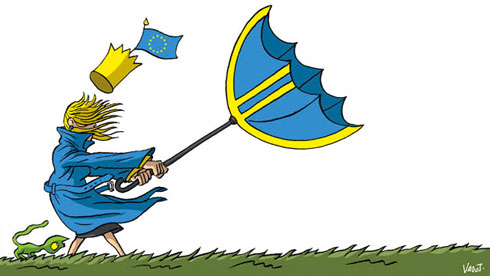
François Hollande and Angela Merkel are doing a stark disservice to the European Union. The Franco-German duo, for once in agreement, yesterday decided to bury a strategic debate on the future of Europe. It’s a debate that has been delayed, confuscated or even prohibited.
Before the meeting, the 27 EU countries had committed to adopting a "roadmap" policy before the end of the year. This was to set out the milestones of an “intégration solidaire” (united integration), to use a cryptic utterance dear to French President Holland. What financial solidarity? What common budgetary capacity? What democratic oversight?
It was not about wrapping up every issue, or engaging in an irresponsible headlong rush, but about setting in motion all the institutions of the Union, and, above all, about opening up a major and open debate. For at least two reasons: the survival of the eurozone is at stake, and the 27 member states have not averted the disaster by deciding, at each one of the numerous “last chance” summits, on another move forward regarding financial solidarity amongst themselves.
Market pressure
However, this sideways shift – and this is the second reason – was done under pressure from the markets, without any political vision, and, above all, out of the public view.
Disagreeing about the contours of a new European federalism, the French and the Germans prefer to take the stance of the ostrich.
Angela Merkel is entering an election period and wants to avoid the slightest risk, while François Hollande fears nothing more than reopening old wounds in his majority government. End of story.
But this petty politics is based on risky assumptions – as if the crisis were finally behind us, and that the peoples of Europe would settle for a short-sighted austerity.
View from Lisbon and Rome
A decisive summit - another one
“Today and tomorrow, the European Council will discuss a roadmap for the reform and completion of the Economic and Monetary Union, which will play a decisive role in overcoming the eurozone crisis,” writes Maria João Rodrigues in Público. The EU affairs specialist and former politician continues –
after three years of inadequate measures that allowed the crisis to spread, major proposals have at last been tabled for discussions, in which Portugal will have to play an active role to ensure that the decision making process is not dominated by an intergovernmental logic favouring the most powerful countries. The equality of Europe’s member states and citizens, which has been significantly undermined in recent times, can only be served by the community method, which is based on the European Commission’s right of initiative and an active role for the European parliament.
“The final summit of a difficult year for the EU will be marked by an atmosphere fraught with worry and alarming uncertainty over just about everything relating to Europe — its future, its identity, its integration process and its federal dream,” writes Enzo Bettiza in La Stampa. For the Italian columnist –
the summit on December 13 and 14 will be fragmented into 48 hours of secretive corridor encounters and discreet bilateral meetings. Now that they have avoided the stumbling block of Greece and temporarily frozen the Spanish deficit, the French and the Germans who are the main protagonists at the summit will get to grips with the two major threats to the cohesion of the EU, that is to say the political turmoil in Italy and the drift towards Euroscepticism in an anti-bureaucratic United Kingdom, behind the closed doors of private diplomatic dinners.
Do you like our work?
Help multilingual European journalism to thrive, without ads or paywalls. Your one-off or regular support will keep our newsroom independent. Thank you!