








Select a language
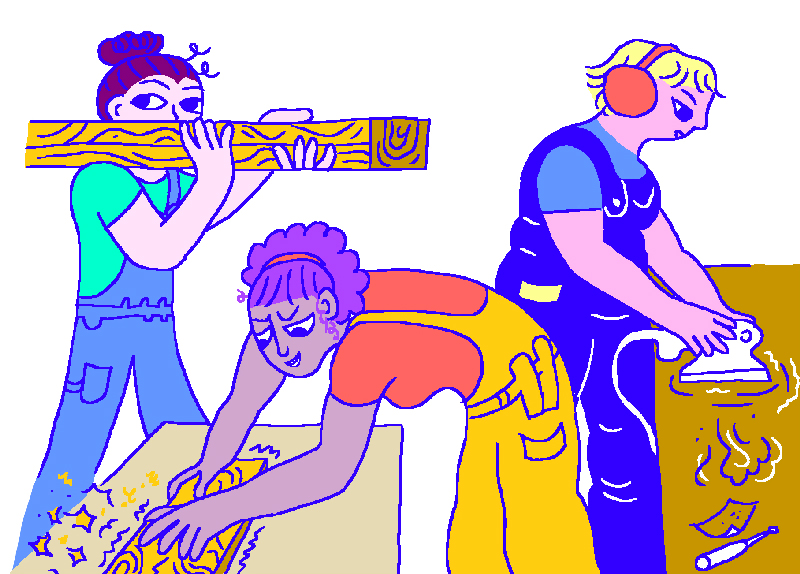
“When you go into the staff room, the walls are lined with calendars with naked women”, says Alice*, a young French carpenter. "I felt I was entering a world where I didn't really belong. They didn't do it to intimidate me, those calendars were there before I arrived, but they won't take them down for me." Before becoming a carpenter, Alice was a civil engineer. She was already operating in a male-dominated world, with only 30% women on average. In her company, she is now the only female craftsperson.
At a time of gender-parity quotas in companies, gender segregation persists in the European workplace. There are still male- and female-dominated professions where more than 50% of the employees are of the same gender.
Vocations imposed by nature
Being born with XX or XY chromosomes does not predestine anyone to become a nurse or a mechanic. However, women are over-represented in the sectors of education, social work and care, and personal service. Such personal qualities as attentiveness and concern for others are a necessity in what are known as the “care” professions. Often these are seen to be a "natural" extension of what women already do in the home and family.
Since I've been self-employed, I work almost exclusively with womens [...] Before, I didn't think that working in gender non-mixity was a solution. Then I realised that equality does not mean the absence of differences, but the acceptance of their existence. We have to take these differences into account to create a working environment that suits us.
Fanny Colin, carpenter
On the other hand, the occupations carried out almost exclusively by men correspond to qualities associated with masculinity, or being "a real man" - especially physical strength and leadership. Such attributes are supposedly found among mechanics, construction workers and company directors.
The invisibilisation of women artisans
Despite their growing presence in the craft industry, women are still rare birds on the construction site, regardless of the country. They are still subject to gender stereotypes and sexism. Whether from teachers, colleagues, apprentices or customers, mansplaining is a daily occurrence. It regularly happens that a customer or a supplier refuses to talk to an experienced female artisan, preferring to deal with a young apprentice whom they consider more legitimate. Such situations are "a classic", says Fanny Colin, a self-employed carpenter.
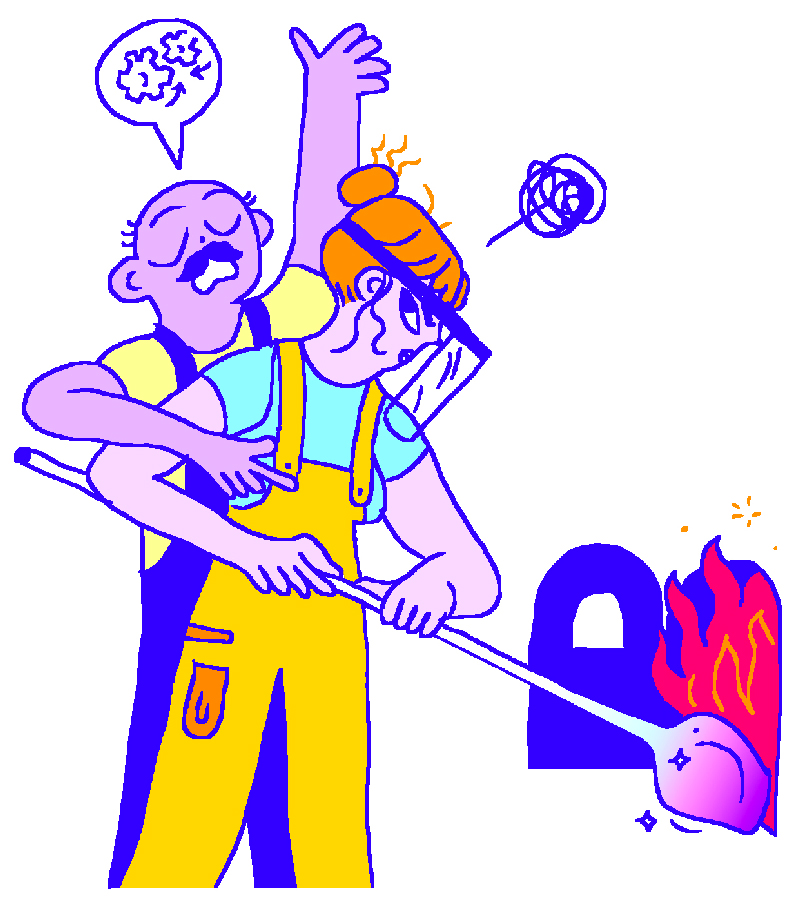
Women’s physical appearance can also be a pretext for devaluing and infantilizing them. The profession of master glassblower has long been a forbidding one to women. Jennifer Gaumer, who works in the profession, has been the object of remarks on several occasions. "I am small, so people want to do things for me, as if I were a child. Working with hot glass is all about movement, playing with gravity, endurance. But I can carry and fix a heavy stained-glass window made of glass and lead", she explains.
Nevertheless, the presence of women does not disorientate everyone. Jennifer's friend Salomée Ebibi trained partly in Denmark, where female glassblowers are an unremarkable sight. "Over there, some women are considered to be experts in the craft. Whereas in France or Italy, it is still very traditional and restrictive. When I went to Murano [Italy] for the first time, they laughed in my face.”
Joining forces to better confront segregation
To improve their daily lives, women in the craft industry are getting organised. In particular, Fanny Colin founded the École des Renardes in 2017. Located in Corrèze (France), this carpentry training school is predominantly female. Two years later, Fanny also organised the first Congress of women carpenters. For three days, 80 female carpenters exchanged ideas in workshops, gave feedback on construction sites and discussed their approaches to the trade. Through their meetings, they also realised that they could choose their colleagues. "Since I've been self-employed, I work almost exclusively with women", says Fanny. "Before, I didn't think that working in gender non-mixity was a solution. Then I realised that equality does not mean the absence of differences, but the acceptance of their existence. We have to take these differences into account to create a working environment that suits us."
In 2019, the Grenoble collective Tangente, a feminist collective of women and transgender people in the building trades, was created. From three members, they have grown to around 40 in one year.
More passionate young women
Young female apprentices can rest assured that the situation is improving. Léa Salat, 16, studies carpentry. In her class there are still only three girls out of 14 students, but she notes that she has not had to prove her value more than anyone else. "We've worked in France, Germany and Romania, with no negative feedback about our gender. Only surprise, but never any remarks that we should do a job that wouldn't damage our little hands." Her teacher, Phil-Oliver Ross, encourages girls to join the course. "If a teenage girl comes to me with a twinkle in her eye and wants to tinker and build, she has a place."
According to this Franco-German, times are changing. "There have been more applications from women in the last two years than in the previous ten years." Nevertheless, even the most benevolent bosses and teachers are not immune to a paternalistic remark. Mr Ross is keen to train women, but he often suggests that he is "protecting" them, "taking them under his wing". Moreover, women artisans are often pushed to continue their studies in order to join design offices, rather than remain on building sites. Even if they are accepted, they are perceived more as "leaders of men" than as normal workers.
The great absentees in the female workplace
In the care and early-childhood professions, the presence of men also comes as a surprise. This is particularly true of midwives, a profession that was forbidden to French men until 1982. Lionel Di Marco, who has been practising since the end of the 1990s, testifies to the difficulties he had in obtaining his first internships. Today, some women still refuse to be examined by men, out of modesty or religious convictions. Often it is their partner who pressures them to refuse the examination. Lionel also points to the homophobic insults he has heard in the course of his career: "I was in a patient lift with a midwife colleague and another man, working in the hospital. When he saw our badge, he sneered and said, 'Ah, you're a midwife? Are you queer then?’" Most of the sexist comments were made by men themselves. But none of this discouraged Lionel from following his vocation. He was raised to do so: his mother was one of the first women to work as an air-traffic controller for the air force.
“Women's jobs" devalued
Necessary and vital, so-called "women's jobs" nonetheless receive little recognition socially and financially. Rachel Silvera, an economist specialising in professional equality issues, explains: "We pay less for work that has to be done 'anyway'. We are in the business of caring for others. Female nurses - they represent 88% of the profession in France - will not let their patients die. They have no flexibility to ask for pay rises." Since it is supposedly in the nature of women to be gentle, these jobs are not seen to require mobilising genuine skills, and there is thus no point in paying for their fair value, according to the economist. In France, a nurse earns 1800€ net per month on average, 50€ less than the average wage.
The mental burden is also unrecognised. According to Ms Silvera, "the fact that a cashier has handled two tons of goods at the end of the working day does not appear in the job description. It's not recognised. But a boy stacking shelves and carrying 20 kilos is recognised. Employment policies have already worked to attract women to jobs where they are a minority, by ensuring that training and techniques are open to them. For this economist, that is not enough. She believes that it will take at least another 50 years for female-dominated professions to be upgraded. She suggests the solution of reverse quotas, such as having a minimum number of men when recruiting nurses.
We have to show little girls that they can do anything: mechanics, bricklayers, carpenters! [...] They need to know that just because they are girls doesn't mean they can't use a drill, chisel or saw. It's not a big deal and I wish someone had shown me that when I was little. I want to open that little door.
Katrin Raskovaloff, artisan menuisière
Between the glass ceiling and the glass escalator
In 2017, women's average hourly earnings in the European Union were 16% lower than men's. Jennifer Gaumer bore the brunt of this: "In Baccarat, in the all-male glass workshop, I was paid less than men in my cohort, who had the same degree as me." While women are still bumping up against the glass ceiling, men are taking the escalator. A specialist in political sociology and professional equality, Marion Paoletti, explains: "In terms of professional equality in their careers, men in jobs considered to be feminine benefit from the ‘glass escalator’, i.e. their presence is valued and they have completely upward careers." This is particularly true for nurses and childcare workers, who become nurse managers or nursery managers more quickly than their female colleagues. Thus, even in female-dominated professions, men are less affected by gender stereotypes.
Another privilege is that domestic work is less of an obstacle to men's careers. In the case of single mothers, paid work does not relieve them of their responsibility as parents. Unlike most of her male colleagues in relationships, carpenter Manoë Wacquez cannot pass the baton at the end of the day. "My colleagues are less busy at home than I am. During the lockdown, I was the only one not working because I had to look after my son. That's why I don't accept more responsibility at work, I have enough at home."
Educating for true gender mixity
"We have to show little girls that they can do anything: mechanics, bricklayers, carpenters!" enthuses Katrin Raskovaloff, a carpenter. For her part, she has opted for private activism by putting tools in the hands of her daughter and her daughter’s 10-year-old friends. "They need to know that just because they are girls doesn't mean they can't use a drill, chisel or saw. It's not a big deal and I wish someone had shown me that when I was little. I want to open that little door.”
Higher education is gendered. According to a 2019 Eurostat report, in European universities female students have gained a foothold in the human and social sciences, education and literature, where they account for between 60 and 80% of classes. Male students are a majority in more selective courses, such as basic research, computer science or engineering, where they account for more than 70%. Despite the feminisation of European universities and despite their better academic results, women still do not reach the top of the hierarchy.
Schools are therefore trying to attract girls into computer science and boys into education, by raising awareness. The notion of "role models" plays a part in the fight against gender segregation, says Marion Paoletti. If women are appointed to the boards of directors of large companies, this opens up opportunities for young women and female students", says the lecturer in political science at the University of Bordeaux. In practice, however, training courses tend to attract women to male-dominated professions rather than the other way round. "Gender is only thought of in one direction: women are pulled up, men are not pulled down. Equality is only achieved at the top, not at the bottom", says Paoletti. This is "elitist equality", which leaves out men in devalued sectors, as well as underprivileged women in these same sectors or those who are not working.
Gender equality in the workplace has been a one-way street. "It's mainly a question of opening up to women", says Rachel Silvera. "Women are increasingly becoming managers. This is certainly an essential step forward, but we mustn't forget that they study longer and come out with more qualifications than men. Professional equality therefore requires the recruitment of men in areas where they are under-represented, as well as the upgrading of female-dominated professions. Some men and women have already started. They have not waited to be born with the ‘right’ gender in order to exercise the profession of their choice.”
* First name has been changed

En association avec Reporters d'Espoirs
Do you like our work?
Help multilingual European journalism to thrive, without ads or paywalls. Your one-off or regular support will keep our newsroom independent. Thank you!

Cet article est publié en partenariat avec Reporters d’espoirs

