











Select a language
In the early hours of Sunday 16 August, the alarm sounded at Mihail Kogălniceanu Air Base in south-eastern Romania. The Spanish pilots on duty in the 12th Wing, part of the Paznic detachment, leapt out of bed: "Alpha scramble! Alpha scramble!" — the term used in military aviation for emergency sorties to intercept unidentified aircraft. It marked the start of a day that, at 05:01, would see a Spanish F-18 shoot down an aerial threat for the first time since the country joined NATO in 1982.

The drone that had violated Romanian airspace was detected some 24 kilometres from the Romanian town of Galați, from the direction of Moldova. From Bucharest, the Romanian Ministry of Defence's surveillance systems raised the alert, and Spain's Torrejón air base had the final say. This is where NATO's Combined Air Operations Centre is based – the body responsible for ordering the shooting down of drones on Europe's eastern flank. The operation was authorised and two Spanish F-18s were scrambled.
Once the alarm sounds, pilots must be airborne within 15 minutes. Once airborne, "they stand by, observe how the drone is operating, then wait until the order to intercept it is given," explains Lieutenant-Colonel Alberto Borja Calvo, head of the Paznic Tactical Air Detachment, pointing to the Danube Delta on a map. He welcomed El Confidencial on 23 September at the Romanian air base, alongside other Spanish personnel.
Lieutenant-Colonel Calvo explains that they always ensure they do not fly near populated areas, "because there are two aircraft, which swap roles almost in real time". "While one is in the best tactical position to fire, the other is in position to monitor," he says. They then execute the sequence to locate, identify and shoot down the target.
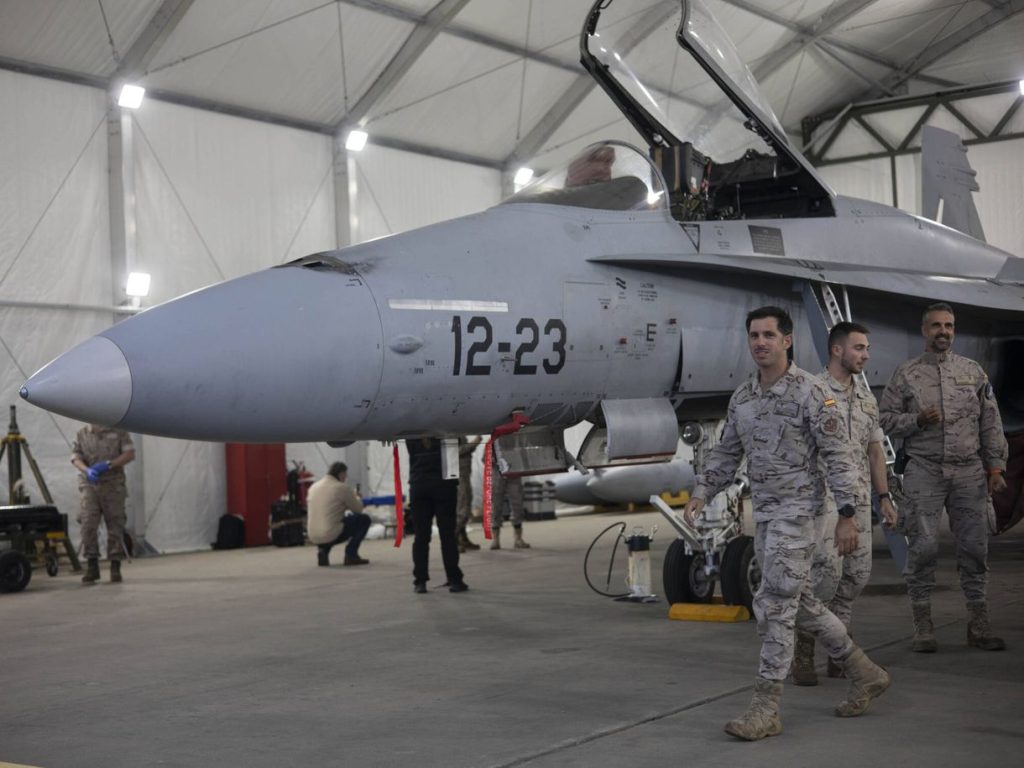
Since 7 August, the Spanish Paznic tactical air detachment — deployed in Romania for NATO's Enhanced Air Policing missions — has maintained uninterrupted surveillance around the clock.
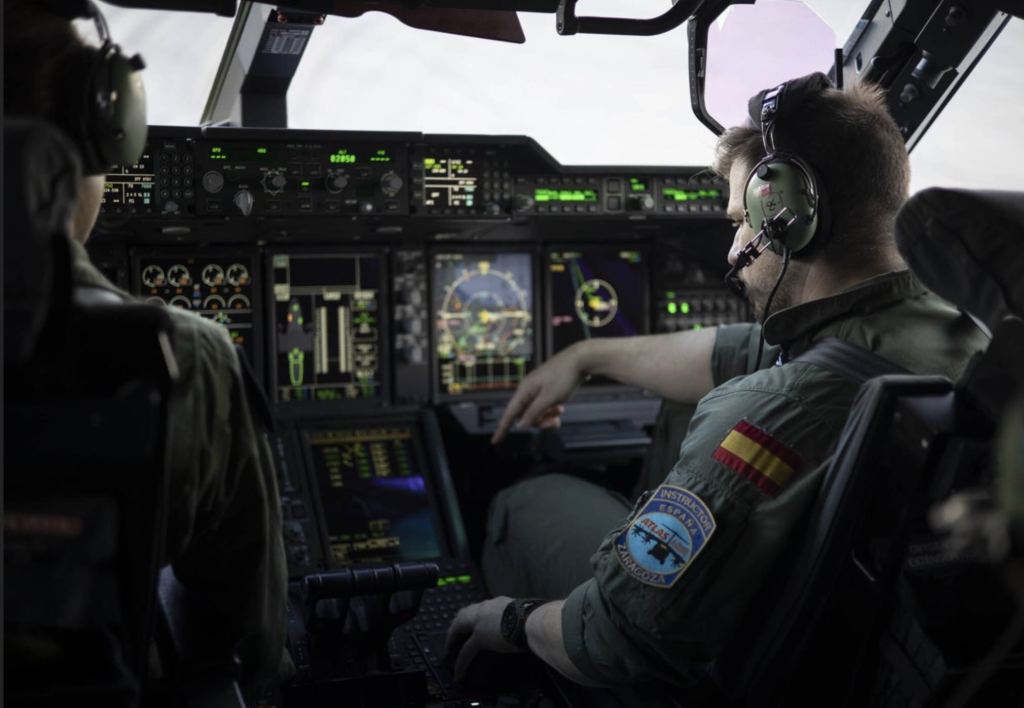
The detachment comprises around 200 military personnel, one commander and 39 aircrew, operating seven F-18s and one A400M in-flight refuelling aircraft. Three NH-90 helicopters are to be deployed in October, as Spain's Defence Minister Margarita Robles confirmed during a visit to the base on 16 September.
Since October 2022, Spain has also had a long-range air surveillance radar deployed in Schitu, a town on Romania's Black Sea coast.
Drones over the forgotten frontier
While the world's attention has been fixed on the Baltics, August proved an eventful month on NATO's forgotten frontier. "In three weeks, we had more alerts than in the previous four months of deployments," says Lieutenant-Colonel Calvo. During the first month of permanent alert for the Spanish operation in Romania, there were 15 live activations — one every two days — and one drone was shot down.
This was the fourth drone to be shot down in Romania in 2026. Between 24 and 26 July, in just 48 hours, Romanian pilots shot down three drones in the Tulcea district, in the Danube Delta. The incursions have become increasingly frequent.
"Russia is not only sending drones to attack Ukraine, but is continually testing NATO's response capacity," Calvo continues — doing so, in this case, "via Romania and via Spain, which is deployed here". "It would be inconceivable to allow a drone carrying an explosive payload to crash into a residential area. It must be intercepted and destroyed, as was the case on 16 August," he adds.
Between the start of the war in Ukraine in February 2022 and 24 September 2026, there have been 144 drone attacks near the Romanian border, 95 scrambles in response to unauthorised entries and 47 intrusions into Romanian airspace, according to the Romanian Ministry of Defence. Of these, 77 attacks, 60 scrambles and 28 intrusions have occurred this year alone. The most serious incident took place on 29 May, when a Russian drone struck a block of flats in Galați, injuring a woman and her son.
A new phenomenon
"We are not fully prepared for drones, but we have made improvements," Romania's President Nicușor Dan told CNN on 22 September. "The drone phenomenon is new and we face the same problem as everyone else," he said, adding that while he did not consider an attack "very likely" in "the next year or two", "we must be prepared". "If you had asked in 2020 or 2021, nobody would have imagined that Russia would attack Ukraine," he added.
So far, most unauthorised intrusions into Romanian airspace have occurred in the south-east of the country – in the Danube Delta and coastal areas near Ukrainian ports, where most of Romania's and NATO's detection systems are concentrated. In the north-east, resources are more limited. Russia is using new, increasingly fast drones, and two recent incidents in the Moldovan region of Romania – in the north-east, where there are no bases – may complicate matters further.
On 8 September, radars detected a drone west of Chișinău – capital of the Republic of Moldova – heading towards Romania. Only four minutes elapsed between detection in Moldova and the moment it crossed the border. By the time it was spotted again near the city of Roman, the drone had travelled almost 80 km from the border in just ten minutes. It was a Geran-3/4, a jet-powered evolution of the Geran-2/Shahed-136, capable of speeds of up to 500 km/h, according to Hotnews. It eventually crashed in the village of Mihăileni, in Rișcani, on Moldovan territory.
Another major challenge is cost. The Romanian Armed Forces spent over €1 million shooting down the three drones in July, according to the broadcaster Digi24. Operations currently rely on AIM-9X missiles fired from F-16s, each costing around $400,000 (approximately €350,000), on top of aircraft maintenance and flight hours. Are there alternatives?
"Defence against drones is layered – electronic warfare systems, anti-aircraft artillery, jamming systems – to prevent the drone from getting through," Lieutenant-Colonel Calvo explains. Ukraine, he notes, "is doing quite well" in this regard, "but ultimately, the layered system is not infallible." When there are breaches or undetected incursions, "the final line of defence is undoubtedly a fighter jet which, within less than 15 minutes of being activated, can be airborne, intercept the drone and destroy it. The fighter jet is the final safeguard to ensure that the drone does not land where it should not."
Original article on El Confidencial
🤝 This article was produced within the PULSE collaborative network. Victor Cozmei (Hotnews, Romania) contributed to it.
🗣️ Have a question, comment or suggestion? Share it with us through the PULSE reader form – we read and reply to every message. Be part of Europe’s conversation. Your experiences and ideas can inspire the next stories we tell. Join the PULSE readers’ community by filling in this short form.
Do you like our work?
Help multilingual European journalism to thrive, without ads or paywalls. Your one-off or regular support will keep our newsroom independent. Thank you!