








Select a language
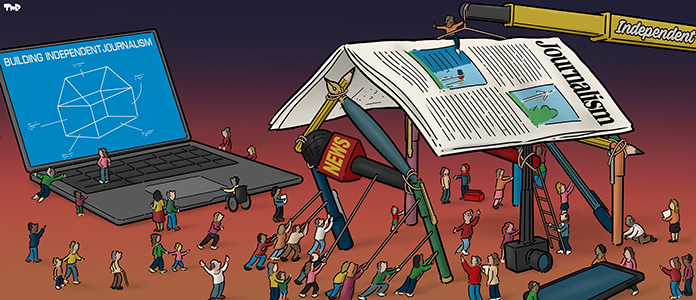
For the first time the rights of people in journalism have taken centre stage at the European Union – and the conclusion is that the way journalists work is not just about wages and conditions, it is also about democracy.
The European Economic and Social Committee (EESC) is a unique part of the European Union structure – a think-tank, advisory and consultative body that brings together European workers, employers and civil society and makes recommendations to the European Commission, Parliament and Council. And the Committee’s opinion on the state of journalism is a major shift.
And it matters. For years, politicians praised journalism as a pillar of democracy. At the same time, they have remained silent and quietly tolerated the erosion of the profession. Journalists in precarious jobs with falling wages. Unsafe newsrooms. Bogus freelancing. Digital overload. Violent harassment. And the constant pressure to do more with less.
Europe has expected journalists to perform, with Superman- and Wonder Woman-like powers to provide a public service under private strain. But now the profession is stretched to breaking point and by a resounding vote the EESC report and recommendations (209 votes in favour with just four against) is calling for urgent change.
The report reveals the poverty of working conditions for journalists in most EU countries. Only a handful of Member States offer stable jobs, decent pay and social protections. In newsrooms, staff burnout is routine as young reporters chain together temporary gigs. Local reporters struggle to survive and freelancers everywhere work with no safety net.
Worryingly, the report also highlights how women in media and minority journalists face brutal online abuse.
The consequences of Europe’s precarious newsrooms is silence, and a pervading self-censorship that is almost built into the structure of modern news media. Journalists who fear losing their jobs, for example, often avoid sensitive stories. When they cannot pay the rent, they are susceptible to undue political or corporate pressure. When they are exhausted, they stop digging. When they feel alone, they self-censor.
This inevitably leads to a stuttering flow of reliable, useful and essential information to citizens and, as a result, democracies weaken as economic vulnerability and fearful conditions lead to the quiet erosion of the media’s watchdog role.
Media workers do not seek privilege or financial gain, nor are they are not asking for special treatment, but they do insist on conditions that let them do their job.
And society depends upon them for vital truth-telling about what is going on in the world. It is in everyone’s interest to create a news environment that is safe, secure and provides a decent livelihood for journalists. Indeed, the EESC report states that precarious working conditions are “a threat to citizens’ right to access free, independent and pluralistic information” and calls for action to protect against psychosocial risks, with fairer treatment of freelancers and support for sustainable media.
Media workers do not seek privilege or financial gain, nor are they are not asking for special treatment, but they do insist on conditions that let them do their job
The Committee, importantly, highlights the dominance of very large online platforms which have captured most digital advertising revenue and shredded the business models of traditional media companies.
Stripped of essential resources, news media have been ruthless in cost-cutting: sacking newsroom staff and spending less on investigative research and journalism itself.
At the same time, online platforms refuse to pay for the journalism content they have ripped off news media, dismantling authors’ rights protections in the process.
The EESC insists that public interest journalism cannot survive in a market that rewards speed over accuracy, outrage over depth and algorithms over human judgment. It calls, instead, for limits on the unchecked power of platforms, warning that Europe cannot outsource its information ecosystem to a handful of private companies headquartered elsewhere.
Artificial intelligence adds another layer of pressure. Some newsrooms experiment with automated content. Some replace human positions. Many journalists now worry about being replaced by software that imitates their work but carries none of their responsibility. AI can be a useful tool, but artificial intelligence can only work to the benefit of media, if it is guided by the social intelligence of journalists.
The EESC recommends balanced rules over the use of AI, and calls for more training with meaningful accountability for those who build and deploy AI systems.
No capes
The EESC report is timely and long overdue. Already, public debate in Europe is Europe is increasingly shaped by wealthy influencers whose work has no editorial safeguards, no ethical codes, and no accountability. They have freedom to publish without constraints, and outside the parameters of responsible journalism. If professional journalism disappears influencers cannot replace it.
All of this leads to a simple conclusion. Journalists are not superheroes and they do not need capes. They need something much more ordinary to defeat the monsters behind disinformation and abusive communications – fairness, safety, dignity, respect and time to do their work without fear.
EU policymakers need to take the EESC opinion as an urgent warning that journalism cannot survive on goodwill and passion alone. It needs structures, protections and, above all, investment in the future. The effective implementation of the European Media Freedom Act would be a good starting point.
Superman was a journalist. But journalism and the European public do not exist in the fantasy world of superheroes. Europe needs a grown up, down-to earth strategy for journalism and news media.
The EESC report, late though it is, provides just such a blueprint for survival, both of journalism and of European democracy itself.
Do you like our work?
Help multilingual European journalism to thrive, without ads or paywalls. Your one-off or regular support will keep our newsroom independent. Thank you!