





Select a language
“This social network serves the needs of consumers who are inundated with superficial, fast-paced content and are looking for something else”, says Felipe O’Garran, a young writer and journalist. After travel reignited his creative instincts, he signed up to the Substack blogging platform. He has found it to be the perfect place to self-publish independently whilst ensuring his work has a future audience.
This appeal has served to attract many writers and journalists. In turn has helped fuel the growth of newsletters (which are a central part of Substack’s business model). In recent months the dynamic has accelerated. The platform has become a sort of refuge for those who are tired of the rules of social media.
Although it was launched in 2017, it is only in the last year that Substack has begun to gain popularity among a wider audience. In March 2026, Substack recorded around 136.3 million unique visitors, 32.77% more than in September 2025, according to the latest Sci-Tech report.
In Europe, the UK has the most Substack users, followed by Germany, France and the Netherlands. In June, the firm announced that its longer articles can now be translated from English into 15 languages, and from over 100 languages into English. It also launched national rankings in some of its fastest-growing markets outside the United States, including the UK, France, Italy, the Netherlands and Spain.
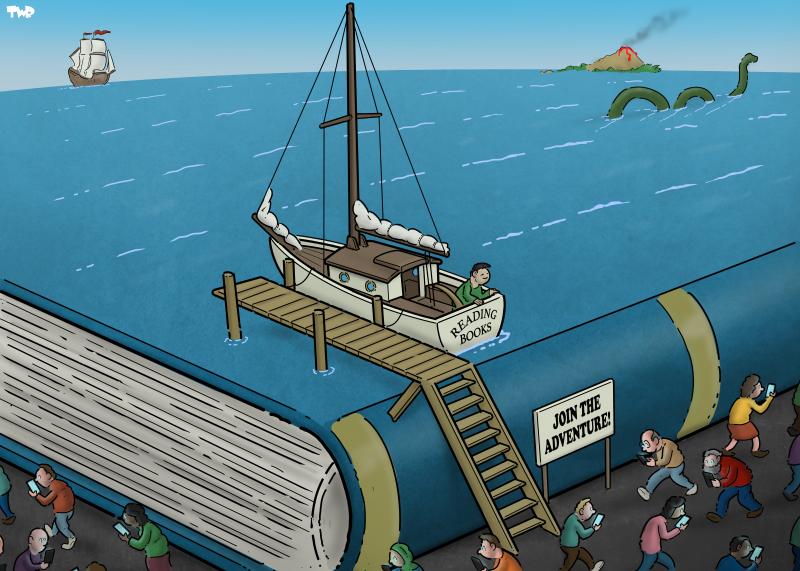
But what caused Substack to become so popular? In an information landscape dominated by ultra-short videos, clickbaity headlines and other attention-grabbing content, it seems that users are now looking for spaces where they can slow down and dig deeper into what interests them.
This concept has been called “slow reading” or “deep reading”. It's a trend that champions unhurried and mindful consumption of content. Ironically, it is also racking up millions of views under related hashtags on both TikTok and Instagram.
The return of slow living
Analogue media has also been quietly creeping back into our daily lives. Paper newsletters, essay-based periodicals and literary reviews are finding an audience willing to devote time to longer-form content.
“A growing number of people are looking for therapy in the form of tools to break free from social media consumption”, reports Violeta Villegas, a psychologist at the clinic of Esther Rodríguez in Seville. This institution specialises in social media addiction, among other areas. Villegas believes that smartphone addiction is not only a fact of life, but also a widely – albeit wrongly – accepted norm.
Aware of the phenomenon, many users have started questioning how they use social media. “Ultimately, what counts is not just the type of content we consume, but the intention behind it”, argues the psychologist.
It might seem paradoxical that trends such as “slow reading”, “deep reading” and “anti-brainrot” – all of which emerged from the very culture of rapid and constant consumption of content – have found a space on social media. Yet it is from here that their advocates are pushing a different way of engaging with digital content – one that, in particular, involves reading.
All these concepts encompass the need to create “mindful” spaces. In the case of reading, specifically, the aim is to prioritise comprehension and reflection on what is being read, whatever the format. Even within the reading community itself, people sometimes find themselves wanting to keep up with the pace of viral posts. However, the aim remains for users to reclaim their own pace, to stop being mere consumers and return to being readers.
“What captures the essence of ‘mindfulness’ is the act of trying to connect with a text, and how it makes me feel when I read”, describes Patricia Sánchez, a health psychologist and director of the PS Psicología centre. She points to the idea of returning to an activity for the sheer pleasure it brings, and as a way to “regain the sustained attention that has been compromised by the consumption habits of the digital age”.
From niche to mainstream
As a platform, Substack was primarily intended for creators. “It was a niche network, designed for those who enjoy reading and writing”, says Andrés Cardenete, a writer. He believes it offers a more natural environment than TikTok or Instagram for building a reading community, and that its growing popularity has attracted a wide variety of users, extending beyond the usual literary circles.
This shift is evident in Italy too, where some of the most popular newsletters are by journalists such as Selvaggia Lucarelli and Stefano Feltri, the politician Alessandro Di Battista, and the vaccinologist Roberto Burioni. Well-known writers, such as Antonio Scurati, Alessandro Baricco and Paolo Nori, have also begun to explore its potential. One of the most striking examples is that of Lucarelli, whose newsletter, Vale Tutto, launched in the summer of 2024, now has around 220,000 subscribers (including both free and paid). According to Substack, it has become the most popular newsletter in the world in the “Culture” category.
A similar trend is at play on the other side of Europe, in Lithuania. In August 2024, the public broadcaster LRT reported on the readership figures of writers such as Andrius Tapinas (over 29,000 subscribers); Tomas Ramanauskas (around 26,000); and Beata Tiškevič (around 21,000). Their content ranges from activism to advertising.
Such popularity would be inconceivable without an ever-growing and active community. Other platforms, such as Goodreads, faced similar challenges. The difference is that Substack's purpose has shifted. It was originally designed to facilitate the sharing of written content; now, there is a type of user who simply reads. This reflects a shift in consumption patterns.
‘The design itself compels you to read’
You receive it in your inbox; you read it if it interests you; you can comment on it or recommend it. The newsletter format revives a form of communication that seemed to have lost ground to algorithms – one in which the reader decides what they want to receive, who they want to read and when to devote their time to it. “It’s like finding a personalised community”, says Chhavi Sachdev, a Mumbai-based journalist and reader, when describing the phenomenon to this newspaper. She points to the continuity the platform offers (similar to a book club) and the fact that this way of enjoying literary content allows readers to “savour their reading more”.
That idea is shared by Andrés Cardenete. “You remove the algorithm and you stop being a passive user”, he says. For Cardenete, there is no other way to read than in a “pleasurable and unhurried” manner. Yet he understands why concepts such as “slow reading” have found a place in a world so full of stimuli. “Social media is fast-paced, but when you go onto Substack, the pace is different.”
That said, both professionals emphasise that we should be careful not to romanticize things. After all, just as this platform encourages linear reading, it also allows us to share articles without engaging deeply with them.
👉 Original article on El Confidencial
🤝 This article was produced as part of the collaborative project PULSE. Contributors included Justė Ancevičiūtė (Delphi, Lithuania) and Lorenzo Ferrari (OBCT, Italy).
🗣️ Have a question, comment or suggestion? Share it with us through the PULSE reader form – we read and reply to every message. Be part of Europe’s conversation. Your experiences and ideas can inspire the next stories we tell. Join the PULSE readers’ community by filling in this short form.
Do you like our work?
Help multilingual European journalism to thrive, without ads or paywalls. Your one-off or regular support will keep our newsroom independent. Thank you!