











Select a language
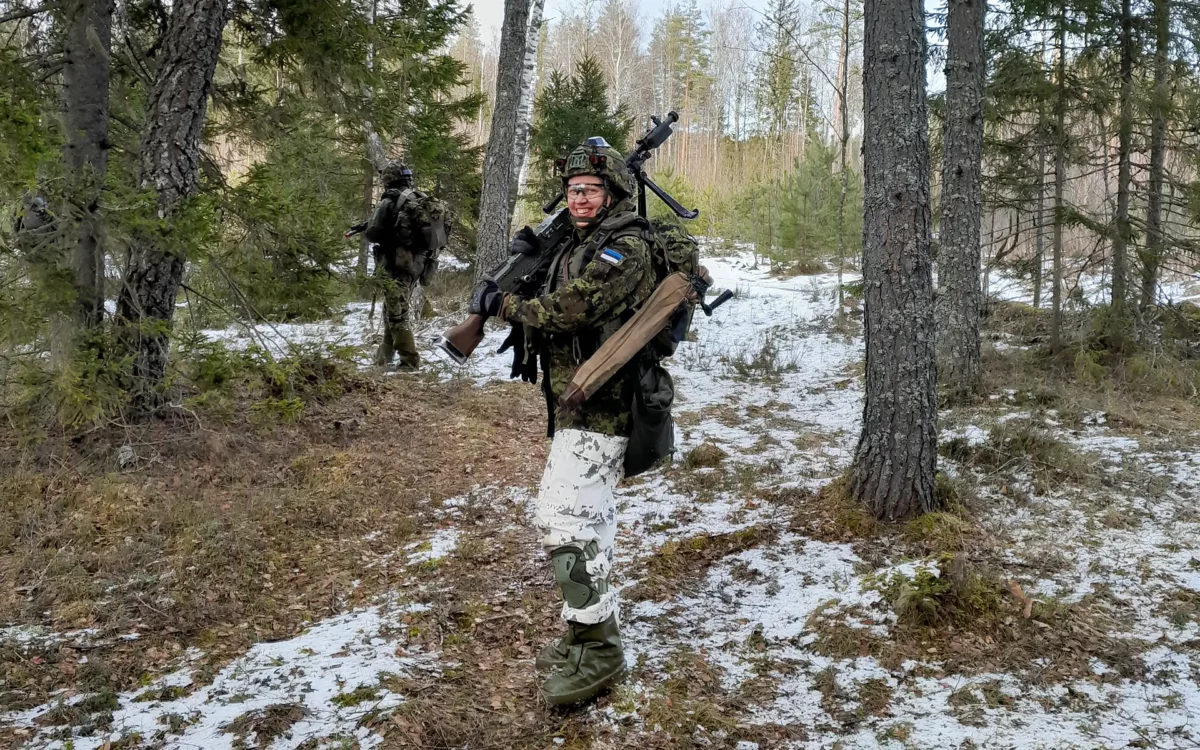
As an environmental activist and staunch pacifist, Ingrid Nielsen from Tallinn would never before have imagined donning a military uniform. “If I could destroy every weapon in the world, I would,” she says.
Then came 24 February 2022. The images from Bucha. The mass graves. The devastated towns. The reports of rape. “I have three daughters,” she says. At that moment, an abstract threat became a personal one. “When you live next to Russia, you do not have the luxury of pacifism. So we prepare ourselves. There is no other way.”
Several times a year, the mother of three stands in a frozen forest and loads a 120-millimetre mortar round. With 35 kilograms of equipment on her shoulders, her hands grow numb from the cold. She is one of four women in her unit.
Since the start of Russia's full-scale invasion of Ukraine, thousands of women like her have joined Naiskodukaitse, the women's branch of the Estonian Defence League (Kaitseliit). Its purpose is to make any occupation impossible. Similar organisations are growing in neighbouring countries: the Zemessardze in Latvia, the Lietuvos šaulių sąjunga in Lithuania, and the Maanpuolustuskoulutusyhdistys in Finland. The principle is the same everywhere: the responsibility for defence is to be shared by the entire society.
In Estonia, this is not merely a slogan but an established system. With just 7,000 professional soldiers out of a population of 1.3 million, the country relies on volunteers: reservists, IT specialists, volunteer first-aiders, teachers and parents. Mothers organise youth groups, and programmers secure networks. Citizens train in the very same woods where they played as children.
“Volunteers are the connective tissue of our resilience,” says Nele Loorents of the International Centre for Defence and Security in Tallinn. “It’s about embedding preparedness in the national mindset.” For Estonia, she says, defence is “about survival”. The same is true in the other Baltic states and Nordic countries.
Lessons from the North
The Military Service Modernisation Act, passed by the German Bundestag in December 2025, is the most comprehensive attempt to strengthen the personnel base of the Bundeswehr since compulsory military service was suspended in 2011. Since 1 January 2026, all 18-year-old men must complete a questionnaire (which is voluntary for women) designed to assess their motivation and suitability for service in the Bundeswehr. From 2027, all men born in or after 2008 will undergo military fitness assessments to systematically identify potential recruits.
A conference – Civil Defence and Societal Resilience – Lessons from Russia’s War of Aggression and the Nordic-Baltic States – took place at the Nordic embassies in Berlin just days before the vote on Germany’s new military service model. Security experts from Finland, Latvia and Ukraine discussed defence in democratic societies.
“Civil defence is not just about soldiers and weapons,” said Florian Constantin Feyerabend, an expert in international cooperation, political dialogue and security policy issues, in his opening remarks. “It concerns society as a whole.” Whilst Moscow is waging a hybrid war that targets societies just as much as armies, Germany has grown too accustomed to taking security for granted and too complacent about peace. “Resilience is not a choice,” Feyerabend said. “Ukraine shows that it is essential for survival.”
‘When you live next to Russia, you do not have the luxury of pacifism. So we prepare ourselves. There is no other way’ – Ingrid Nielsen
In the Nordic and Baltic countries, this societal resilience is deeply rooted. In Latvia, defence begins in everyday life.
“In an emergency, citizens must take responsibility because the armed forces and the emergency services will be overwhelmed,” says Sigita Struberga of the Latvian Transatlantic Organisation pro-NATO NGO. In Latvia, defence education is part of the school curriculum, and in Finland children are taught to recognise disinformation from an early age. Politicians regularly visit Helsinki’s underground shelters – large enough to accommodate almost the entire population of the capital. “Everyone has a role,” says Finnish researcher Pekka Kallioniemi. “And everyone must know what that role is.”
Ukraine, in particular, offers a valuable lesson. “In Ukraine, resilience is not something the state imposes from above,” says political scientist Oksana Huss, who is originally from Ukraine and now conducts research on resilience at the University of Duisburg-Essen. “It emerges horizontally.”
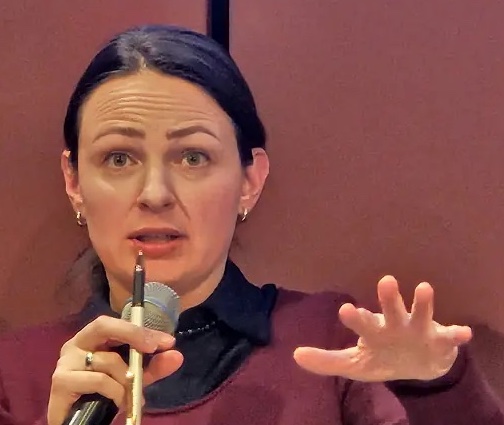
Following the Revolution of Dignity in 2014, when the state under then-President Viktor Yanukovych used violence against demonstrators, citizens began to organise medical care, logistics and community protection networks themselves. From these improvised initiatives emerged robust networks that equipped soldiers, cared for displaced people and ultimately kept entire cities functioning during the Russian invasion of 2022.
In Germany, in contrast, says Oksana Huss, many still expect the state to take care of everything. “In a real crisis, that won’t work.”
A new debate in Germany
Whilst defence is part of everyday life in the Baltic states, Germany is only now beginning to revisit the issue. For decades, security was effectively outsourced – to military alliances, diplomacy, and economic interdependence. Now the topic is returning – to classrooms, youth centres and social media.
Soldiers visit schools, talking about deterrence and foreign deployments. Conferences on societal resilience, once a niche topic, are fully booked. Even the Heinrich Böll Foundation, which has close ties to the Greens, dedicated its annual foreign policy conference in January 2026 to the question of how democracies can become more resilient militarily, politically, and at the level of society.
‘I will not defend my country because I don’t know what I’m supposed to be defending here’ – Yannick Kiesel
Just a few years ago, this would have been almost unthinkable in the traditionally pacifist environmental movement.
The extent to which German society is prepared to embrace this shift in mindset remains to be seen. But the debate has moved beyond political institutions and become part of everyday life. And it revolves around a question that has long been answered in the Baltic states but is only now being asked in Germany: what role does society itself play when things get serious?
A shift across society
The change is happening slowly and remains controversial. For many Germans, defence is still something distant and abstract.
Berlin peace and environmental activist Yannick Kiesel, for example, firmly rejects the German government’s arguments regarding the extent of the threat posed by Russia and the necessity of remilitarisation. Yes, Russia is an aggressor, and yes, the war must end. But, as he puts it, “No one has shown me a long-term plan for how Ukraine is supposed to win.”
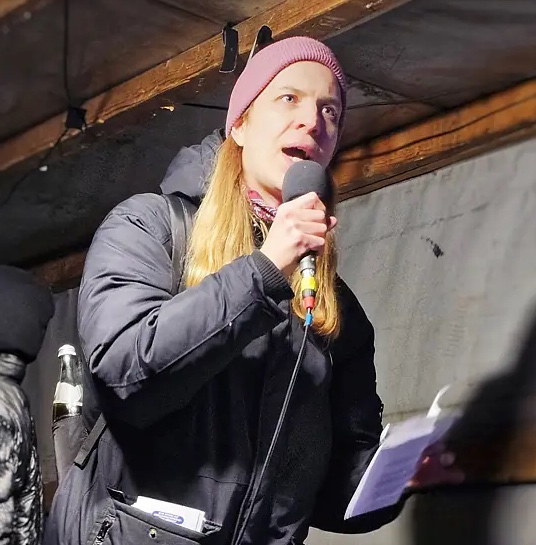
Kiesel describes the devastation in the frontline towns and cities – minefields, destroyed infrastructure, the loss of home. For him, the question remains: what could have been done earlier, and what can be done now to prevent further loss of life?
He rejects the notion that ‘‘our freedom” is being defended in Ukraine. “People in Ukraine are dying because they are defending their country – not our freedom.” The kind of patriotism evident there, he says, would be hard to find in Germany. “I will not defend my country because I don’t know what I’m supposed to be defending here.”
For Kiesel, security does not come from military strength but from social stability. “Social cohesion,” he argues, “does not improve by arming ourselves for defence. It improves when we strengthen education, the social sector and integration.”
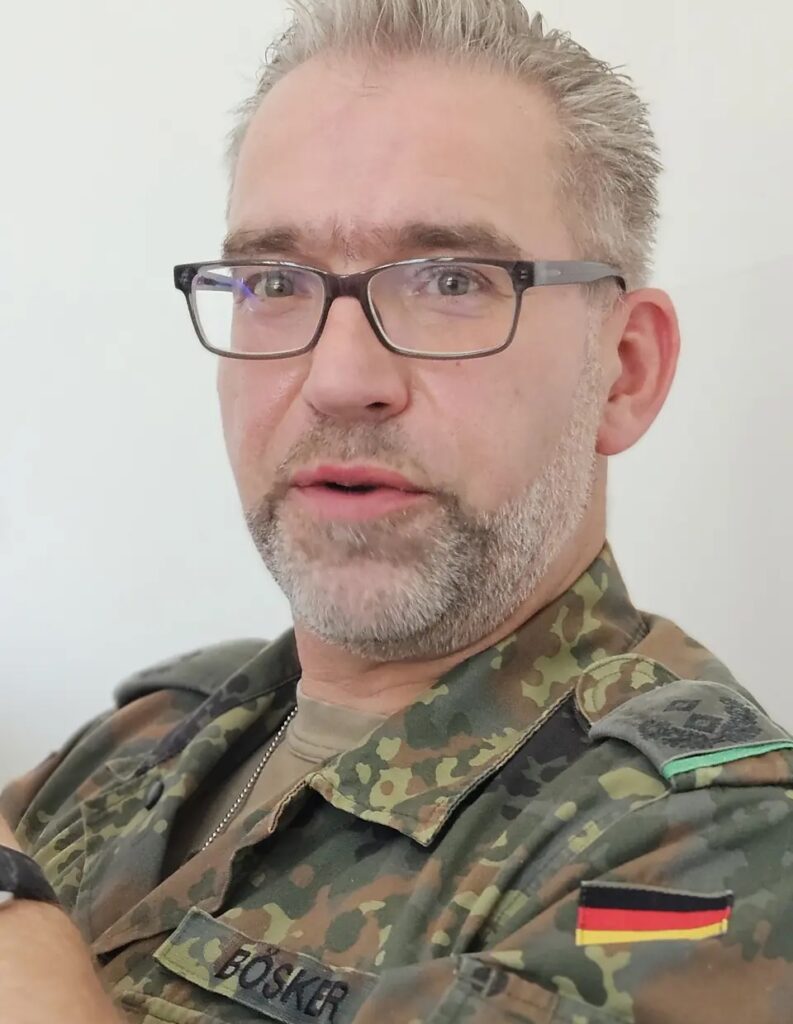
Reserve officer Roland Bösker from Dessau disagrees. “It is precisely because we can discuss social injustice freely that we must safeguard this freedom.” Bösker joined the Bundeswehr in 1989. A reserve lieutenant-colonel, he now works in public relations and is a member of the federal executive committee of BundeswehrGrün e.V., a security policy network with close ties to the Greens.
For too long, he argues, a “friendly indifference” has prevailed along the lines of “Things are working out somehow; someone else will protect our freedom.” In his view, the renewed debate over military service sparked by the war in Ukraine is shattering this illusion. “It’s not just ‘someone else’”, he says. “It’s every single individual who has to make a decision.”
One experience during his deployment with the Bundeswehr in Lithuania in 2017 made a particular impression on him. A man recognised the NATO uniform worn by him and the other soldiers, began to cry and said: “Europe is looking out for us.” For Bösker, this was a moment that showed him what defence means for smaller countries. “Europe is a union of democratic and free countries,” he says. “And this freedom must be safeguarded.”
The practical dimension
Not everyone has to become a soldier. Conscientious objection to military service has long been respected and remains so today, as does civic engagement. In Germany, too, defence takes many forms – in disaster relief, in hospitals, in public authorities. “What matters is participation.” Deterrence does not begin with weapons, but with awareness, Bösker argues. “The stronger this awareness is, the more resilient society is – and the less likely war becomes.”
This awareness also has a practical dimension. In the event of an attack on the Baltic states or other NATO allies, Germany’s Operationsplan Deutschland (Germany’s Operational Plan, or OPLAN DEU for short) stipulates that “key military components of national and alliance defence are to be integrated with the necessary civilian support services”.
Due to its geographical location, Germany would become a logistical hub, a staging and transit area for NATO reinforcements – hundreds of thousands of soldiers with vehicles, tanks and ammunition. Military transports would roll along railways and motorways, whilst civilian hospitals would treat the wounded. Bottlenecks would then also affect everyday life. Defence would no longer be a distant scenario, but visible – and felt in everyday life.
“This is not panic,” says Ingrid Nielsen in Tallinn. “This is our reality. We must be prepared.”
Still, it remains difficult to predict whether Germany will one day develop a similar approach to its own defence as Finland, the Baltic states or Ukraine. The issue, however, has moved beyond conference halls and political debates. Even amid criticism of the new conscription model, the question is no longer just how strong the army is, but how prepared society is.
The Zeitenwende (‘historic turning point’) proclaimed by former Federal Chancellor Olaf Scholz is not yet complete. But it has begun. And, as Roland Bösker argues, it is “not a decision – it is an ongoing process.”
O
👉 Original article on Jádu.
🤝 This article is published in partnership with Perspectives, a project and label co-funded by the European Union that stands for authentic, trustworthy, independent, and multi-perspective journalism. Led by the Goethe-Institute and implemented together with newsrooms from Central and Eastern Europe, Perspectives is committed to credible content that reflects Europe’s complex realities through diverse voices and viewpoints. Views and opinions expressed are those of the author(s) only and do not necessarily reflect those of the European Union or the European Commission. Neither the European Union nor the granting authority can be held responsible.

O
.
Do you like our work?
Help multilingual European journalism to thrive, without ads or paywalls. Your one-off or regular support will keep our newsroom independent. Thank you!


