














Select a language
There are plans in Sweden to lower the age at which children can be sent to prison. From 2 August this year, if the conservative government gets its way, 13-year-old offenders could be given prison sentences, despite widespread opposition to the proposed legislation. The Swedish Legal Affairs Committee, the Bar Association and aid organisations have all strongly criticised the draft bill, which contravenes a number of protections, including the UN Convention on the Rights of the Child.
Nevertheless, with this autumn’s parliamentary elections fast approaching, the government is sticking to its plan, which will initially run for five years, citing the need to combat gang crime in Swedish cities.

At first glance, reports of hand grenade attacks and shoot-outs involving very young people are indeed disturbing. Criminal gangs such as “Foxtrot”, whose ringleaders recruit minors or young adults for their local networks from their bases abroad, appear to have a stranglehold on major cities such as Stockholm and Malmö where, just a few weeks ago, a 15-year-old boy was shot dead in the entrance to a building. The perpetrator is believed to be a 15-year-old girl who is said to have previously committed a murder in Stockholm.
Police presence in schools and mosques
That incident, in Malmö’s Rosengård district, was grist to the mill for those urging a tougher stance against the gangs. However, crime statistics show that there has actually been a sharp decline in shootings in the city in recent years, down from 65 in 2017, to just 17 in 2025. So far this year, there have been four.

Malin Moran has been a police officer in Malmö for nearly 20 years, ten of them in Rosengård.
In an interview with Der Standard, she confirms this broadly positive trend. “When I began working in Rosengård, I quickly realised that we needed to start with community-oriented policing,” she says. For her, this means being physically present in communities and showing people that the police are committed to preventive measures too. For a time, Rosengård police officers were stationed in schools to build connections with children and teenagers, and they are also present at the weekly Friday prayers in mosques.
“People were very wary of us at first,” recalls Moran. “Some of them were worried, afraid that we were only there because they had been threatened and needed protection.” But little by little, and prayer by prayer, people got used to the officers and came to realise that the police are there for everyone, she says.
“Some of them come from countries where there isn’t much trust in the police, and we want to show them that things are different in Sweden.” Moran is convinced that lowering the age of criminal responsibility won’t change anything and that the answer is for police to work more closely with children to keep them away from gangs.
Gang-style recruitment method
Robin Pihl, 30, works for Helamalmö, an organisation that is active in several Malmö neighbourhoods and aims to give children and teenagers there a future. He manages its branch in Nydala, a neighbourhood that ten years or so ago had one of the highest crime rates in the whole of Sweden, and he agrees with Moran.
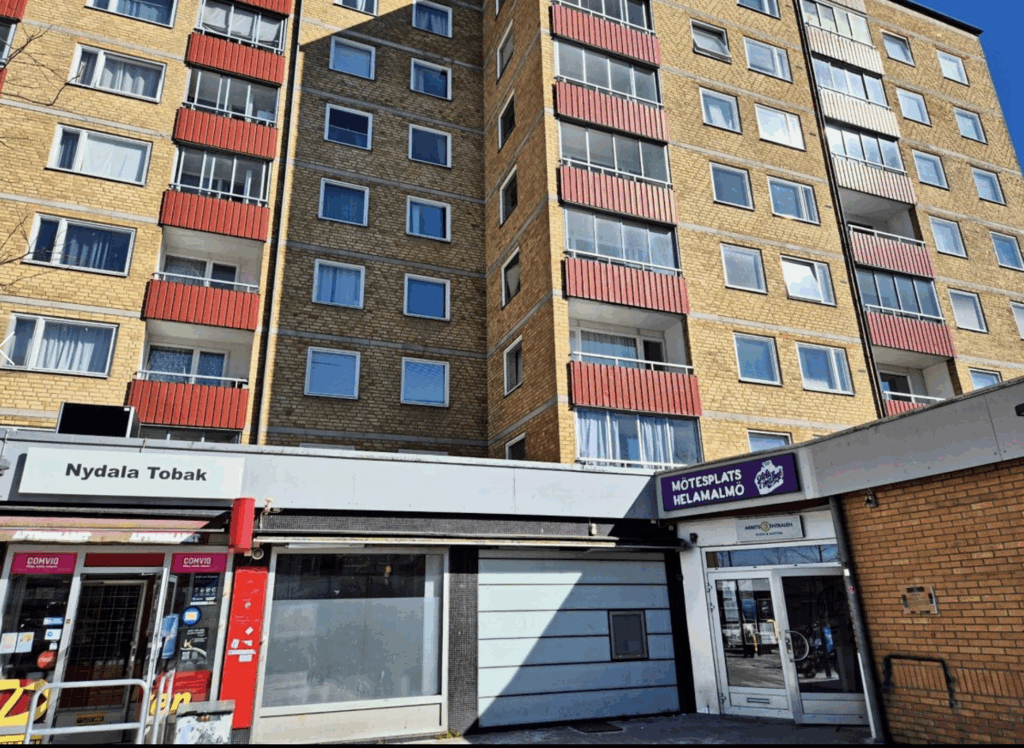
Helamalmö’s youth centre is in the corner of a square surrounded by the beige prefabricated tower blocks so typical of Sweden’s “problem neighbourhoods”. With its lilac-coloured entrance, it could easily be mistaken for a mobile phone shop, yet behind the glass door lies a 1000 m2 youth centre where local children can find a safe haven.
Around 250 children and young people regularly attend the centre’s afternoon activities, where they can always find food and a listening ear. Both are essential in a city where studies show that child poverty in some districts exceeds 50%. “To put it bluntly, our recruitment strategy is similar to that of the gangs,” says Pihl, adding that this is because both focus on meeting people’s basic needs in the neighbourhood.
“A gang member might invite a young person for a meal to establish contact. Later, the young person is given a small job so they can support themselves and feel part of a community.” At Helamalmö, too, hungry children are given a meal and enabled to find work, and are no longer alone. The only difference is that, here, everything is legal.
‘To put it bluntly, our recruitment strategy is similar to that of the gangs. A gang member might invite a young person for a meal to establish contact. Later, the young person is given a small job so they can support themselves and feel part of a community’ – Robin Pihl
The organisation also tries to build bridges between people in the neighbourhood. Older tower block residents are also affected by poverty, and were given free meals as part of earlier Helamalmö projects. “Those occasions enabled old and young to meet and get into conversation, for the first time in some cases,” says Pihl. These days, when minor disputes break out, people phone Hela first, rather than the police: “People know we have a network and that we don’t just know the children, we know their parents too.” This means problems can be resolved more quickly.
Pihl does not mince his words on the subject of the planned lowering of the age of criminal responsibility: “I don’t believe in giving up on people, I believe in giving them a second chance. And prison means giving up on them.” For him, even the current age of criminal responsibility – 15 – is too low: “There is no evidence that imprisonment works. No statistics to back that up.”
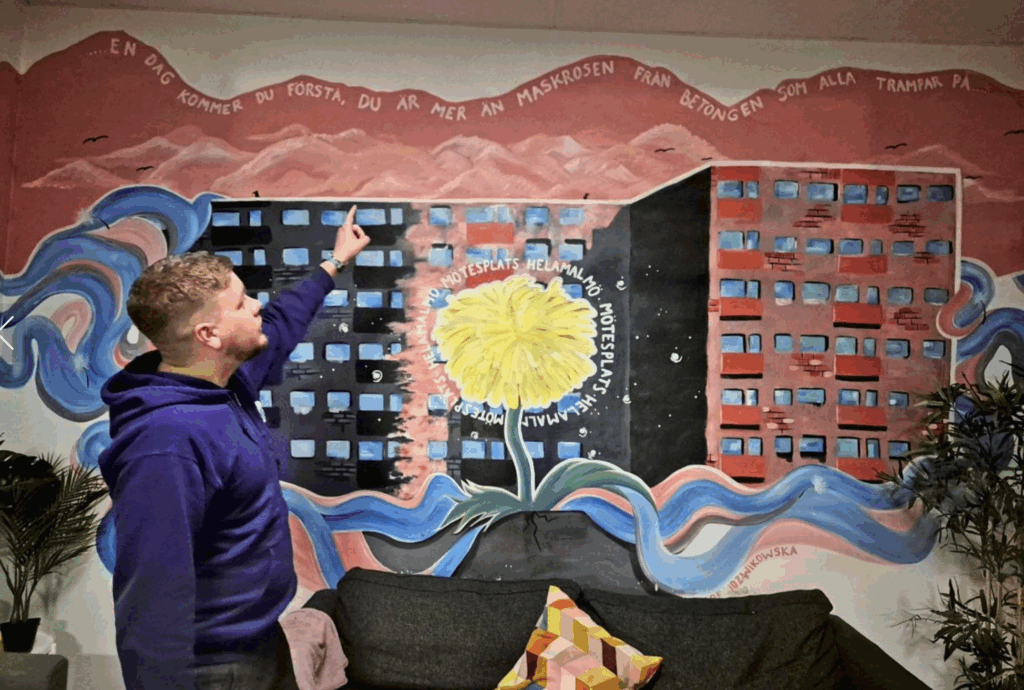
Quite the reverse: in 2010, Denmark lowered the age of criminal responsibility from 15 to 14, but U-turned just two years later under a Social Democratic government, on the basis that lowering the age of criminal responsibility had not had the desired effect and children should not be treated as criminals.
In January this year, a study by the Danish Centre for Social Science Research (VIVE) concluded that it had actually had the opposite effect – children were being labelled as criminals at an earlier age, making it harder for them to escape the cycle. In the two years with the lower age of criminal responsibility there was actually more youth crime in Denmark than before.
Chaos in the neighbourhood
Pihl argues that more investment is needed to combat child poverty in Swedish cities and strengthen children’s social networks. He describes housing blocks like the ones in Nydala as being a form of “systematic oppression”. For a long time there were no facilities here at all: people had to travel at least half an hour to get to medical facilities, job centres or even a library.
“Here at Helamalmö you’ll find the only library in the area, for example,” he says, adding that when the authorities leave entire neighbourhoods to their own devices, the result is chaos and the law of the jungle – precisely the kind of environment in which gangs thrive.
Pihl is adamant that what is needed is an environment in which children and young people can thrive, and that this could be achieved by investing in youth facilities and schools. There are no plans on the table for this, however.
🤝 This article was produced as part of the PULSE project. Emma Louise Stenholm from Føljeton contributed to it.
👉 Original article in Der Standard
Do you like our work?
Help multilingual European journalism to thrive, without ads or paywalls. Your one-off or regular support will keep our newsroom independent. Thank you!


