





Select a language
Aria doesn't hesitate when asked if she is happy with her choice to come out as transgender. Gender transition, says the 27-year-old woman from Brussels, is “the best thing that’s ever happened” to her, “contrary to what some people might think”.
Coming out as transgender to those close to her four years ago has enabled Aria to live her identity more freely. “I’ve regained a taste for life, so to speak,” is how she sums up her experience.
The umbrella term “transgender” refers to people whose gender identity is different from the one assigned at birth. Although they now appear regularly both on television and in legislatures, transgender people remain largely misunderstood by cisgender people – those who identify with the same gender identity as the one assigned to them at birth.
Marion (the name has been changed) is a 31-year-old education assistant based in France who considers themself non-binary. For them, “being trans means not understanding the concept of gender in the first place, and above all not wanting to conform to it.” They also see it as a way to be themself and to feel more like themself. “I’ve gained a greater sense of balance. When I realised I was non-binary, I felt like everything became clearer, and it was very calming. It allowed me to understand and explain a lot of situations from my past and childhood, and to stop telling myself that I’m weird or abnormal.”
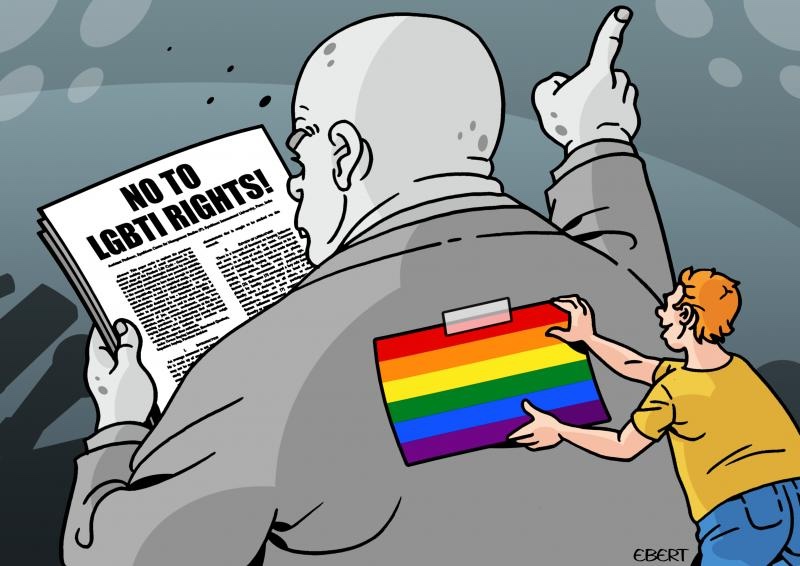
Mainstream media and politicians often only present a stereotyped account of trans identity. It is commonly reduced to either medical transition (which itself does not concern all transgender people) or to questions of discrimination and access to the law. Much less attention is paid to the concrete reality of the existence of trans people and the intimate experience it represents. Indeed, public figures all too often use hateful and dehumanising rhetoric to call into question the right of transgender people to exist.
Discrimination on the rise
In recent years, Europe has seen a campaign against trans rights. On 16 April, the UK Supreme Court ruled that the legal definition of a woman is based on biological sex. Although it was argued that transgender rights were still protected under the Equality Act 2010, some organisations pointed out the far-reaching implications of the decision, warning that trans women's access to single-sex services and spaces could be jeopardised.
The Supreme Court’s ruling, hailed by Prime minister Keir Starmer’s Labour government for bringing “clarity” (although it is still considered by some to be extremely vague in its application), was the culmination of an intense lobbying campaign by the trans-exclusionary feminist organisation For Women Scotland.
Such a decision is especially significant as it comes amid an ongoing culture war that has seen highly public controversies like the publication of the Cass review, which criticised the National Health Service’s medical assistance to trans youth, or the scandal surrounding the boxer Imane Khelif. High-profile individuals like Elon Musk and J. K. Rowling. who use their wealth and influence to attack gender minorities across the globe, have weighed in on the “debate on gender”. At the same time, the media sometimes repeats far-right talking points uncritically, thus playing a fundamental role in a political backlash with very real consequences for trans people.
In Hungary, a law introduced in 2021 barred organisations from sharing LGBT-related information with minors in schools and the media. In 2024, the French Senate adopted a bill banning hormone treatments for under-18s and strictly controlling puberty blockers. The government disapproved of the text, and it is still unclear whether Parliament will examine it.
And things are no better across the Atlantic: executive orders signed by Donald Trump banned trans people from the military and women's sports.
Across Europe, transgender people are facing increasing insecurity. In 2023, 14% of LGBT+ people surveyed by the European Union Agency for Fundamental Rights (FRA) said they had been physically or sexually assaulted because of their gender identity or sexual orientation in the five years preceding the survey – three percentage points more than in 2019. If we only consider the statistics related to transgender people, this rate rises to 20% (compared to 17% in 2019).
As the FRA summed up its findings, “overall, the survey results show that LGBT+ people, and in particular trans and intersex groups, continue to experience hate-motivated violence and direct and indirect discrimination and victimisation, despite the protection afforded by EU law.” Moreover, for several years now, there have been habitual (and growing) attacks on the rights of LGBT+ people by actors on the right and far right, jeopardising the gains made in the fight for trans rights.
In its annual report for 2024, the International Lesbian, Gay, Bisexual, Trans and Intersex Association (ILGA) reports a sharp increase in hate speech against LGBT+ people, particularly by public figures and institutions. The report reveals a paradox: on the one hand, public acceptance of sexual and gender minorities is slowly but surely increasing in Europe, and some governments are facilitating changes in civil status. On the other hand, access to healthcare, family recognition, freedom of association, and housing are becoming more complex issues for LGBT+ people. ILGA also notes an increase in “scare tactics around sex education [...] with the far right and other actors instrumentalising children in anti-LGBTI arguments and sowing division amongst young people and parents”.
For Aria, this growing insecurity is cause for worry. Even though she has not personally been attacked for being trans, Aria acknowledges that she could face harassment or abuse in the future. At the same time, she thinks that the increasing publicity of the debate on trans rights (and what some falsely depict as a “trans epidemic”) is what is fuelling the backlash: “It seems that for people, because it’s more publicised, trans identity is new and that a lot of people are trans, but that’s not true,” she says. “It’s a small minority, which we have to defend. A minority that has the right to exist.”
Marion also confesses to being scared. “Not for myself [...] but for my loved ones; and I think we always worry more about others than we do about ourselves. In the same way, the decline in abortion rights in some countries has worried me a lot, but it seems far away because in my immediate circle I only have people who are safe, and the danger doesn't seem to be in my daily life.” Still, they feel a growing threat: “I feel like things are getting worse,” they say, perceiving “a really bad backlash; and I feel sorry for trans people in countries where it’s getting really horrible. Selfishly, I’m crossing my fingers that it stays as far away from [France] as possible.”
Fighting back
Despite the challenges discrimination has brought to the LGBT+ community, it has also served as a powerful motor for indignation and civic engagement. For instance, in Hungary, where Viktor Orbán’s governing Fidesz party has long made the suppression of gender minority rights a centrepiece of its ongoing power grab, people responded to the banning of Pride by organising the largest pro-LGBT+ march in the country’s history. Over 100,000 people took part in the event in open defiance of the ban.
Aria says she would like to protest, but a physical disability prevents her from doing so. And for her part, Marion remains confident. “Even if politicians try to isolate us and ruin our lives, I think we can fight back, and that’s also important: not staying alone, not leaving people alone.” Marion tries to communicate this resolve in their work as a teaching assistant in a French high school, making sure that the young queer people under their responsibility “feel heard and know that they have the right to exist, and that it is beautiful and wonderful to be yourself and to be surrounded by people who care about you. And that it’s okay to be different from what society wants us to be.”
‘We’re more interested in the question of discrimination and suffering than in the actual experience of discrimination, which is what can lead to feelings of indignation and then to militancy; something that has been little explored’ – Arnaud Alessandrin
For Marion, the fight for the rights of gender minorities has already led to positive change: “I feel that even if what is visible publicly, like the media or political decisions, is transphobic, there is an improvement in the perception of non-queer people.”
Beyond their collective benefits, such efforts can also be individually empowering. A 2023 study looking at the psychological consequences of grassroots movements by LGBT+ people found that “activism [...] may facilitate the development of resilience in LGBTQ+ people.” Coming together and standing up for one’s rights may promote “identity affirmation [...] or the positive regard toward one’s identity”, thus promoting “LGBTQ+ identity development [...] and wellbeing”.
Still, there is a long way to go before sexual and gender minorities are fully accepted in Europe, and the victories that some activists have won often come at a great cost. The challenges that come with activism can also be mentally harmful. Frustration, anxiety, and direct attacks are commonplace.
Pathologisation and self-determination
The first European country to allow transgender people to change their civil status was Sweden in 1972. At the time, this change could only be made on the condition of having undergone gender-affirmation surgery.
When states authorise the modification of a person's legal gender, it is often linked to a psycho-medical vision of the lives of transgender people. To be recognised as a transgender person under the law means ticking a number of boxes: having received a psychological diagnosis, hormonal treatment, surgery, or even sterilisation.
Despite scientific consensus – which is for many people the only factor that lends legitimacy to trans identity – on the fact that being trans is a natural and healthy expression of human diversity, transgender people are often portrayed as mentally ill, their feelings ignored and their right to self-determination called into question. This has pushed more and more activists to call for trans experiences to be depathologised. Only eight European countries allow gender self-determination: Belgium, Denmark, Finland, Ireland, Luxembourg, Malta, Portugal and Spain. By contrast, two European countries prohibit altogether any change of civil status: Bulgaria and Hungary.
But what is often absent from discussions on protecting the rights of transgender individuals is the potential to create positive change for society as a whole. “I think society has a lot to gain from including and understanding trans people”, Marion argues. “There is so much dysfunction and misery associated with the gender binary. To stop viewing gender as two boxes could help prevent people from suffering because of their gender. I’m talking mainly about women here, who experience sexism on a daily basis, but more generally about all people who experience patriarchy.”
For Marion, understanding trans identity means understanding that gender is not binary – and that no one has to fit into “one of the two boxes that society forces us into”.
“On top of that, society always wins when it stops discriminating and becomes more open and welcoming”, they continue. “In any case, I’m not interested in a world that isn’t.”
“A story told by others”
In public discourse and in the media, much of the debate on trans rights is rife with familiar, well-rehearsed clichés, and transgender people have found it hard to claim a grand narrative focusing on the experiences and individualities of the people concerned. “In 2015, over 96% of transgender people surveyed were somewhat dissatisfied or not at all satisfied with the way the subject was covered in the media,” says Arnaud Alessandrin, a gender sociologist at the University of Bordeaux. Although they are more visible in the media today, trans people still feel that the discourse concerning them remains stigmatising and discriminatory even when it is not openly hateful, notes Alessandrin.
And when trans identity does get people talking, it is rarely done in a way that trans people would approve of. “We’ve noticed that what interests us most is the political dimension of trans identity,” says Alessandrin, pointing to issues such as access to the law, change of marital status, etc. This is also visible in stories that have an “embodied dimension”, meaning that they delve into the “biographical account of a celebrity, his or her life story”.
Personal stories are often structured as life journeys, featuring a before-and-after narrative of transition. Such a “sensational” approach, says Alessandrin, leaves little room for more intimate issues, such as schooling for trans people or their relationship with ageing. Still, the researcher notes that these subjects have started to get more attention than in the past.
“Trans identity is a story told by others,” says Alessandrin. And when this tale is told to the general public by cisgender people, it cannot escape the subjectivity of the person recounting it. “This storytelling is often accompanied by familiar language, such as ‘the wrong body’, ‘suffering’, and the idea of ‘mourning’.” These words were not necessarily used by the transgender people interviewed in Alessandrin’s study.
While trans people’s stories have gained in subtlety since the early 2010s, they remain steeped in the weight of suffering: the psychological pain, the medical burden, or the impact of discrimination. These are all legitimate considerations, but they may hinder more positive interpretations of transition. “We’re more interested in the question of discrimination and suffering than in the actual experience of discrimination, which is what can lead to feelings of indignation and then to militancy; something that has been little explored,” says Alessandrin.
This dispossession of the narrative goes hand in hand, the researcher argues, with a “polarisation” of trans identity. “Transgender people are [either victims] or heroic, courageous, beautiful, subversive,” he says. “We end up attaching a subversiveness to people who didn't ask for it.”
In her essay Whipping Girl: A Transsexual Woman on Sexism and the Scapegoating of Femininity (Seal Press, 2007), author and activist Julia Serano criticises what she calls the “mystification of trans people”: a process consisting of “so strongly endorsing the idea of a taboo nature attributed to ‘sex change’ that we lose sight of the fact that transsexuality [this term employed by Serano is itself controversial today] is quite real, tangible and often commonplace for those of us who experience it directly.” For this American thinker, “there’s nothing fascinating about transsexuality. For many of us, it’s simply a reality.” In her view, making transgender people a subject of mystery only serves to emphasise their “artificiality”: the gender assigned at birth is imagined to be “natural” in contrast to the illusory one in which trans people live their day-to-day lives.
But how can we create an understanding of trans identity as a positive affirmation of self when, as Arnaud Alessandrin mentions, media narratives about transgender people sideline the day-to-day issues and realities they experience? “We rarely talk about the intertwined dimension of subjectivity”, he laments. Not all experiences fit into a standard media canon. “The best way to combat this is to give a voice to trans people in the plural”, he concludes. “To understand this subjectivity, this multiplicity”.
👉 Read the original article on Green European Journal
Do you like our work?
Help multilingual European journalism to thrive, without ads or paywalls. Your one-off or regular support will keep our newsroom independent. Thank you!