










Select a language
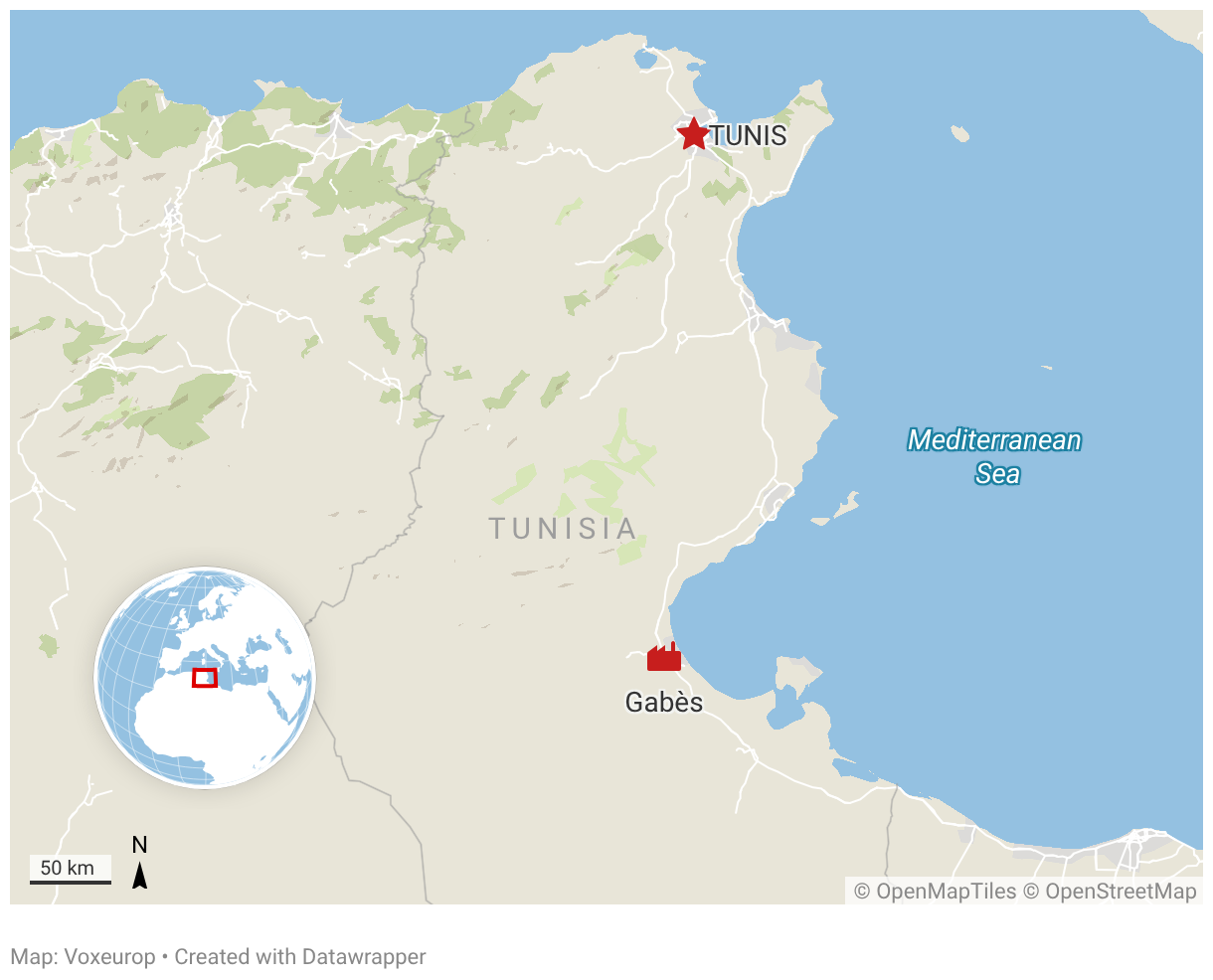
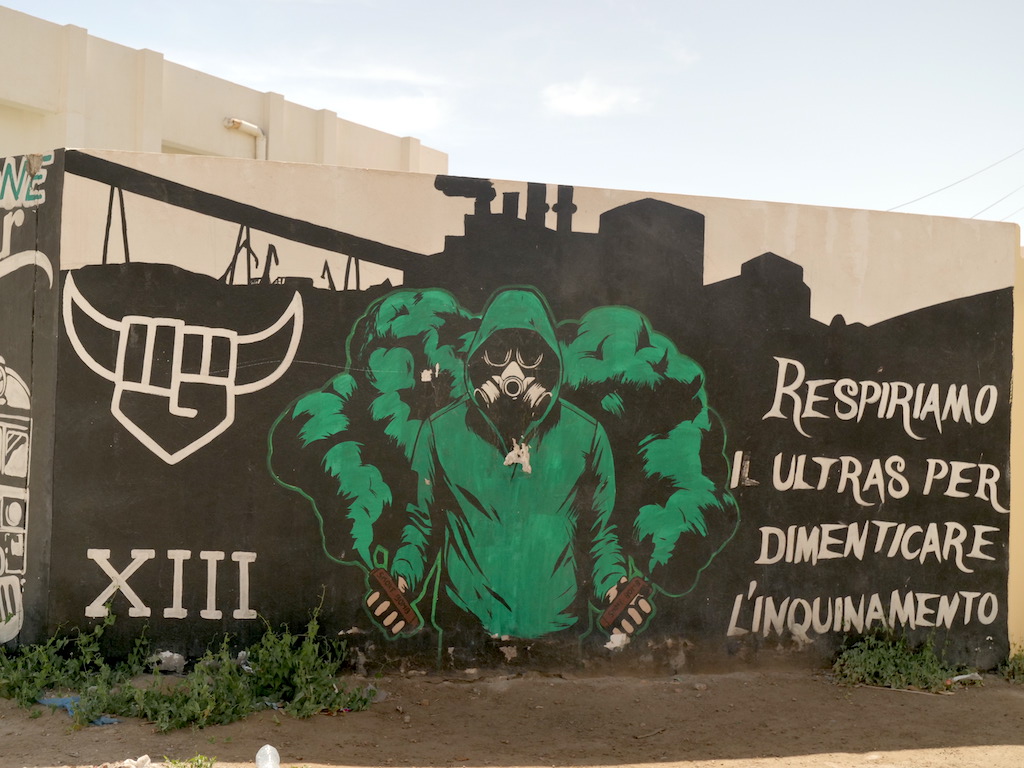
On the walls of Gabès, in southern Tunisia, graffiti rail against pollution. “They were painted by local ultras groups when they learned about the implications of the new Tunisian green hydrogen strategy on the people of Gabès” says Islem Zrelli, a young local environmental activist.
In 2024, the Tunisian Ministry of Industry, Mines and Energy launched its National Strategy for the Development of Green Hydrogen and its Derivatives, drawn up with Germany's development agency GIZ. The aim was to turn Tunisia into a major producer and exporter: 8.3 million tons of green hydrogen a year by 2050, around 6 million of them for Europe, which would require 100GW of renewable power.
Much of that hydrogen would be produced in Gabès. And part of it would go to the plant that residents tried to shut down for decades.
Gabès: fifty years of pollution
The smell from the chimneys greets every visitor driving into Gabès, a city set in what is often described as the Mediterranean’s only seaside desert oasis.
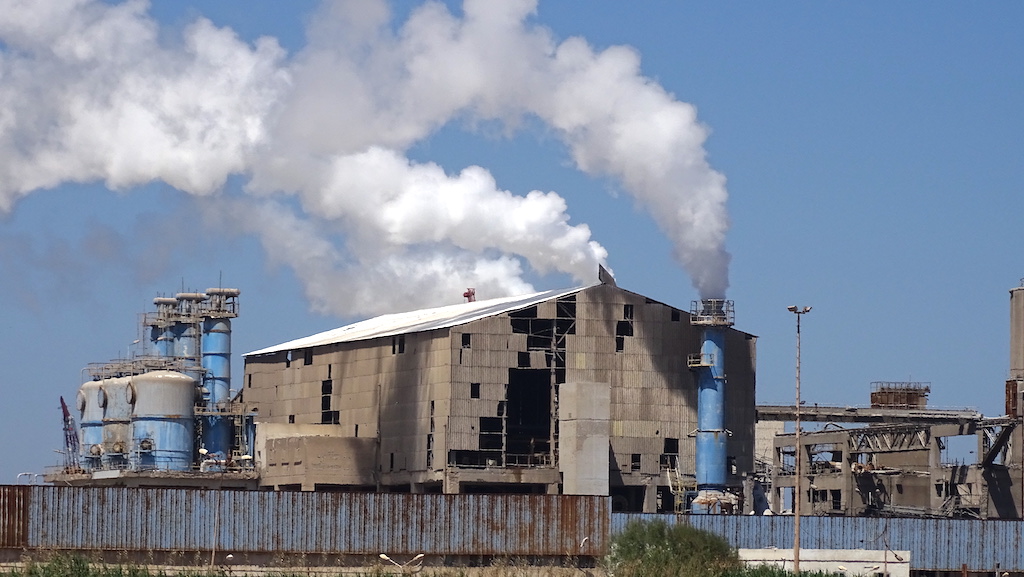
For more than fifty years, the city has lived alongside the Groupe Chimique Tunisien (GCT), a state-owned company that turns the phosphate mined in the nearby Gafsa region into fertilizers and phosphoric acid.
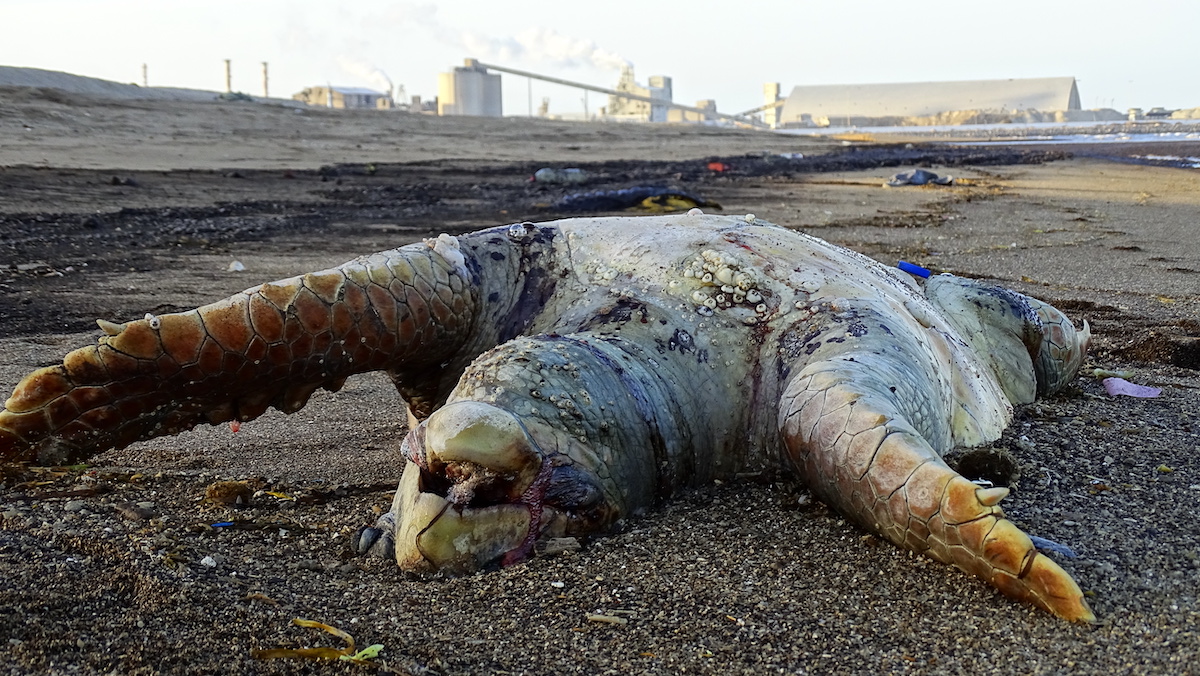
People there call it the Tunisian Chernobyl: the sea is too polluted to fish and the land is too dry to grow food due to GCT’s pollution. Despite the lack of systematic epidemiological studies in the area, cases of severe respiratory illness in Gabès have been linked to sulfur dioxide and PM10 pollution.
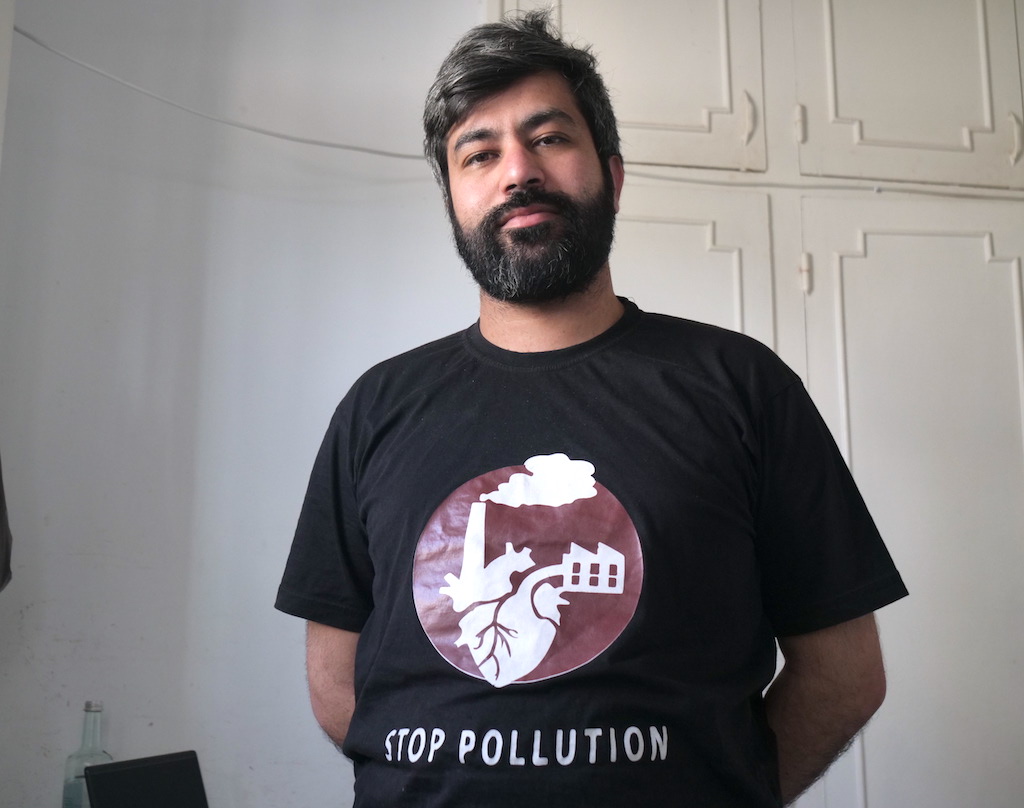
“There has been a time when the suffocation cases in schools were so frequent that ambulances silenced their sirens to hide what was going on,”recalls Islem Zrelli, a local environmental activist from Stop Pollution, a movement that has campaigned since 2012 for the right to a clean and healthy environment. “Kids are the most vulnerable victims of the GCT pollution!”
From the roof terrace of his house in Chott Essalem neighbourhood GCT’s run-down plant and its plumes of smoke are in full view. “Clouds of chemicals pollutants have been released into the air day and night for 50 years and a river of toxic waste runs into the sea” - he says. “We can’t drink tap water, we can’t go to the beach because it’s covered in phosphogypsium, a radioactive pollutant. Look at the sea, it’s black! You can’t imagine how often I find dead animals on the shore.”
A recent study found that stockpiles of bentogypsum, a new phosphoric acid purification by-product, stored in the open behind GCT’s crumbling containment walls are spreading widely, posing serious health risks.
A green lifeline for a polluter
Despite the evidence the Tunisian government has done little. Instead, the new green hydrogen strategy plans to use a large share of the country’s green hydrogen to decarbonise the Groupe Chimique Tunisien, extending its life.
One of the strategy’s three pillars for domestic use is a pilot project inside the GCT site in Gabès, advised by GIZ, to produce around 630 tonnes of green ammonia a year.
In 2025 a restricted ministerial council went further and quietly reversed a 2017 order to dismantle GCT’s units, doubled phosphate processing targets, launched green hydrogen and green ammonia production at Gabès site, and removed phosphogypsum from the list of hazardous substances, opening the way to selling it.
Each tonne of phosphoric acid produced generates between four and five tons of phosphogypsum, according to a 2021 study on biodiversity loss in Tunisia by the consultancy Oréade-Brèche. Over the past 25 years, an estimated 70 million tonnes have been dumped into the Gulf of Gabès, contaminating sediments over some 60 square kilometers.

“After all the damage they’ve done here, now they come with green hydrogen, without consulting the people, without asking what we think,” says Kheireddine Debaya, one of Stop Pollution’s leaders. “We don’t want GCT to be green. We want it to shut down.” Debaya is on trial after GCT accused him of obstructing its right to work; he faces one year in prison.
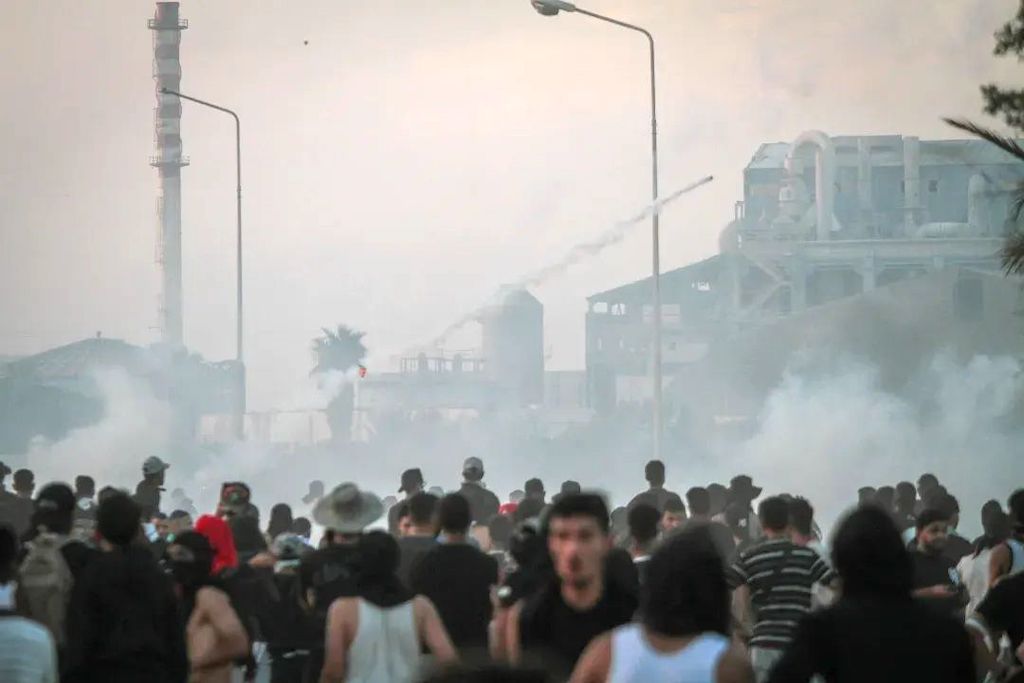
Shutting GCT down was the demand of the 130,000 people who marched through Gabès in October 2025 in what the organisers describe as the largest environmental justice protest in North Africa’s history. Police cracked down hard.
Mohamed Ali Cherif, a young rapper from Gabès, whose songs denounce the pollution, lost an eye to a police rubber bullet during the protest. Many others were injured, and movement leaders were prosecuted.
Why Europe wants Tunisian green hydrogen
The hydrogen planned for Gabès is meant, above all, for Europe: since 2020, Germany has led the EU in crafting the legal and financial framework that makes green hydrogen a pillar of Europe’s energy transition.
That year, the German government set aside €7 billion to bring hydrogen technology to market and €2 billion for international hydrogen partnerships. In 2021, it set up the H2Global foundation to organise hydrogen imports from outside the EU for German industry.
After Russia’s full scale invasion of Ukraine in 2022, hydrogen became central to the European Commission’s “RepowerEU” plan to diversify the continent’s energy supply, and its dependence on Russian gas. It added a target of importing 10 million tonnes of renewable hydrogen by 2030, on top of 10 million tons produced within the EU.
Tunisia soon emerged as a key partner due to its geographical proximity, existing pipeline infrastructure and the extensive unused potential for solar and wind power for the production of green hydrogen. In December 2020, Germany signed a Memorandum of Understanding with Tunis for a Power-to-X alliance with Tunisia, and from 2022 to 2025 GIZ ran a €6 million project called "Promoting a green hydrogen economy in Tunisia".
Berlin’s goal is stated in the official justification for its 2024 development aid, recorded in the OECD Creditor Reporting System: to “promote a national hydrogen strategy, thus establishing the necessary strategic and regulatory framework and improving the political conditions for a green hydrogen economy. The project is also optimising conditions for private sector investment.”
Under the strategy, much of the hydrogen will shipped to Europe through the SouthH2 corridor, a 3,300 km dedicated pipeline from Algeria to Germany via Tunisia and Italy. The EU has listed the pipeline as a Project of Common Interest (PCI), a status that speeds up permits and gives priority access to EU funding.
A neocolonial strategy?
On 24 April 2024, the World Anti-Colonialism Day, a group of activists and trade union members gathered outside GIZ’ offices in Tunis. They were holding banners asking to “stop neocolonialism”.
“We oppose the green hydrogen agenda because we see it as energy colonialism. It serves the needs of Germany, of Europe, of the industrial core, while neglecting ours as Tunisians, as the periphery, as a country from the global South,” argues Saber Ammar, an engineer and researcher at the Transnational Institute (TNI). “GIZ, on behalf of Germany and the EU, is interfering with our priorities. Green hydrogen is not the priority for Tunisians.”
What Ammar, one of the organisers of theApril 2024 protest outside GIZ, cannot understand is why an energy-dependent country would bet on exports. Tunisia imports roughly 90% of its gas from Algeria, and runs an energy deficit of $3.8bn.
“Germany started preparing the grounds for this type of energy privatization oriented partnership already in 2015, when the Tunisian government passed a law, drafted with the help of GIZ, that allowed private actors to produce renewable energy and export it” – argues Ilyes Ben Ammar (not related to Saber Ammar), a union leader at STEG, Tunisia’s public electricity and gas company. “For every foreigner that exports electricity to Germany or Italy, there is a Tunisian that does not have electricity, and a national need that is not satisfied” he adds.
‘We oppose the green hydrogen agenda because we see it as energy colonialism. It serves the needs of Germany, of Europe, of the industrial core, while neglecting ours as Tunisians’ – Saber Ammar, Transnational Institute
Trade unionists see the 2024 strategy as the next step in that direction. The strategy was implemented by the Ministry of Industry, Mines and Energy in close collaboration with the GIZ Tunisia “on behalf of the German Federal Ministry for Economic Cooperation and Development (BMZ)”, as the strategy document itself states. To the unions, it is another move towards privatising Tunisia’s energy sector: costly, profit-driven, and not designed for the needs of the Tunisian people.
Fadel Kaboub, President of the Global Institute for Sustainable Prosperity and Associate Professor of Economics at Denison University, argues that the strategy, often sold as a win–win, would lock Tunisia at the bottom of the value chain: exporting a low-value product while giving up land and water.
“This is green extractivism”, Kaboub says. “It's a colonial economic design. Decarbonisation without decolonisation is not going to deliver development or prosperity. It won’t deliver justice.”
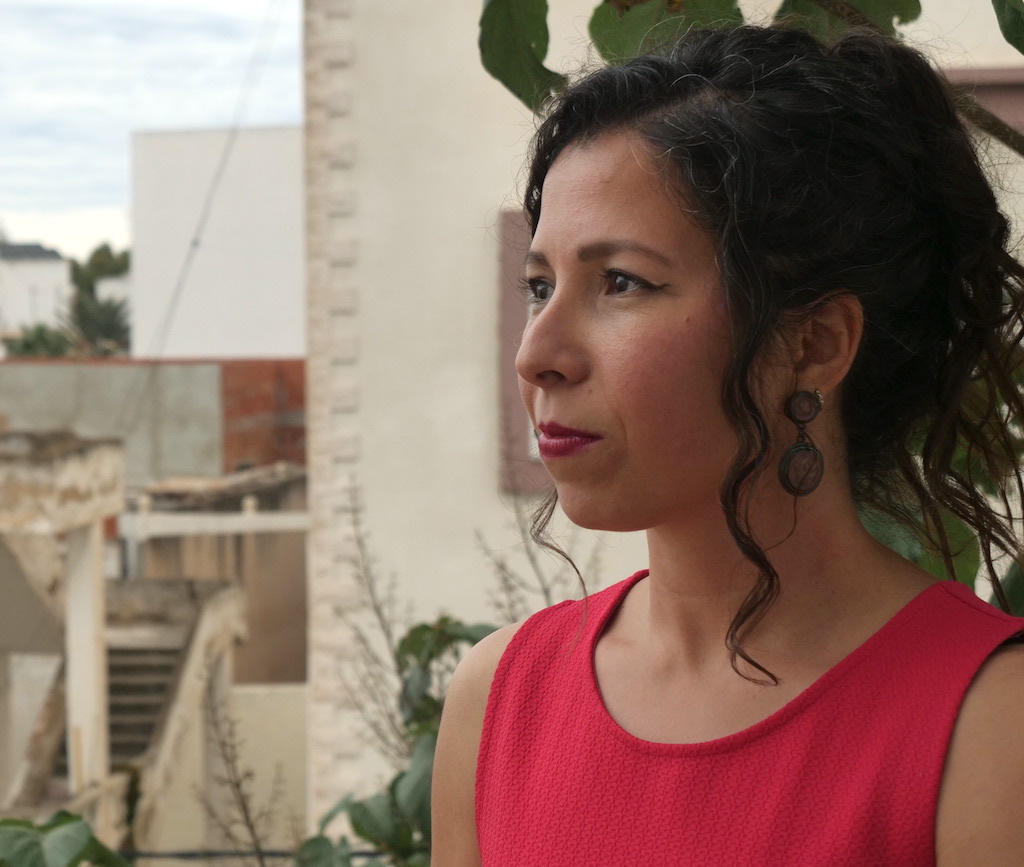
Dr. Hanen Keskes, campaigns lead at Greenpeace Middle East and North Africa, warns that the strategy offers no technology transfer. Because green hydrogen is so capital-intensive, it risks pushing Tunisia into a new debt trap, since the infrastructure would have to be financed with loans from international lenders and foreign investors.
“It's a whole ecosystem that is very, very reminiscent of the fossil fuel system”, says Dr. Keskes. “It won’t allow us to add any value to our own economy beyond the low-value export of raw material. No technology is being transferred to us; we're not building any of the components. We’re actually allowing the value chain to be built elsewhere in Europe, while we just export our raw, depletable resources. That is why it's unequal.”
Few jobs, less water
The strategy promises more than 400,000 jobs. Critics call the figures wildly optimistic. Recent studies and experience across renewable energy show that most jobs come during the construction phase, which is labour-intense, but temporary. What remains afterwards is a much smaller number of high-skilled technical jobs in project oversight and maintenance.
The Gabès Pilot project would run on just 8MW of renewable power, which is not enough to make a dent in a region where unemployment exceeds 26% and is still higher among young people. Even a 2021 report by GIZ and the Tunisian Ministry of Energy admits that job and value creation in Tunisia would be “limited”.
Those modest gains come at a heavy cost: Tunisia is arid and drought-stricken and hydrogen production is thirsty: making 1 kg of green hydrogen takes at least 9kg of freshwater.
The plan relies on desalinating seawater. Desalination produces brine, a highly salty by-product, which would be discharged into the Gulf of Gabès. Brine raises the salinity of the water, and can harm marine life on the seabed, further threatening the region’s fisheries.
Does Europe even need hydrogen?
From a European perspective, the main problem is weak demand.
“Green hydrogen is not stalling just in Tunisia: it’s stalling everywhere,” said Julian Reul from H2global, a German market-based funding mechanism designed to accelerate the global production and adoption of green hydrogen and its derivatives. “The reason is the lack of demand and of stable, long-term offtake agreements. Those are what you need to get the bank financing and to make your project bankable, and reach final investment decisions.”
The EU uses very little hydrogen today, mainly in the oil refining and fertilisers industry, as well as, to a lesser extent, in plastics. Those are the sectors expected to keep demand going, the so-called “no regret” uses, where green hydrogen is the only realistic source for decarbonisation.
Elsewhere, demand is moving slowly.
“The transport sector, in particular aviation and long-distance shipping, may take up hydrogen in the short term if the law requires it,” explains James Kneebone, who researches European clean hydrogen policy and industrial decarbonisation. “But the volumes involved will probably not be enough to justify importing and trading green hydrogen internationally.”
‘Green hydrogen is not stalling just in Tunisia: it’s stalling everywhere’ – Julian Reul, H2global
With lower demand, it may be cheaper for Europe to produce what it needs at home than to import it. Cheaper production abroad would be cancelled out by the costs of converting, shipping and handling the hydrogen.
Hydrogen, the smallest of all molecules, leaks easily and makes steel pipes brittle. Moving it requires specialised pipelines, storage and terminals, which adds to its cost. Green hydrogen also struggles to compete on price with its grey and blue hydrogen, made from fossil gas, which benefit from decades of established production.
“It’s just too expensive,” says Pascoe Sabido of Corporate Europe Observatory (CEO), a Brussels-based lobby watchdog. “Green hydrogen will never be competitive without public subsidies, and the beneficiaries will be a handful of big companies.”
In an open letter to the European Commission in 2025, 144 civil society organisations, CEO among them, called for an energy transition that does not rely on what they describe as neocolonial extraction abroad. They argue that hydrogen imports projects harm the communities where they are built, and that current investment could end up entrenching fossil fuels: if green hydrogen proves uneconomic, the new infrastructure could switch to fossil-based hydrogen and natural gas under a green label.
Stalled
Today, the green hydrogen market in Tunisia has stalled. In 2024, energy multinationals have signed six memoranda of understanding worth an estimated value of €120 billion. Little has happened since.
Saber Ammar sees local opposition as a major reason.
“Through our advocacy and mobilisation, we managed to stop the legal framework in parliament. We convinced some deputies to drop it” Ammar says. “In a speech on 1 October 2025, the president talked about green hydrogen and he said that young people were rejecting it. He was talking about us!”
We’ve asked GIZ several times for an interview on the state of the strategy for green hydrogen development. GIZ spokesperson Tanja Stumpff sent this statement:
“Tunisia aims to harness the potential of green future technologies and produce green hydrogen from wind and solar power. Until 2025, the Deutsche Gesellschaft für Internationale Zusammenarbeit (GIZ) GmbH supported Tunisian partners on behalf of the Federal Ministry for Economic Cooperation and Development (BMZ) with advisory services, expertise, and training. Among other things, GIZ advised the Tunisian Ministry of Energy on developing the framework conditions for a green hydrogen economy.”
In Tunis the path is unclear. Civil society wants justice to be the yardstick for any hydrogen strategy. In spring 2026, the president dismissed the energy minister a few days before a key vote on renewable energy concessions. Neither the government nor GIZ has yet opened the decision to the people of Gabès. In Gabès, the graffiti is still on the walls. GCT, meanwhile, has been told to double its output.
🤝 This project was funded by the European Journalism Centre, through the Official Development Assistance Germany Grants. This programme is powered by the Gates Foundation.
Do you like our work?
Help multilingual European journalism to thrive, without ads or paywalls. Your one-off or regular support will keep our newsroom independent. Thank you!