







Select a language
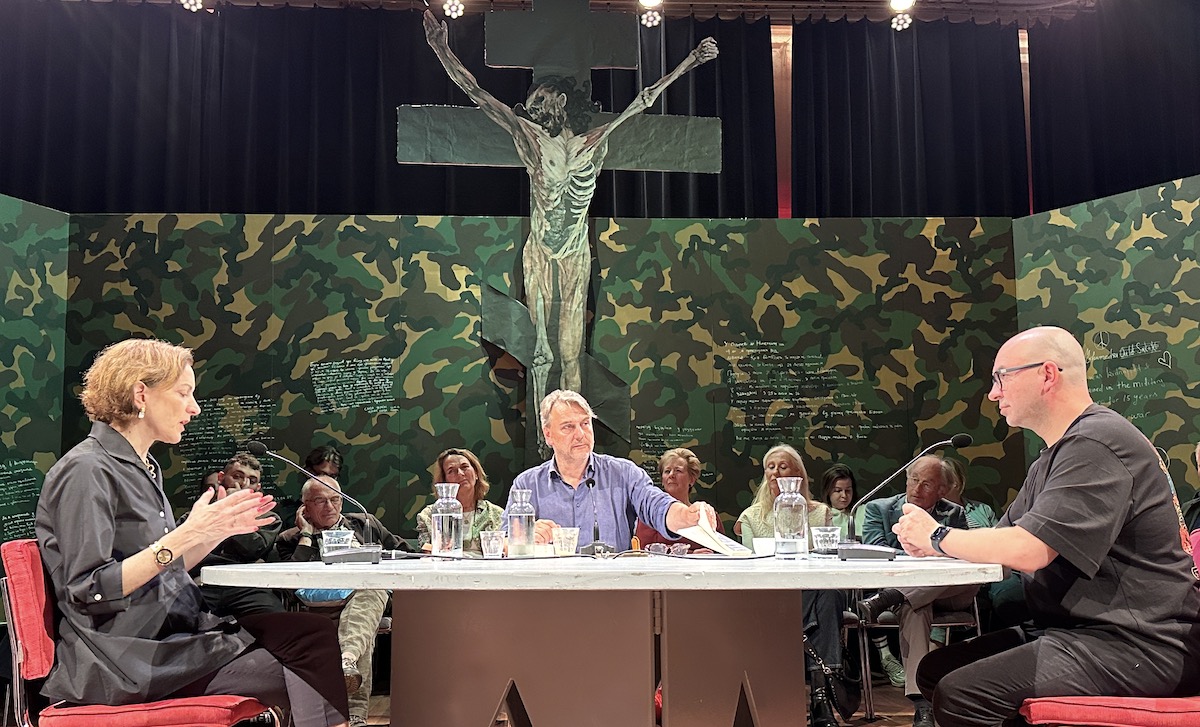
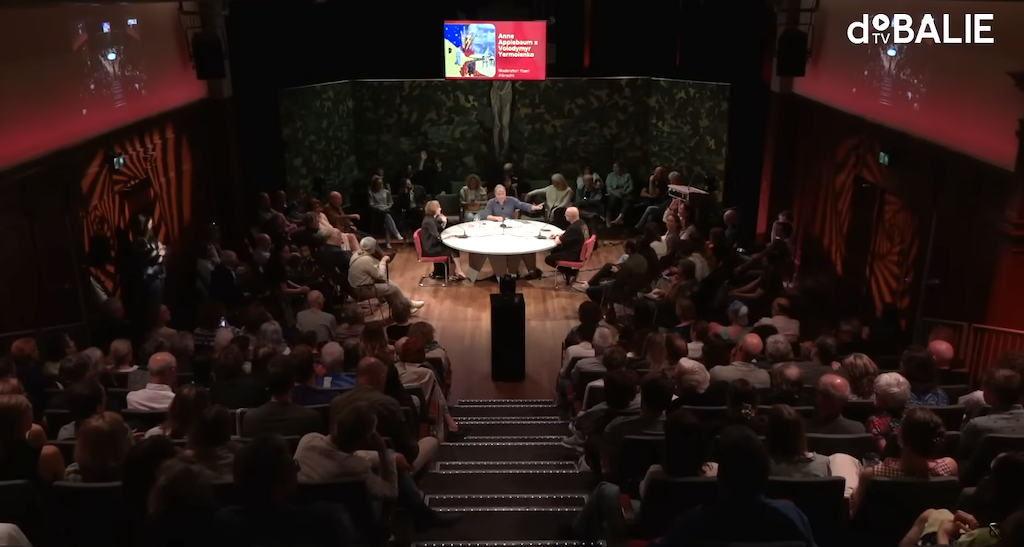
In a conversation at the De Balie cultural centre in Amsterdam, Volodymyr Yermolenko and Anne Applebaum discussed the fragility and recurrence of our times in light of the war in Ukraine.
Moderated by De Balie’s director, Yoeri Albrecht, the discussion moved from art to empire, from the induced starvation under Stalin in the 1930s to the prisons in occupied Ukraine today, and from Europe’s post-war optimism to a world that is once again beginning to resemble an age of autocrats.
When Volodymyr Yermolenko first travelled to western Europe after Russia launched its full-scale invasion of Ukraine, he said he had felt “like in the Matrix”. Riding the Paris metro, he remembered thinking: “This is so beautiful and so unreal compared to the reality of war.” The dissonance stayed with him, not as a sentimental travel note, but as the beginning of an argument about what Russia had been fighting.
In the Ukrainian philosopher’s view, Russia had not only been fighting for influence or territory. It had been fighting against “the very material and physical reality of human beings and human suffering”. The Kremlin’s project, he suggested, had relied on persuading societies that an invented world could eclipse the actual one: “They all try to persuade ourselves that the virtual world they invented is more real than the reality itself.” He had even told Anne Applebaum that Donald Trump had seemed to be learning something from Vladimir Putin – “the idea that you can invent a virtual world, a world of fantasy that will try to beat reality.”
Ukraine, Yermolenko argued, had been forced into the opposite relationship: an intimate, bodily proximity to reality. “We are very, very intimate with the reality,” he said – with “the reality of human bodies”, “the reality of cities”, and “the reality of mortality”. He described this as tragic, but also as a source of empathy: “Reality comes through death… as soon as we understand how fragile we are, we can have empathy with others.” Ukraine, he said, had been living a paradox: “a very, very great amount of pain, but also a very great amount of joy… a very great amount of tragedy, but also a very great amount of happiness.”
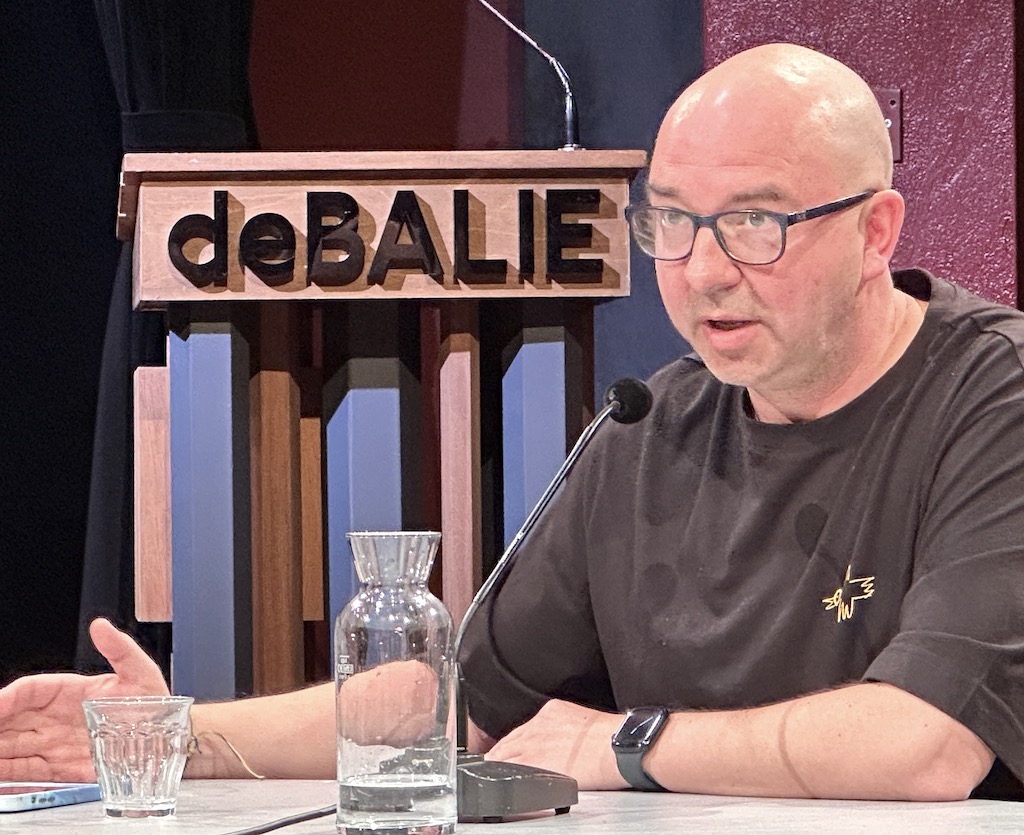
To make sense of that paradox, Yermolenko reached for an artistic metaphor – chiaroscuro. He said he had loved 17th-century Dutch painting for its “play with the darkness and light”. The key, he suggested, had been that “if you start the painting from the dark, it’s probably your only chance to see the real light.” Bohdan, a soldier who had lost his hand on the battlefield, had given him a gift inscribed: “The darker the times, the brighter the people.”
Tragedy, he argued, had often produced culture and renewal: “Renaissance was possible only after the darkness of the 14th century plague… Avant-garde art in Europe was possible after the tragedies of the First World War.” He invoked Baudelaire’s Les Fleurs du mal: out of pain, “you can get flowers, you can get beauty, you can get empathy”.
The long exception of freedom
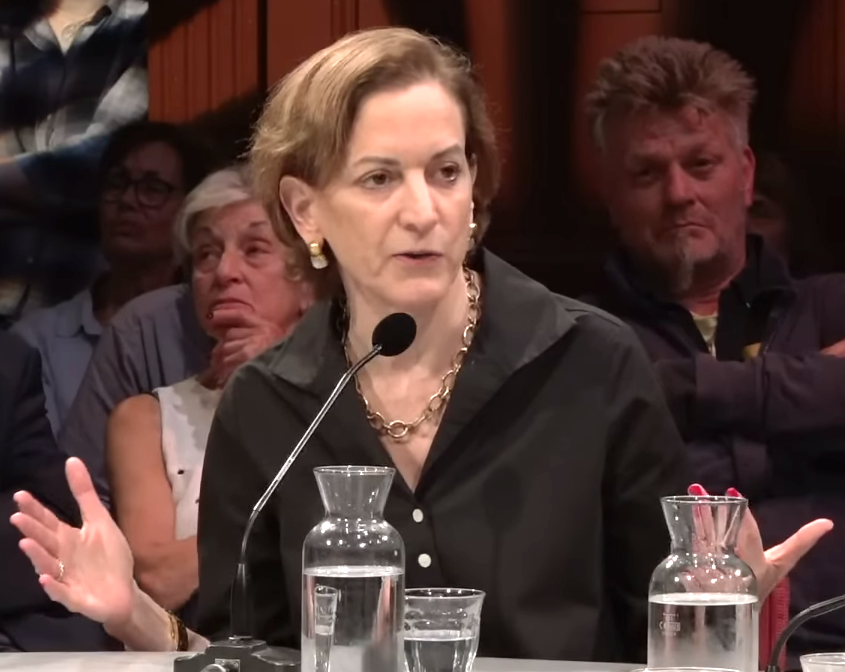
Anne Applebaum jumps in with a blunt historical observation. In Europe and the United States, she said, people had been “very lucky for a long time”: they had lived through “a period of actual incredible prosperity and freedom” – “something pretty unique in world history.” It had not been the norm; it had been the exception.
She reminded the audience that “most of humanity in most of history has been ruled by what we would now call autocrats; kings or warlords or empires.” The West, she suggested, had grown used to the anomaly and had begun to treat it as natural. In doing so, societies had forgotten how many actors had been invested in destroying liberal systems – not because of misunderstanding, but because the language of democracy, rights and rule of law had threatened their survival.
In Autocracy, Inc.: The Dictators Who Want to Run the World (Doubleday, 2024), Applebaum had described a network of dictatorships that had not necessarily shared ideology – “nationalist Russia or communist China or theocratic Iran or Bolivarian socialist Venezuela” – but that had shared an enemy: “rights and rule of law and independent courts, and transparency and accountability.” Those concepts had often been “the language of their own oppositions”, and therefore “the language that was most threatening to them”. The result had been a kind of unity: not friendship, but coordination against a common threat.
Ukraine, Applebaum argued, had been the clearest case. Russian leader Vladimir Putin had not merely been reacting to NATO’s expansion or geopolitics. He had been reacting to the example of democratic uprising close to home. The Orange Revolution and Maidan uprising had shown crowds in Kyiv holding anti-corruption signs and EU flags – a symbol, she said, of “the rule of law and democratic values – even if that symbolism isn’t always as strong within the EU itself.” For Putin, this had been intolerable. If people could take to the streets “in Kyiv”, they might do so “in Moscow too.”
From that perspective, the invasion had not simply been about sovereignty or national identity. It had been intended “to destroy this movement” and to demonstrate something larger: that the liberal world order, and the international rules built after 1945, “doesn’t exist and doesn’t matter”. Putin had been trying to show, she said, that he could invade a sovereign state – despite the UN Charter – “kidnap children, kill civilians”, and defy the laws of war and even the Convention on the prevention of Genocide, and still face no effective restraint. “What Putin was trying to show,” Applebaum said, “was that these laws, this language and these rules don’t work anymore.”
Empire without borders
Yermolenko insisted that the war had not been “a war for territories.” He recalled how, after Russia invaded Georgia in 2008, eastern Europeans had argued it had never really been about Abkhazia or South Ossetia. The same logic, he said, had applied to Ukraine: breaking the idea that empires could cease to exist.
He traced European and American history as a long arc of de-imperialisation – anti-colonial wars, the collapse of empires after 1918. Russia, he said, had been unusual. It had collapsed “several times as an empire”, but had “succeeded in re-establishing itself”, unlike other imperial powers. That survival had fed a mythology: “other empires can collapse, but not the Russian one.”
Putin’s historical imagination, Yermolenko argued, had been shaped by model figures: “Stalin – not Lenin”, plus Peter I and Catherine II. The latter with her “plan to capture the northern Black Sea region”, and Peter I with the control of the Baltic Sea.
He also offered a wider claim about political norms. After 1989, liberals had assumed democracy was normal and autocracy was deviant. Putin had reversed that: “Putin thinks that empires and autocracies are a norm and democracy is a deviation.” Historically, Yermolenko conceded, that view had an uncomfortable plausibility: in sheer duration, autocracy had dominated – a worldview Putin shares with China’s Xi Jinping and Donald Trump.
This mattered because an older liberal formula had been breaking down. The notion that capitalism produced democracy, and democracy produced welfare, had been undermined by China’s authoritarian-capitalist model. In that contest, Yermolenko said, “democracy is somehow losing the fight for hearts and minds.” Reinventing democracy had therefore become urgent – and Ukraine, he believed, had played an outsised role because its citizens had remembered, viscerally, what unfreedom meant – a concept Ukrainians have a word for: nevola.
People knew it not from theory but from occupation. When the Russian army arrived, he said, “the first thing they create is the torture chambers, and they show the population where those chambers are.” The point being to display who holds “the monopoly of violence.” For Yermolenko, this had made Ukraine a frontline not only of geography but of political memory: democracies, as Plato and Aristotle had warned, had been strongest when people still remembered the alternative.
Starvation as policy, culture as target
Albrecht steered the discussion into the historical mechanisms of subjugation. Russia, he said, had attempted to dominate Ukraine through russification – but also through starvation. He asked Applebaum about the Holodomor, the famine of 1932–33, which she had written about in her essay Red Famine: Stalin's War on Ukraine (Penguin Randomhouse, 2017).
Applebaum described how collectivisation – the state takeover of farms – had produced resistance across the Soviet Union. Private farms had remained widespread after the revolution, and peasants had reacted violently when their land and animals were confiscated. In Ukraine Stalin had combined famine with national repression, as the armed resistance to the Bolshevik conquest had been very strong in Ukraine, she explained. In terms of losses, Applebaum cited the “best number” available: “between 3 and 4 million people” who have died.
The famine was followed by a cultural assault. Ukrainian theatres were closed, a dictionary was banned, buildings were destroyed, and even the Ukrainian Communist Party – which had enjoyed limited autonomy – was dismantled. Russians moved into some emptied areas, deepening a long project of russification.
Yermolenko connected this to the present in three ways. First, he pointed out that much of the current fighting had been taking place on “the most fertile lands on Earth.” Starving such land had required extraordinary coercion, because Ukrainian food culture had been rich. Second, peasant culture had been woven into identity – he mentions the embroidery vishivankas, shirts with botanical motifs, crops and plants – and the Holodomor had attacked that “essence”. Third, Ukrainian resistance then, as now, didn’t come from the élite, “but from the deepest layers of society” – contrary to Russia, where he said there had been a gulf between a freedom-seeking elite and a people who did not support it. Collectivisation had targeted “this economic freedom” and aimed “to erase this individuality”.
He also recalled a contemporary echo: In occupied villages in Kharkiv region, locals had told him that Russian forces had encircled villages, stopped shops from functioning, and cut off food for months – tactics that resembled the Holodomor’s methods of isolation and confiscation.
Applebaum added a broader pattern: modern autocracies had inherited the Soviet obsession with destroying anything independent – “independent small businesses, independent organisations, independent institutions.” Many contemporary regimes attempted to do this without mass murder; Putin, she said, had still been “obsessed with making sure that there are no independent organisations, art groups or businesses” outside state control.
Prisons, repetition, and the politics of fear
Albrecht then turned to the history of prisons and camps – the Gulag, occupation playbooks, and the continuity of violence. Applebaum said one of the strangest experiences of her career had been realising that books she had written about “the distant past” had begun to read like guides to the present. In occupied Ukraine, she said, Putin’s forces had repeated “almost exactly the same things” the Soviets had done in Poland and East Germany after 1944.
The mentality, tactics and goals had resembled each other so closely that Applebaum believed the continuity had been literal, not metaphorical. “I actually happen to know that there are KGB playbooks for this,” she said. She had seen them in archives and had had “no doubt” someone in Russia had returned to those records – “certainly when they moved into Crimea in 2014.”
Yermolenko interpreted this repetition as ideology. Russia, he argued, had tried to convince the world that history did not progress and could simply be replayed. He contrasted Russia’s slogan “We can repeat” with Europe’s post-war moral vow: “Never again”.
He then offered one of the conversation’s most disturbing images. A man tortured with electric current in the Kharkiv region had said that, before attaching electrodes, Russian soldiers had told him: “Let’s make a phone call to Putin” – a practice other human-rights defenders had confirmed as systematic. For him, the phrase revealed an attempt to merge individual violence with the figure of the leader – a machinery of domination.
From there he coined a term: “thanatocracy”, rule by death. Under Stalin, he said, the message to society had been: “I own your death.” If the state could claim ownership over death – the most intimate, supposedly natural boundary – it could produce fear “at an industrial scale.” In Putin’s Russia, Yermolenko said, citizens were given a grim freedom: “You are free to choose how to die.” Russians could die at home “as an alcoholic” or die in the army in “meat attacks” – waves of soldiers sent to be killed for minimal gains.
This logic of fear, he argued, explained why dictators were respected when they displayed the capacity for extreme violence – and why Stalin had been mourned. People did not trust him; they feared him, and their remaining sense of safety had depended on him. “It’s about fear, not trust,” Yermolenko said. “Russians don’t trust Putin, they fear him.”
Why Ukraine had broken away
If Russia’s system had relied on fear and centralisation, why had Ukraine been the one major post-Soviet society to “break from the core of what was left of the Russian Empire”? Albrecht posed the question as a puzzle of political culture.
Yermolenko argued that Ukraine’s political tradition had been more decentralised and rooted in what Ukrainians called hromada – community. It carried “some freedom-loving and even anarchic spirit,” which could hinder coherent state-building, but also produced resilience. Russia, he said, had feared Ukraine winning because it might spark a “domino effect” among other subjugated nations within the Russian state – from Tatarstan to Buryatia.
Applebaum agreed that Ukraine’s colonial condition had fostered grassroots organisation. Ukraine had often been organised “almost always against the state”, partly because elites frequently became Russified and integrated into the empire. “To be truly Ukrainian,” she said, “was then to be something different.” This had created traditions of civil society and local leadership.
She cited Ukrainian journalist Natalia Gumenyuk’s reporting from liberated villages in 2022. Russian occupiers, Applebaum said, had been confused to find mayors with legitimate authority because they had been elected and trusted. Russia lacked that tradition of local, elected power; its local leaders tended to be appointed. That difference mattered in war: it shaped who could organise food, medicine and defence.
Applebaum also noted the downsides. Ukraine had often had a weak state since the 1990s because people distrusted the government – a legacy of the colonial rule that had also encouraged corruption. Yet in wartime the same decentralisation had become an asset. Even the army reflected it: units raised their own funds for drones and vehicles, combining a modern military with “some kind of insurrectionist revolutionary army.”
How the war was imagined to end – and how it didn’t
Looking forward, Albrecht asked whether the war would end through a cynical bargain – a “diplomacy of elegance”, as Ukrainian writer Andrei Kurkov had written – leaving occupied territories in exchange for EU membership. Applebaum cautioned against that entire framework. The idea of trading land for peace, she said, had been popular in op-eds and think tank circles, especially after the US presidential election, but it had not been grounded in Russian statements. “There is no evidence of any kind that the Russians would agree to that,” she said. “They have never said ‘if you let us keep Crimea, we’ll leave you alone.’”
Yermolenko’s answer was even more categorical. Russia had already declared five Ukrainian regions part of Russia, including areas it did not control. If Ukraine conceded Crimea, he argued, Russia would simply move to the next demand: “OK, but Odessa Oblast is also ours… Kyiv is Russian.” The problem was not an appetite for specific land; it was an imperial process. Russia, he said, was “an empire that has a center but doesn’t have borders.” Putin had once said Russia’s borders were “nowhere,” Yermolenko recalls.
The philosopher then urged Europeans to take Russian rhetoric literally. When the Kremlin had demanded NATO return to pre-enlargement borders, he believed it had meant it. Russia had sought not just influence but a revived sphere, “under some kind of Warsaw Pact.”
Meanwhile, Yermolenko warned, Europe had not only faced military pressure but political corrosion – a “Russification of the West” through Trumpism, far-right parties and corruption, and through the seductive idea that the empire was “good”. Europe, he said, had found itself in geopolitical solitude as the United States became unreliable. In that context, Europe’s self-image as a continent of dialogue was insufficient. It was built on agora – conversation – but “you have to be able to protect agora; you have to have an agon… the ability to fight.” Ukrainians, he said, had been doing that. Europeans had been joining – but slowly – partly because they still imagined it as distant. “But it’s not,” he said. “It’s a war against Europe.”
Applebaum ended on a different kind of forecast. The war, she argued, would end with political change inside Russia – not necessarily regime change, but a shift in national understanding. “It will end when the Russians themselves understand that the war was a mistake,” she said – when they accepted that recreating the empire would fail.
She compared it to colonial wars that had ended when the imperial power decided it no longer wanted to pay the price: France in Algeria, Britain in India. She could not predict when such a moment would arrive, but she believed that when it did, it would be recognisable – and “this war will be over, and a lot of other things will be also over.”
This article is an edited summary of the conversation held at De Balie on 27 June 2025. It is published in partnership with De Balie.
Watch the recording of the conversation, preceded by a reading by Ukrainian writer Andrei Kurkov:
Do you like our work?
Help multilingual European journalism to thrive, without ads or paywalls. Your one-off or regular support will keep our newsroom independent. Thank you!


