






Select a language
Mark Deuze is a former journalist, professor of Media studies at the University of Amsterdam. He is author of several books, including Life in Media (MIT Press, 2023), Media Life (Polity Press, 2012) Media Work (Polity Press, 2007), and Well-Being and Creative Careers, What Makes You Happy Can Also Make You Sick, (Intellect, 2025).
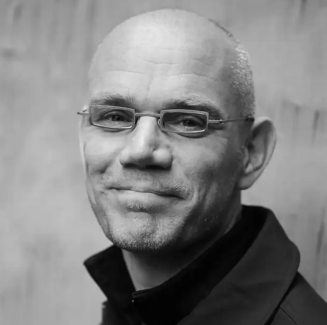
Deuze categorises journalists alongside workers in the creative sector, such as those in film, theatre, music and gaming. He also considers the industry's approach, management and structure to be similar across these sectors.
This article is part of a series examining the precarious nature of journalism and the difficulties and challenges faced by journalists in Europe today. By discussing how and why we work and how the industry operates, we aim to spark a conversation on the state of the profession.
Voxeurop: You wrote “The media industry's more predatory characteristics are not a bug, but a feature of a system bolstered by the passion of its professionals”. Could you please explain this systemic characteristic?
Mark Deuze: The media industry tends to be quite predatory towards its workers. In my book, I start by stating that there is no hierarchy of suffering. It's not a matter of people who clean offices at night, often undocumented, or people who work in agriculture, often without papers. That's an entirely different kind of precarity. You could argue that all economic systems are predatory to some extent.
What makes the creative or media sectors unique is that they exploit people's passions. This includes their bodies, talents, tastes, and competences… What the industry focuses on, what it says it wants and promises to reward, is people's passions, their romantic ideals, and their belief in creativity and storytelling as contributing to society. This is especially true of journalism, which is supposed to be an essential part of a healthy democracy.
Passion is beautiful, but underneath, there is often profound labour exploitation and a lack of professionalisation and clear legal and moral commitments from employers to employees.
According to your research, this is a characteristic of this industry.
Yes, this is nothing new. For example, I found research that examined the personal diaries of American journalists from the late 19th century. They were talking about the same things as film and television workers in Hollywood in the 1950s and rock and pop musicians in the 1980s, and influencers today. In this respect, I don't think things are necessarily worse today.
What is new today?
What is new is that, due to a variety of circumstances, professionals in these kinds of careers are now more likely to speak out, protest, signal and organise collectively, either through traditional means such as unions or non-traditionally, as you are doing by reporting on the issue and telling the story of what it is really like to be a freelance journalist and conduct an investigative report independently, only to be paid a few euros, if you're lucky, for three weeks' work.
This is particularly pertinent in a world that decries disinformation and misinformation yet fails to protect and support journalists. The exploitation and predatory nature of the creative field as a whole, and the media industry in particular, is based on exploiting passion.
‘Precarity also creates opportunities, and these lie in all kinds of collective organisation. This applies not only to journalists’
So, the difference today is that people are speaking up.
The big difference is this unusual combination of pertinent global social movements, such as #MeToo and Black Lives Matter, and the pandemic. This prompted many media companies to cut ties with freelancers and check in on employees, finding that nobody was doing well.
What is also different today is a new generation of workers entering these industries who are more demanding when it comes to social justice and employer care.
I also think that, from the 1980s until the early 2000s, governments, businesses and even workers and unions would talk about how work was the most meaningful aspect of people's lives and a form of self-actualisation.
This was largely because other systems that give meaning to life, such as the family, the church, mosque or synagogue, and team-based sports were in decline. People would traditionally find meaning in family, community or spiritual life, but that disappeared for many.
Instead, the promise was that work would provide such meaning. So you need to choose a career that reflects who you really are, what you love doing, and so on. I think we're now entering a time where people don't believe that anymore, and I think the shared experience of the pandemic has accelerated this.
On top of that, politicians and business leaders may say that I can choose self-actualising work and that I can make it if I work passionately – but I still can't afford a house. The climate crisis isn't getting any better. It's as if there's no return on my “investment”, no reward at the end of the rainbow.
So you have new generations — not just young people — saying, “Wait a minute! If I pour so much of myself into my work and I love it, it should love me back.” To me, that's a very healthy basis for what is beginning to look like a movement.
In my research, I considered the experiences and feelings of journalists together with game developers, filmmakers, music workers, online content creators and advertising creatives because, even though these are vastly different industries and sectors, the people working in them experience the same issues and often choose these careers for the same reasons: to tell stories, to pursue creative freedom, and to be rewarded and respected for it.
However, none of these things materialise for most people, so they have a common cause.
You mean that these people experience the same type of precarity?
Yes. However, I would argue that precarity also creates opportunities, and these lie in all kinds of collective organisation. This applies not only to journalists.
I hope that different organisations – media firms, unions, charities, trade associations – will talk to each other more, come up with a shared narrative, and realise that this issue affects all of them in a similar way, whether they are freelance journalists in Italy, game developers in the Netherlands, or filmmakers in Denmark. Maybe we could connect these initiatives, build together, and take it to policymakers and people who can put pressure on media industries. It's a shared responsibility, too – we can point to industries that need to do better.
What can media professionals do better?
People who choose media careers tend to have one thing in common: they want to tell beautiful, meaningful stories and be autonomous while doing so. That's what journalists want. Creative workers want to create beautiful stories, campaigns and films, and that's great. So when they talk about their work and their passion, they focus on the storytelling.
But all that passion, joy and romantic idealism obscures the fact that it's still just a job. It's work. The thing about work is that it's inherently political. It comes with labour laws, rules about working conditions and employers' duty of care, protections, rights and responsibilities.
And I think that's where the passion trap comes in, as an Italian study, La trappola della passione pointed out in 2012. The passion trap is not "I'm going to be exploited by a bad industry". It's "I'm going to forget that this is just a job". But our job is not who we are. Once you embody the notion that this is what I do, not who I am, while still being romantic – being intrinsically motivated is a beautiful thing – then you can effectively critique it.
But if it's part of who you are, how can you step outside of it and then point out its flaws and problems? That's really difficult – that would feel like betraying yourself. I will say, though, that this is something media professionals do to themselves. Understandably, though – I'm not judging them – us academics do it too, we make the university out to be something much more benign and wonderful than it really is for most.
One of the most shocking things I found in my research, and in the research of many colleagues, is what happens to media professionals – journalists, for example – when they at some point in their career come to realise that they love their job, but their industry doesn't love them back.
‘It’s absolutely beautiful that there are still people who choose a job based on passion, and it‘s something we should protect at all costs, especially in the age of artificial intelligence, robots and machines’
This can happen when you are made redundant due to budget cuts, despite having done great work. It can also happen when your project doesn't get any funding for no apparent (or transparent) reason, or when you experience discrimination or bullying because of your gender, ethnicity, or simply for who you are, rather than because of the good work you do. For many people who experience this, it comes as a kind of “disenchantment”, as a French colleague of mine calls it.
I think it's appropriate to use the term “disenchantment” when work that feels romantic, beautiful and passionate becomes a desillusion. And that's so sad, because we need journalists to believe in the value of their work.
What can we do then, as journalists?
I think a fair question would be how we can prevent people from becoming disenchanted by a career like this. It's important to worry about how much people get paid, of course. However, I believe that a more profound discussion should focus on recognising that people are intrinsically motivated to pursue creative careers for reasons that have nothing to do with earning enough money or having healthcare, despite these being important factors.
It has to do with a kind of enchantment and romantic ideal. We live in an increasingly neoliberal, capitalist and exploitative world that is rather bleak. It's absolutely beautiful that there are still people who choose a job based on passion, and it's something we should protect at all costs, especially in the age of artificial intelligence, robots and machines.
How can we discuss the future of journalism from a perspective of love and care? It may sound naive, but in the book I conclude that an important point to make when discussing solutions is that, in academic work about precarity it is often said that the passion people feel for their work traps them. As I said, it's the “trappola della passione”: the passion is the problem. But I actually have learned that it can be exactly the opposite. Passion is their strength.
The problem is that all that passion is invested solely in the end product, be it the story, the newspaper, the website, the app, the magazine, song, campaign or the film. As long as the end product is good, that's where your passion is focused. But what if we could redirect some of that passion towards creating a better industry for all?
What makes me optimistic is the fact that, for my research, I used research conducted by the industry itself, which it started doing since about the start of this century. Before that, there was hardly any formal documentation on how media professionals worked. It just didn't exist. Now, almost every day, some industry somewhere in the world is launching a new survey or publishing a manifesto about workers' rights for influencers, journalists and so on. I think that's hopeful; it's a start.
Do you like our work?
Help multilingual European journalism to thrive, without ads or paywalls. Your one-off or regular support will keep our newsroom independent. Thank you!