












Select a language
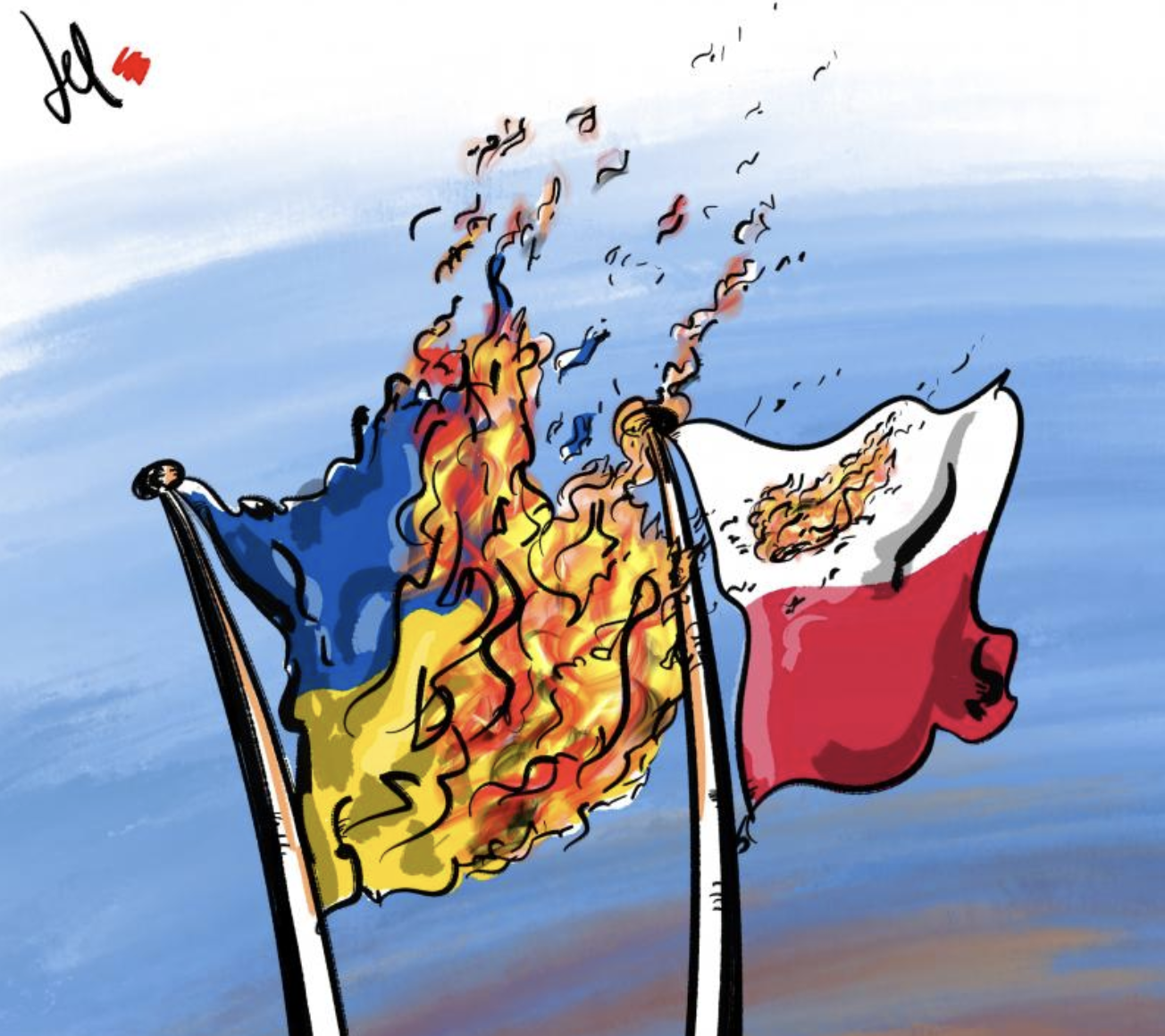
“The topic of Ukrainians’ presence in Poland has become very politically charged,” says Daryna Sydorenko, a senior advisor at the Alliance 24/08 NGO and coordinator for Observatory of Hate – See. Monitor. React., which monitors anti-Ukrainian hate speech, disinformation, and incidents of violence in Poland.
Sydorenko’s project monitors Polish information space, looking for hostile narratives and tracing how they move between anonymous social media accounts, Telegram channels, politicians and mainstream media. Its preliminary monitoring found a connection between the rise of hostile language on Polish-language Telegram and acts of aggression in the real world.
“Over the last two years, on Facebook, TikTok, Telegram, and even already on LinkedIn, we saw a spike in negative comments about Ukrainians,” Sydorenko says.
In the months after Russia launched its full-scale invasion in February 2022, support for receiving Ukrainian refugees was exceptionally high, standing at 94 per cent. By July 2026, 52 per cent of Poles opposed accepting refugees from Ukraine, while 42 per cent still supported it. Opinions differ depending on the issue: refugees, military aid, trade, Ukraine’s EU membership and the country’s future borders all produce different responses.
But the political space around Ukraine has become more contested, often expressed through disagreements over historical memory between two nations.
The Volhynia issue
Poland has a complex relationship with its eastern neighbour, especially over history after the First and Second World Wars. The most contentious subject is the violence in Volhynia, eastern Galicia and Chełm region, where many Ukrainians, Poles and Jews used to live alongside each other.
Ukrainian insurgent forces carried out mass attacks against Polish civilians in 1943-45 that led to the deaths of up to a hundred thousand people. The killings were an organized effort at ethnic cleansing to prevent any Polish sovereignty over Ukrainian-majority areas claimed for a future Ukrainian state. Poles, including elements associated with the Home Army, carried out retaliatory attacks against Ukrainian civilians that resulted in the deaths of up to twenty thousand people. Historians continue to debate the precise number of victims, classifications of genocide, chronology, extent of coordination by different organizations, and the broader political and wartime context.
This tragedy that was once relatively removed from the public space in Poland, has become a major topic in Poland over the last decade. This follows the establishment of the July 11th National Day of Remembrance by parliament in 2016.
For example, in 2008, only 20% of Poles said they knew a lot about the Volhynia massacres, while 41 per cent said they had heard nothing about it. By 2023, 64 per cent said they were well informed and 92 per cent stated they knew about the events.
‘The mentioning of Ukraine and Ukrainians is always accompanied by very strong emotions. For example, anger, aggression and irritation’ – Daryna Sydorenko
That increase in awareness has coincided with a period in which the relationship between the two countries has been both unusually close and contentious. After February 2022, Poland became one of Ukraine’s principal supporters. Close to a million Ukrainian refugees are under temporary protection in Poland, while Polish society has provided extensive assistance. At the same time, disputes over grain imports, agriculture, refugee policy and military support began to enter both Polish and Ukrainian domestic politics.
Poland and Ukraine have resumed cooperation on the search and exhumation of victims of wartime violence. In July 2026, Polish specialists began exhumations at the sites of the former villages of Ostrówki and Wola Ostrowiecka in Volhynia following the approval of Ukrainian authorities.
“Reliable debate always involves mutual listening, taking into account the opinions of both sides and considering new developments,” says Anna Mierzyńska, a Polish journalist and social media analyst who studies disinformation.
The problem, she says, is what happens when descriptions of historical atrocities are repeatedly placed next to negative stories about Ukrainians in today’s Poland. According to Mierzyńska, this historical component has become a part of a broader set of narratives aimed at reducing support for Ukraine.
“One of the demands of [far-right] groups was the exhumation of victims of the Volhynia massacres,” she says, “When the exhumations began, it turned out that they did not matter to them.”
According to the expert, this indicates that even when there are attempts to address historical grievances, the political messaging remains unchanged. She identifies several recurring themes: Ukrainians as a physical threat, the use of the Volhynia killings to make Poles fearful of Ukrainians, and claims that Ukrainians could seek Polish territory after the ongoing Russo-Ukrainian War. Earlier narratives focused more on competition for jobs, healthcare and places in schools and kindergartens.
“Since the full-scale Russian aggression against Ukraine, [these narratives] have been interwoven with current reports about crimes committed by Ukrainian citizens in Poland, with many of these being fake news,” the expert adds.
“The most common narratives are intended to discourage people from helping Ukrainians,” she says. “Ukrainian refugees are blamed for problems that already exist in Poland.” The result, Mierzyńska says, is a particular kind of political message: the violence of the 1940s is presented as proof of how Ukrainians living in Poland behave in the 2020s.
From history to the news feed
The same pattern appears in Sydorenko’s monitoring of Polish-language Telegram channels. “People who see themselves as being outside of the system use it,” she says, “They are looking for alternative information. They are not satisfied with the way news is presented by established, verified media, or they feel that those media outlets do not reflect their views.”
Her team found cases in which Polish media highlighted a suspect’s Ukrainian nationality when it was not relevant to the story. In one case involving counterfeiters, two suspects were Polish, one Ukrainian and one Russian, but only the Ukrainian national was mentioned in the headline.
The historical narratives operate alongside these stories. Sydorenko says her team has monitored claims that a “Banderite school” has been established in western Ukraine and that the ideology of Stepan Bandera – the leader of Ukraine’s nationalist movement during and after the Second World War – is spreading. These messages appear alongside discussions about the Ukrainian Insurgent Army (UPA), the Volhynia massacres and the ongoing exhumations.
She says that “In one verbal attack on Ukrainian teenagers in Poland, the offender also used this language. He called them ‘Banderite children’ and told them to go back to Ukraine.”
‘We cannot build resilience if we act only at the information level‘ – Anna Mierzyńska
In another case, a video showing a Ukrainian receiving a traffic fine was circulated on Telegram. Comments called for the person’s deportation. “The channels tried to create a picture where offences committed by Ukrainians prove a common characteristic,” Sydorenko says. “That they are arrogant, that they break Polish laws and that they abuse Polish hospitality.”
How quickly online hatred spreads to verbal and even physical abuse was evident in Wrocław in July, where a Ukrainian couple was attacked in front of a convenience store for simply speaking Ukrainian.
Sydorenko says the hostility is visible even under stories that have little to do with Ukraine’s government or the war itself.
“The mentioning of Ukraine and Ukrainians is always accompanied by very strong emotions. For example, anger, aggression and irritation.”
Russian disinformation
The role of Russia is important in spreading hatred toward Ukrainians on Polish social media. However, besides the many bots, a lot of the hateful narratives have been picked up by ordinary citizens with no connections to the Kremlin.
“Researchers in Poland observe high activity by pro-Russian circles, Russian accounts and influencers on social media in these areas,” Mierzyńska says. “Very similar anti-Ukrainian content appears in parallel on Russian Telegram channels, sometimes in Russian state media, among pro-Russian activists in Poland and in far-right circles.”
She adds that “It is also known that Russia benefits from the popularization of anti-Ukrainian content. Therefore, it is irrelevant whether the content is disseminated by Russian actors themselves, or whether they merely inspire specific groups in Poland, or perhaps – this should also be taken into account – some groups are simply paid to disseminate it. What matters is the effect.”
Sydorenko describes a similar movement between platforms and political actors. She says some narratives begin in anonymous channels, are picked up by influencers or political figures and later appear in mainstream media. Even credible outlets can also strengthen a narrative without deliberately endorsing it, particularly through flashy headlines. “It is very important for journalists to monitor not only the Russian propaganda space, but also to make sure that they themselves do not become amplifiers of these thoughts, moods and frameworks”, she adds.
For Mierzyńska, fact-checking alone will not solve the problem because the hate and fake news campaigns operate through repeated emotional exposure. “We cannot build resilience if we act only at the information level,” she says. “It is necessary to take care of good relations between Poles and Ukrainians. Integration, getting to know each other, and building trust are necessary.”
For Poland and Ukraine, the historical dispute is not going away. The Volhynia massacres remains a central part of Polish memory, and the search for all victims and their identification should continue – together with Ukrainian partners.
👉 Original and full version on New Eastern Europe.
🤝 This article was produced as part of the PULSE Thematic Networks.
🗣️ Have a question, comment or suggestion? Share it with us through the PULSE reader form – we read and reply to every message. Be part of Europe’s conversation. Your experiences and ideas can inspire the next stories we tell. Join the PULSE readers’ community by filling in this short form.
Do you like our work?
Help multilingual European journalism to thrive, without ads or paywalls. Your one-off or regular support will keep our newsroom independent. Thank you!


