














Select a language
In Sofia, DEN’s budget is renewed every time a grant arrives. Founded in 2023, the Bulgarian media outlet reports on issues such as domestic violence, access to water, and social inequalities – issues that the local outlets tend to ignore – through podcasts and long-form reporting. DEN's initial budget is €20,000, which comes from European programmes, Open Society grants, and German and Bulgarian private funds. The team is tiny, and there are no salaries. The two founders work full-time for €600–650 per month (the average gross salary in Bulgaria is around €1,300 per month) and supplement their income with other activities.
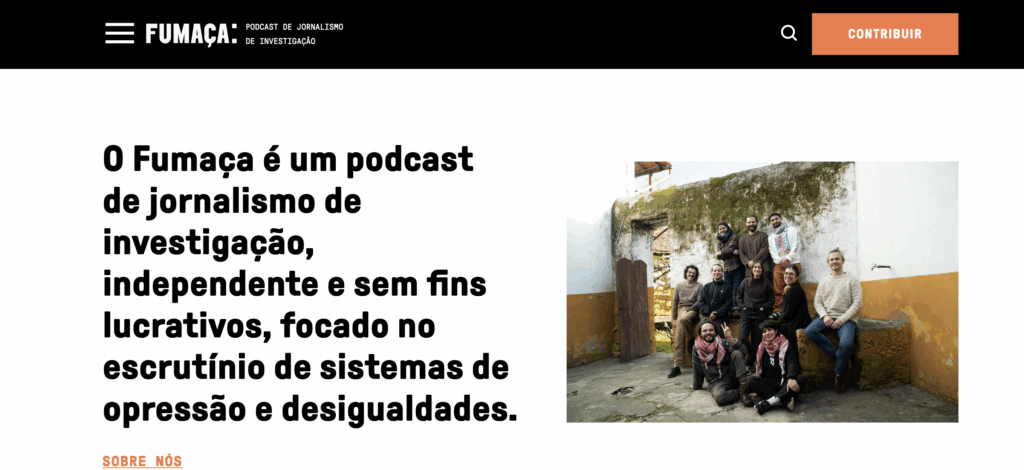
In Lisbon, Fumaça seems to rest on firmer ground. Founded in 2016 by a group of volunteers, it became a professional media outlet in 2018 thanks to the Open Society Foundations. Today, 11 people work there, primarily producing audio reports inspired by the work of Democracy Now!. Sixty percent of Fumaça’s budget comes from European foundations, and 40% comes from individual supporters. There are no adverts, no paywalls, and no deadlines. Stories are only published when they are ready. But the typical tension remains: financial pressure is constant.
Based in Rome and Milan, IRPI Media is an investigative news outlet founded in 2020 by a group of freelancers who have been active since 2012. Their investigations cover issues such as corruption, organised crime, and the environment. Though the community donates, such donations count for little. European foundations and journalism grants cover almost the entire budget. For IRPI Media’s director Lorenzo Bagnoli, the diagnosis is all too clear: “As long as 80-90% of our support comes from non-profit organisations, we will always be precarious.”
Where will the funds come from tomorrow?
While grants help, ultimately they’re a vicious circle. Funding bodies never interfere with individual stories, but each grant has a theme: the environment, migration, artificial intelligence... The result: newsrooms end up chasing philanthropic trends. So the inevitable question arises: where has independence gone?
The problem is exacerbated by growing competition. “In 2015 there was less money, but also fewer competitors,” explains Bagnoli. “Now, even major organisations like OCCRP are participating in calls for proposals that used to be left for smaller media outlets like us.” And then there are the cuts.
Open Society and other foundations have reduced their investments in journalism, and “many have decided that it’s no longer a priority. Everything has become more complicated.” The risk of “grant chasing” looms large: building projects with the aim of winning tenders, rather than responding to real journalistic needs.
Paul Salvanès, CEO of Voxeurop, shares these concerns. “While it is regrettable that so-called structural funding is almost non-existent, European funding, grants, or subsidies can represent a genuine opportunity” – for those like Voxeurop, with no advertising or private publishers supporting their operations. However, the long-term unreliability of funding can lead to “economic uncertainty in newsrooms” and produce a snowball effect. “Media outlets like ours are encouraged to professionalise the work of ‘grant chasing' and invest their resources and time, to the detriment of their editorial output and the monetisation of their audience, which is the Holy Grail, but takes a long time.”
Where public funds make a difference: the Netherlands and France
The situation is not so precarious in other parts of the continent. Some countries have made structural choices that radically change the state of play.
In the Netherlands, the government directly funds journalism as an investment in democracy, not as political aid. The Fonds Bijzondere Journalistieke Projecten (BJP) provides grants that cover not only travel and documentation expenses, but also – and this is crucial – the journalist’s working hours. The Fonds BJP is now a foundation supported by the Ministry of Culture.
“The intention is to be aware of the important role that journalism plays in democracy, in informing citizens, in making the choices they have to make,” explains Joëlle Terburg of the BJP. “We want to democratise the field of journalism, to prevent long and demanding projects from remaining the preserve of the elite who can afford to devote themselves to them. If that were the case, we would lose many valuable voices and many points of view.”
This model is completely independent of the government. Projects are selected by a group of about 40 journalists with different backgrounds. The criteria are relevance, urgency, and journalistic method. “We don’t fund breaking news, but investigations that require time and money.”
In France, the Fonds pour une presse libre (Free Press Fund, FPL) represents another approach. The FPL is the first press fund dedicated to independent journalism, created by the founders of the independent media outlet Mediapart, but strictly separate, and recognised as a public interest entity. The FPL relies exclusively on private donations: about 80% of its income is from individual donors, and the rest comes from European foundations such as Fondation Civitates and Fondation Charles Léopold Mayer.

Over 10,000 donors support the fund, which awards grants to projects that demonstrate independence, journalistic integrity, and fair working conditions. The FPL explicitly refuses to support organisations for which journalists work precariously. For larger projects, the fund refuses to be the sole source of funding, in order to avoid dependence. Applicants are required to guarantee at least 25% of their project’s funding independently.
In addition to financial support, the FPL offers training courses and digital security workshops for journalists working on sensitive investigations. Several media outlets that have been supported by the FPL have more than tripled their monthly donor base since 2025.
Germany: cooperatives, philanthropy, and physical hubs
Germany offers a third model, and perhaps the most mature. The TAZ Panter Stiftung, affiliated with the left-wing daily newspaper Tageszeitung, demonstrates that sustainability is possible when a deep-rooted culture of giving is combined with a cooperative structure.
Between 2008 and 2024, the foundation raised €9.2million: 7 million from donations (about 80 percent) and €2.2 million from private and German state foundations. “It is quite unique that around 80 percent of our income still comes from private donors, who are not large donors individually,” explains Gemma Terés Arilla, head of the foundation. “The largest donation I have seen so far was around €20,000. Large private donors donate an average of around €1,000 per year. And then there are many who donate between €20 and €100 per donation.”
The TAZ newspaper itself is based on a cooperative model. Over 25,000 people have purchased shares that generate no interest or financial returns. Each member has one vote, regardless of the number of shares they hold. The aim is to safeguard editorial independence through widely distributed community support. Sixty percent of the foundation’s donors are also members of the cooperative, creating a virtuous circle of participation. “People donate because they still believe that a better world is possible,” reflects Terés Arilla. “It may sound idealistic, but that’s how the idea for TAZ was born.”
A similar model has been adopted by Voxeurop in France. “In 2017, Voxeurop chose to become a journalistic cooperative. This allows our readers to become members (by purchasing shares in the cooperative) alongside the cooperative’s journalists and translators,” explains Paul Salvanès. This solution, he adds, “also allows us to stabilise our economic model and make it less dependent on other sources of funding. Today, we have almost 250 members, in over 30 countries, all of whom hold the cooperative’s capital. This model is the basis of our journalism’s independence.”
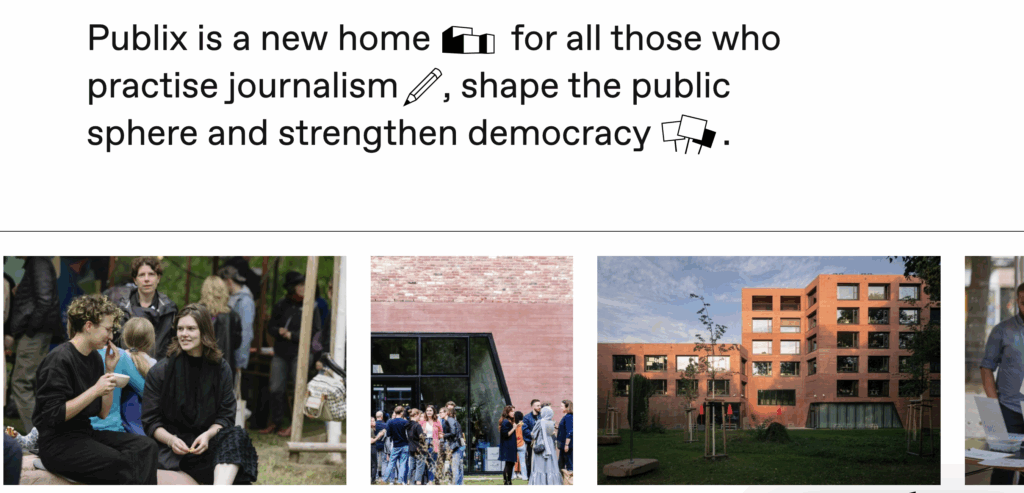
Another German innovation is Publix, a Berlin hub inaugurated in 2024. The Schöpflin Foundation invested €25 million in the construction of the building, which houses freelance journalists, independent editorial offices such as Correctiv, and the German office of Reporters Without Borders. There are currently around 450 people actively using the premises.
Revenue comes from monthly rents, the popular café, ticket sales for events, and studio and room rentals. Additionally, there is €200,000 in public funding for a technology journalism fellowship. “Publix’s economic sustainability model is designed with a very high level of self-financing,” says director Maria Exner. But caution is required here too. “The financing of our numerous activities cannot be taken for granted. We are constantly seeking additional support from philanthropic and corporate partners.”
In France, a similar hub model, the Maison des Médias Libres, was set to be established in Paris. Conceived as a place where independent media could benefit from below-market rents, share resources and spaces, and collaborate, the hub is now at risk due to allegations of sexist and sexual violence against the project’s main financier (€15 million of the total), former industrialist Olivier Legrain.
The voice of Europe: record grants, but freelance trouble remains
At the European level, Journalismfund Europe is playing an increasingly central role. In 2025, it disbursed a record €5.26 million – 40% more than in 2024– and applications have increased by 104%. In 2026, the cross-border grants programme alone is worth €1.12 million€. Despite all this, director Ides Debruyne still has a serious concern: the fact that many media outlets do not pay freelancers, even when they obtain grants for their investigations. The vicious circle is obvious.
Grants cover research costs, but not editing and production. Media outlets believe they should not have to pay for something that is already partially funded. According to Debruyne, this is unethical and, in many countries, also illegal. “No business would say ‘give it to me for free, because I know that most of the costs have already been paid by others.’”
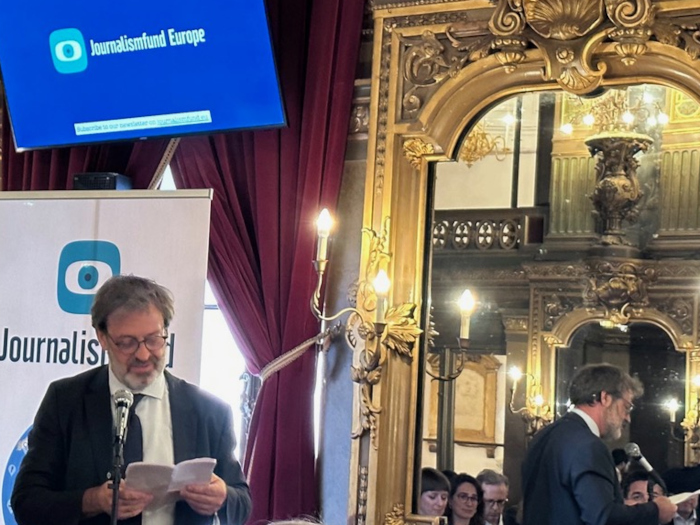
While the solution obviously involves journalists defending their rights and establishing clear agreements with media outlets from the outset, there is also more: radical collaboration through shared platforms, local capacity-building, genuine cross-border networks – not just transitory two-year projects. “Small local media outlets can learn from each other in these capacity-building spaces,” Debruyne explains, in reference to JournalismFund’s PM4D project.
Cultural change, above all, is what the situation demands. “We need to show the public that independent journalism is good for them, that it brings people together, improves debate, and strengthens democracy. This message is not shared often enough.”
Re-educating the public: journalism is not free
The topic of reader relations comes up in all of our conversations. While in some European countries – especially in the north – the idea that quality news comes at a price has established a foothold, elsewhere this awareness is either absent or still developing.
There is also the problem of fragmentation. With the proliferation of newsletters, independent media outlets, and membership campaigns, the public is overwhelmed with requests. There is no single point of access for “supporting independent journalism.”
Ides Debruyne of JournalismFund shares this concern. “In many countries, it is simply impossible to keep an independent journalism platform alive through advertising or subscriptions. Some language areas are too small for this to be sustainable. The market does not solve everything. We will therefore continue to need funding from governments and other organisations. The question is: how can we organise and stimulate such funding?”
The interrupted experiment: Taktak and the fragility of European projects
Not all experiments in this domain are successful. Taktak is a prime example. The project, funded for two years by the European Commission, was born out of a concrete need: to create a tool that would allow readers to donate directly to freelance journalists, not just to the outlets that publish their stories.
Irene Caselli, who participated in the project coordinated by Worldcrunch, explains its genesis. “It was born from the idea of creating a slightly more flexible structure, whereby a freelance journalist writes a story for a major newspaper and perhaps readers appreciate it but have no way of giving something back to the journalist.” The goal was clear: to create a financial incentive for freelancers, via a donation that would always be seen as an extra.
The project comprised eight partners and produced genuine results: a detailed report on European freelancers, two academic white papers, and a functioning platform with a donation button.
But when European funding ended, and the request for renewal was rejected, everything was cut short. In the meantime, Worldcrunch closed after 15 years of activity. The fragility of the two-year grant-project model became clear: value is created, operations are set in motion; but in the absence of any bridge toward autonomous sustainability, everything grinds to a halt.
Irene Caselli reflects on the experience: “it’s obvious that this project could never have been ready in two years. But then the Commission’s priorities change, there is no interest in renewing support, and there are very few other places you can go to ask for money. You become terribly dependent on these grants.”
“In a context where funding is shrinking and competition is increasingly fierce, funds like these, which should be the icing on the cake of a media outlet’s economic model, risk becoming the cake itself, creating a dependency that is not editorial, but economic,” adds Salvanès.
The challenge is twofold: firstly, to re-educate the European public to see independent journalism as an essential service, rather than a free commodity; and secondly, to push for more independent public structural funds, accompanied by genuine cross-border collaboration, not two-year projects that expire and leave a void.
Until this happens, the balancing act continues: precarious, unstable, partial, but necessary.
*Voxeurop received funding from the FPL for the implementation of a website feature.
🤝This story was produced within the PULSE project, a European initiative supporting cross-border journalistic collaborations led by OBCT, together with n-ost and Voxeurop. All material and angles for this article were discussed and developed collaboratively.
Interviews with DEN, Fumaça, and FPL were conducted by Hugo dos Santos, and interviews withTAZ and Publix were conducted by Heloisa Traiano. Different versions of this article are published on Alternatives Economiques (France), StartupBusiness (Italy), and Reset Network.
O
Do you like our work?
Help multilingual European journalism to thrive, without ads or paywalls. Your one-off or regular support will keep our newsroom independent. Thank you!


