









Select a language
The war on drugs has failed. There is nothing new in the claim, even if European leaders are taking a lot of time to acknowledge it. Indeed, it is the widely shared consensus among drug-policy experts. Never have illicit drugs been so widely available and used by so many people in the world, despite more than four decades of prohibition and often harsh prison sentences.
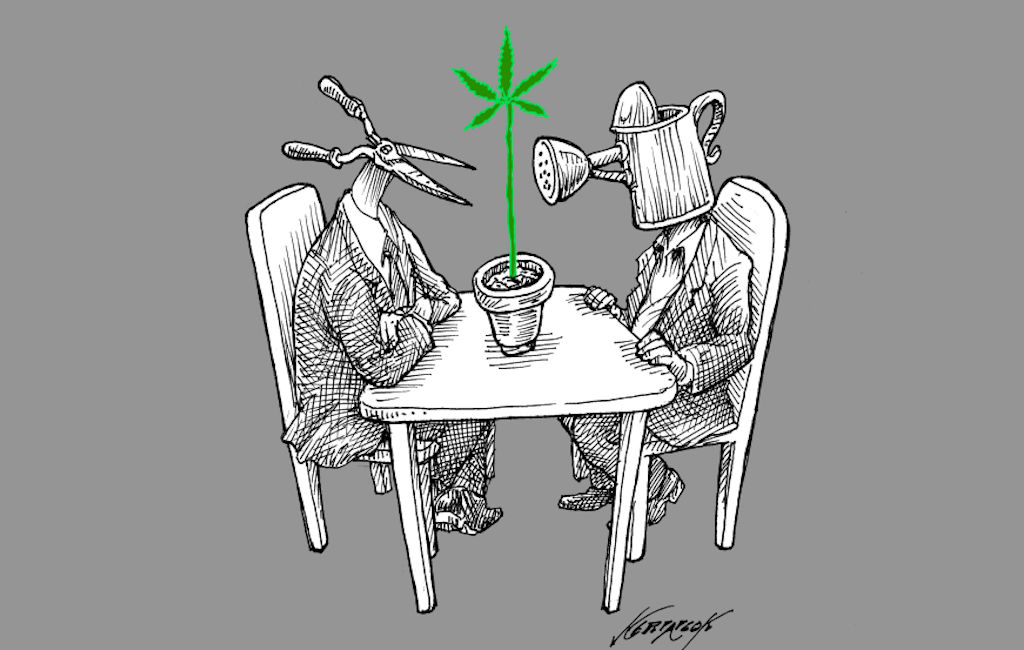
A growing number of Europe’s governments are reconsidering their treatment of cannabis. To the point that the European Union's “national competence” argument and its approach of turning a blind eye to cannabis decriminalisation is beginning to look short-sighted.
Voxeurop has looked at the legalisation of weed in the EU's largest member state, Germany – with its location at the heart of Europe, its population of 85 million, and its 4 million cannabis consumers last year. How will Germany’s initiative affect the approach of other governments and the EU?
Control it, tax it, ban advertising, make harm-reduction services widely available, stop stigmatising consumption, and ensure packaging and access are safe and only available to adults – across the world, these are the cornerstones of all recent evidence-based government attempts to regulate recreational cannabis.
For years, the EU institutions have looked the other way or pretended not to hear when asked about cannabis legalisation. In 2011, the author asked Viviane Reding, then EU Commissioner for Justice and Home Affairs, about the EU's attitude to the US states that were pioneering legalisation and regulation of cannabis. As always, she replied that it was not an EU competence, it was a health issue, and so on.
However, since then a lot of water has passed down the Rhine. Following an election promise to legalise by Germany’s liberal-left-green coalition, the Berlin government started to rev the motor this year, if only slowly. First came a number of expert hearings, announced by Germany’s Commissioner for Addiction and Drug Issues, Burkhard Blienert. Then, in late October a draft proposal – “Eckpunktepapier” – was published, detailing a plan for a recreational-cannabis market. It will be followed by a bill in the Bundestag in the first half of 2023.
Last year the Netherlands was frustrated in its attempt to solve the problem of wholesale cannabis – dubbed the "backdoor problem" – by the prospect of triggering an EU-law infringement procedure. Unperturbed, Berlin is planning to keep the European Commission on side. According to the Eckpunktepapier, Plan A is to obtain the approval of the EU institutions.
In the proposal, presented by German health minister Karl Lauterbach, the idea is to bypass the legal hurdles of the UN drug-control conventions and EU law by simply issuing an "interpretative declaration". However, according to a legal analysis published by the Transnational Institute (TNI) in September 2022, the Germans are choosing a delicate path, and not one of the three or four viable methods identified around the world. According to the TNI, countries such as Uruguay, Malta, Canada, Mexico and most recently Colombia have opted for better solutions.
Legal options for Germany:
A legal report by the medical-cannabis company Cansativa sees four different paths for Germany:
- As Uruguay and Canada did, simply ignore international agreements regarding cannabis.
- Germany withdraws from the UN treaties and reapplies for accession subject to reservations. This would significantly slow down the legalisation process.
- Germany tries to amend the UN conventions. A difficult challenge, given the widely divergent approaches by signatory countries of the drug treaties.
- Germany activates the “inter se modification" of the treaties, based on the Vienna Convention on the Law of Treaties, which provides a safety valve. Two or more signee states act together to modify a treaty without incurring a breach of its provisions.
This is important, because all three UN drug conventions contain provisions on cannabis. The 1961 Convention names the cannabis flower and resin, the 1971 Convention mentions THC, the psychoactive compound in cannabis, while the 1988 Convention contains provisions on the cultivation and eradication of cannabis.
According to the German proposal, the aforementioned plan A is to submit the "interpretative declaration" to the European Commission in the hope of getting a green light. But if this "interpretative solution" does not pass – which most cannabis law experts are betting on given the lack of legal basis – the Berlin government has added a vague option B to its preparatory document. Namely, that the proposed legislation "be accompanied by a German plea for certain amendments/updates at the level of EU and international law".
Martin Jelsma, author of the paper “Cannabis Regulation vs international and EU law: Legal tensions and compliance options”, warns in his analysis that beyond the three UN conventions, there are three potential conflicts related to EU law lying in wait for the German cannabis-regulation plan.
First, there is the question of whether obstacles arise from the Schengen Acquis and the opening of borders within the Schengen area. More specifically, how to deal with the 1990 "Convention Implementing the Schengen Agreement of 14 June 1985", which, in one of its chapters, calls for "adopting, in accordance with the existing United Nations Conventions, all necessary measures to prevent and punish illicit trafficking".
Second, a specific provision of a 2004 EU decision on harmonising penalties for drug trafficking requires EU countries to ensure that the sale of drugs is "punishable by effective, proportionate and dissuasive criminal penalties".
Finally there is the issue of how to connect the legal dots between the UN conventions and the EU’s laws.
Key points of the German plan:
- Adults over 18 may purchase and possess up to 30g of cannabis for recreational use.
- Privately growing up to 3 plants at home will be legal.
- Public consumption will be allowed.
- Only officially licenced growers may sell weed in the country – i.e., effective state control.
- No decision yet on edible cannabis products such as space cakes and sweets.
- An upper THC limit for 18-23 year-olds is considered likely.
- Advertising of cannabis products to be banned.
- Packaging of cannabis products would follow the logic of tobacco products, with neutral outer packaging.
- Sales will likely take place in licenced stores like pharmacies – though this idea is strongly opposed by the association of German pharmacists
The Eckpunktepapier also refers to a 1994 ruling of the German Constitutional Court and an earlier interpretative declaration from 1993, when the Third UN Convention of 1988 was ratified. These texts provide a legal basis for decriminalising possession, cultivation and purchase for personal use. But they do not offer a sufficient basis for state-controlled sale, regulation, taxation and wholesale distribution. Also in domestic law, Germany needs to amend its own narcotics law (known as BtMG) to get rid of references to cannabis.
Tom Blickman, head of the drugs and democracy programme at the TNI, tells Voxeurop that he expects the European Commission to remain circumspect. As is its habit, the Commission will ask for more details before providing guidance, Blickman believes. He warns that some "less liberal governments" in the EU could use this opportunity to push back the progressive German proposal in the European Council.
In terms of possible sanctions, the German government risks a confrontation with the International Narcotics Control Board (INCB) for non-compliance with the UN drug conventions. This organisation is mandated to take legal action over the treaties. Although there is the theoretical possibility of sanctions for persistent non-compliance – such as an embargo on international trade in controlled drugs with the offending country – they have never been adopted by the INCB, and the TNI believes they are highly unlikely to be activated.
Neither, in the history of the United Nations, have the drug conventions been brought before the International Court of Justice (ICJ).
This lack of international repercussions should come as no surprise, given that more than half the US population currently lives in a state where recreational use of cannabis is legal, and that Canada made weed fully legal in 2018.
Finally, for the sake of completeness, Germany would also – theoretically – face EU infringement proceedings if it proceeded with legalisation without EU approval.
Voxeurop sent its questions to the European Commission. There was an unusually long 8 days’ wait for a response, which shows the sensitivity of the subject. The official told Voxeurop that – despite the German government's claim in a recent tweet – the European Commission "has not yet received the official request for consultation from Germany", and is therefore not yet in a position to comment on the project.
However, the official pointed out that existing EU legislation provides for minimum criminal penalties for trafficking in illegal drugs and prohibits the cultivation of cannabis. Indeed, "in the EU, it is permitted to grow cannabis plants with a maximum tetrahydrocannabinol (THC) content of 0.2% – a regulation enshrined in the EU's Common Agricultural Policy.
However, member states can go beyond this and regulate cultivation according to their assessment of this exception. EU legislation is clear on the obligation of governments to "take the necessary measures to ensure that crimes related to drug trafficking, including cannabis, are punishable". But European legislation does not cover the personal use of drugs. It is therefore up to member states to decide how to address the issue of personal use of drugs, including cannabis, said the EU Commission official.
So while the Berlin government can simply choose to ignore UN treaties, presumably with no hard consequences, it will be more difficult to comply with EU legislation. If non-compliance is cited in an infringement procedure, the Germans could face heavy financial penalties.
Ultimately, an EU policy on regulated cannabis is more a question of when than if. This is especially true if it takes seriously all the expert advice published in recent years on harm reduction and human rights advice – some of it by EU bodies. This underscores the case for controlled, taxed and regulated pot markets, which would protect Europe’s young people and the health of all its citizens.
Quick European Cannabis Overview
Across Europe, a growing number of countries are moving forward with attempts to legalise or regulate.
Malta was the most recent country to legalise the sale and consumption of cannabis, while the Czech Republic is moving towards full regulation and legalisation.
The Luxembourg government, under pressure from France, has abandoned its promised opening of a legal cannabis shop and is now waiting to see what Germany does. Ironically, the Berlin government is also interested in Luxembourg, which this year announced a new legal approach to cannabis with a minimal risk of breaking EU laws. The proposal that has yet to be adopted by its national parliament.
Although not an EU member, Switzerland is in the process of legalising recreational cannabis in two of its cantons.
Austria abolished all fines related to the use and private possession of cannabis two years ago.
Italy and Croatia have both recently failed in their attempts to pass legalisation bills.
In Spain more than 500 legal cannabis social clubs offer millions of consumers semi-legal access to weed.
Finally, the Netherlands, widely associated with the legalisation of pot, only regulates the consumption of cannabis and, at least in law, still prohibits the cultivation and sale of pot at coffee shops.
Do you like our work?
Help multilingual European journalism to thrive, without ads or paywalls. Your one-off or regular support will keep our newsroom independent. Thank you!