













Select a language
Shëngjin (Albania) – As Nizam sped toward Italy on a crowded migrant boat, he filmed what he believed was the final stretch of his harrowing journey. The 21-year-old house painter from Bangladesh held up his phone, framing his face before panning to the roughly 50 others packed onto the white fiberglass vessel. Behind him, a man covered his eyes with his hands, seemingly in tears, while another passenger, smiling, patted him on the back. The boat’s stern sat low as it cut through the twinkling Mediterranean.
Later, Nizam* posted the clip on TikTok, providing an account of his ill-fated crossing. "Let's go, our time has come. Don't worry, we'll be back together," says a voiceover in Urdu.
But days later, instead of stepping onto Italian soil to chase the future he had long imagined, Nizam found himself behind the fences of Italy’s controversial migrant camps in Albania – facilities embroiled in legal battles since their controversial launch in the autumn 2024. Back home in a small village in Bangladesh’s Madaripur district, Nizam’s parents anxiously awaited news.
His mother and one of his three sisters had taught him to read, but instead of going to school, Nizam worked to support the family. On social media, he crafted a playboy image, posting videos of himself perched on borrowed superbikes, sunglasses on, a stylishly cropped flop of hair completing the look. But his reality was far from glamorous. With his elderly father unable to work, Nizam was the only breadwinner in the family. “Our family is very poor,” he later said. “I have to work.”
Desperate, his parents scraped together money to pay a trafficker well known in the village. They sold a small piece of land and plunged into debt. Smuggled first to India, then Sri Lanka, Kuwait and Egypt, Nizam eventually arrived in Libya – first Benghazi, then Tripoli – where he fell into the clutches of the mafia. They seized his passport and imprisoned him for three days, torturing him while filming the abuse. The videos were sent to his family as ransom demands.
Nizam was released after his parents paid part of the ransom. "One night, they took me to a beach and forced me onto a boat," he recalled. The boat set off for Italy from the Libyan port of Zuara.
Nizam was unable to swim, and the vessel was so overcrowded he was certain he would die. Yet as the boat approached Lampedusa's coastline, he clung to the hope that the worst was behind him.
His journey took an unexpected turn. More than 300 migrants who departed from Libyan ports in late January were intercepted by Italian authorities. Nizam was among them. He was transferred to a naval vessel stationed 20 miles off Lampedusa and screened for health conditions, age and nationality.
Forty-nine, including Nizam, were told they would be sent to migrant camps in Albania. A group of Egyptian migrants reportedly went on a hunger strike.
“It was a moment of desolation, very emotionally taxing,” said Cipriana Contu, a lawyer who later spoke with one of the Egyptian migrants. “He said when they learned they would be sent to Albania, they went on hunger strike, and some burst into tears.”
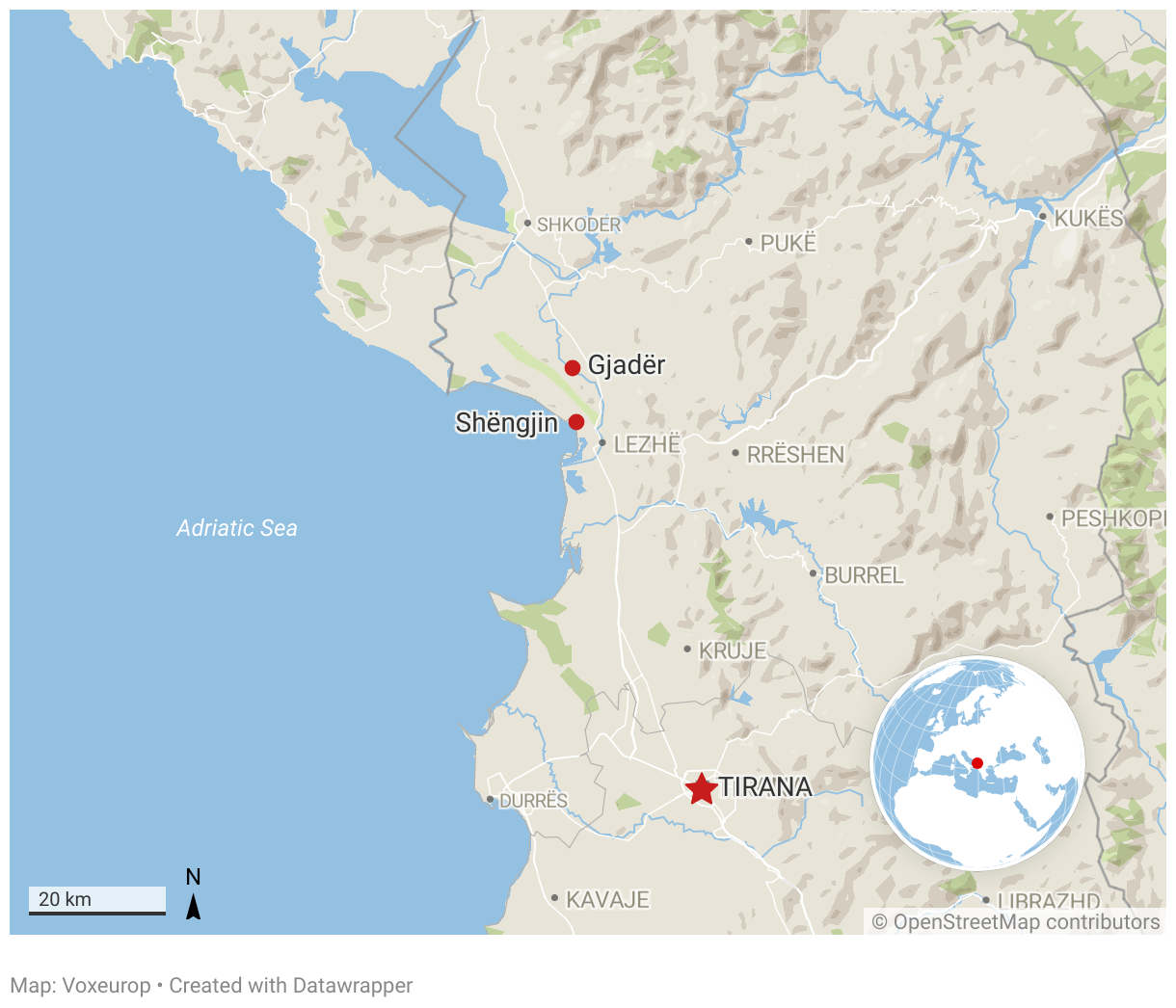
A week of uncertainty followed, as exhausted migrants were shuttled between two centres in Albania – in the port town of Shëngjin and Gjadër, 20km away – while they completed paperwork and underwent health checks, interviews and court hearings. Six, later discovered to be minors or vulnerable, were relocated to Italy. The remaining 43, Nizam included, filed asylum requests, which were swiftly rejected, clearing the way for their deportation.
Before that could happen, however, an Italian court intervened, ruling – not for the first time – that the migrants could not be legally held in Albania. Together with the other migrants, Nizam has since been transported to a reception centre in Bari, Italy, where he awaits the outcomes of his asylum appeal.
The right wing Italian prime minister Giorgia Meloni’s fast-track asylum scheme in Albania has been hailed by EU leaders as a model to curb illegal migration but criticised by opponents as inhumane. “It is a propaganda experiment predicated on making people suffer,” said Rachele Scarpa, a MP for Italy’s opposition Democratic Party. “Unfortunate people’s essential rights are being reduced to a minimum.”
Silvia Calderoni, a lawyer representing Nizam and three other migrants transferred to the camps with him, declined interview requests, stating that her four clients needed psychological support before speaking publicly. Court documents and interview minutes obtained by Voxeurop and the Balkan Investigative Reporting Network (BIRN) reveal the toll of the ordeal.
The voyage
Unveiled by Meloni and her Albanian counterpart Edi Rama in 2023, the offshore processing scheme foresees the incarceration of adult males from so-called safe countries and a fast-track 28-day asylum process before probable repatriation. Only those picked up in international waters without ID can be transferred to Albania. Italy initially budgeted €653m for the scheme over five years but expenses have already soared. Meloni originally projected 36,000 migrants per year.
She has won praise from the European Union with Ursula von der Leyen, the EU Commission president who has championed proposals for repatriation hubs outside the bloc, urging heads of state in October to draw “lessons from the Italy-Albania protocol”. The UK’s centre-left prime minister Keir Starmer, who declared plans to deport migrants to Rwanda "dead and buried", visited Meloni in September to learn from the initiative.
While Italy’s migrant centers in Albania remain under Italian jurisdiction, on 11 March the European Commission opened the door for EU member states to establish repatriation centers outside the bloc. The proposed regulation, introduced following pressure from anti-migration governments, will replace the 2008 Return Directive to allow “return hubs” in third countries provided they uphold “international human rights standards and principles,” according to a draft of the document.
The proposed hubs would be for failed asylum seekers alone. This differs from the Italy-Albania deal, which foresees the offshore processing of asylum requests.
However, Meloni’s efforts have stalled due to legal challenges by Italian courts linked with a 4 October ruling by the Court of Justice of the European Union (CJEU) that a “safe” designation must apply to a country’s entire territory.
On 24 January, the Italian military vessel Cassiopea took position as migrant departures from Libya surged during favorable weather. The Italian coastguard and finance police intercepted eight boats approaching Lampedusa, transferring many of those on board to the Cassiopea. The migrants were screened on board for those eligible for transfer to Albania.

Fifty-three migrants produced IDs and were taken to Italy for regular asylum processing, according to an interior ministry note. A further 49 – including 41 from Bangladesh, six from Egypt, one from Ivory Coast, and one from Gambia – were sent to Albania. Pre-screening was conducted by USMAF, the government office responsible for detecting infectious diseases on ships. Officials of the United Nations High Commissioner for Refugees (UNHCR) officials monitored the operation, though the International Organisation for Migration (IOM), which was also present in previous missions, was absent as their contract had expired.
Nizam was not the only one from Madaripur. Malik*, 27, had once been a university student, but after his father's death, worked on farms to support his mother, who couldn’t afford the medicine she needed for her diabetes. Rohan*, 22, had set out to provide a better life for his wife and unborn daughter, but his journey took a dark turn in Libya. Arrested by police and sold to the mafia, he spent two years in prison, where he endured beatings and suffered a fractured shoulder.
"I never studied, but my daughter must study,” he said during an interview with Italian officials in Albania, according to the minutes.
Confusion about their destination reportedly led to chaos. During an inspection of the Albanian camps by opposition MPs, legal experts and psychologists, an Egyptian migrant recounted that he and his compatriots had refused to eat on the boat. “They didn’t know they were going to Albania,” concluded Contu, who participated in the inspection. “They were exhausted and incredulous,” added Papia Aktar, a Bangladesh-born interpreter and legal advisor also present.
An interior ministry official with knowledge of the operation could not confirm the incident. “We have had no indication of refusal of food,” she said.
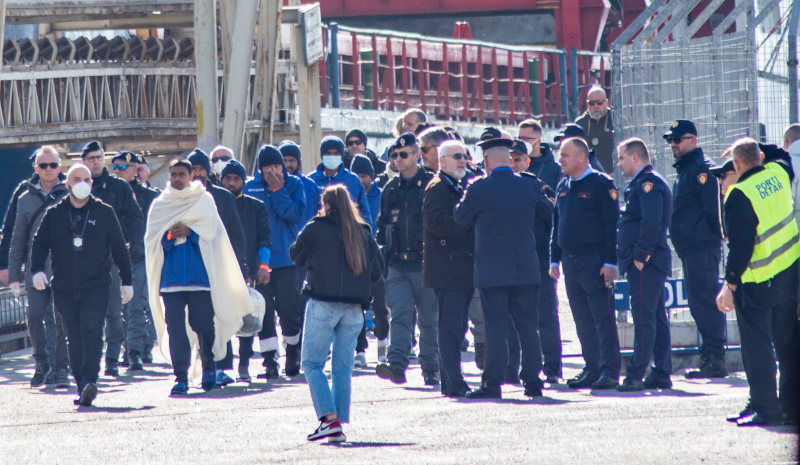
The Cassiopea docked in Shëngjin at around 7:30am on 28 January. Voxeurop and BIRN were present as the migrants disembarked. Stepping off the ship in groups of nine or ten, they shuffled forward, their feet heavy with fatigue, past a cordon of police officers, doctors and aid workers. They wore identical blue jumpers and sandals, some wrapped in shawls and warm hats against the biting winter air. Clutching small plastic bags of personal belongings, they disappeared into the camp set up at the port.

Among those witnessing their arrival was Ded Bukaqeja, owner of a telecom company providing internet at the camps. A member of the first wave of Albanian migrants who fled to Italy by ship in the 1990s after the fall of the Communist regime, he saw echoes of his own past. “They were exhausted, deeply shaken. It was heartbreaking,” he said. “When I saw them suffering like that, it brought everything back – exactly how we were when we left. No one leaves their home country for fun.”
In Shëngjin’s fenced reception centre, comprising grey prefabricated containers, the migrants were checked for infectious diseases, provided clothes, fed and briefed on their asylum process. During their stays, they were given limited access to phones. “Some of them haven’t communicated for days, and family members might believe they are dead,” said a legal assistant for Medihospes, in her twenties, which provides a range of services at the camps. During in-depth medical and psychological screenings, four migrants were discovered to be minors. Another was identified as vulnerable. All five were soon relocated to Italy to follow the regular asylum procedure, which usually takes years to complete.
Fast track glitches
The remaining migrants in Shëngjin were issued detention orders, which required approval by Italian courts within 48 hours, then transported to Gjadër, a larger centre surrounded by 5m walls. Asylum interviews were conducted via video link, with officials in Italy questioning migrants about their journeys. According to interview transcripts, migrants had no assigned lawyers – standard practice for such interviews – but were accompanied by an interpreter.
Malik told interviewers that creditors determined to force him to pay back soaring loans had attacked his sister in Bangladesh with a stick, breaking her nose. During 11 months in a Libyan prison, he claimed, captors had ripped out his finger nails and burned him with cigarette butts. “I have marks all over my body from the violence I suffered in Libya,” he said. “They did not give me food, drink or allow me to wash. They treated me in pitiful conditions.”
He pleaded with the commission not to send him back to his home country. “I would just like to have the opportunity to come to Italy and stay to work,” he said. “I would like you to carefully consider my request.”
Nizam, the whitewasher, made a similarly desperate appeal. “I have a request to the Italian state, to send me to Italy so I can find a job,” he said. “With that job I can support my family and have a better future.”
During the interviews, a further vulnerable case was detected and relocated to Italy. “We identified a vulnerable person because he was limping. I later learned he had burn marks,” explained a second legal assistant for Medihospes, a former public official in Lezhe who requested anonymity.
All of the other asylum requests were rejected on the following day. The migrants, including Nizam, had seven days to appeal.

Francesco Ferri, a migration expert at ActionAid who was also present at the inspection, said it was unacceptable that vulnerabilities had not been detected earlier. Checks, he argued, were carried out too rapidly for psychological scars to be detected.
Contu said the migrants she met during the visit seemed confused about legal procedures and that more time was required to process trauma. “Somebody who comes from an experience of persecution needs time, both to digest [that] he has undergone persecution and torture, and to express himself,” she said. “The risk is either they do not say everything or they come across as contradictory.”
The ministry source countered that migrants had free access to lawyers at any time in the camps, adding that migrants were thoroughly informed about their legal rights, receiving a 20-minute initial briefing followed by individual consultations lasting two to three hours.
The legal assistant and former public official agreed. “We try to help the migrants and want their asylum applications to be successful,” he said.
A legal showdown
Meanwhile, Italian media speculated on whether courts would approve the detentions. In an effort to break the previous impasse, Meloni had reassigned detention rulings to a Rome appeals court. Subsequently, the court director simply reassigned the same judges.
On 31 January, the hearings took place behind closed doors in half a dozen office-style rooms of a Rome court. Judges, preparing to question migrants via video link with interpreters, could be seen through the doors as they swung open and shut. Lawyers sitting in corridors anxiously reviewed documents while awaiting their turn. Journalists were barred from entering.
For some of the migrants, the burden of the uncertain futures had clearly taken its toll. “The detainee cried throughout the hearing,” read the minutes for Nizam’s hearing.
Calderoni, his lawyer, criticised the fast-track system, saying she was assigned cases less than 24 hours before hearings. This left her with little time to prepare or speak with the migrants. “We are forced to work in the dark,” she said.
In an order issued on the evening of 31 January, the court declined to approve all 43 detention orders, once again referring the decision to the CJEU.
In a further blow to Meloni’s scheme, the migrants were to be relocated to Italy. A video shot by an Albanian port official, which has been shared with Voxeurop and BIRN, shows the migrants carrying large black bags as they walk in single file up a metal ramp onto a coast guard patrol boat. Unlike when they arrived, they wore warm jackets and proper shoes.
The migrants arrived in Bari on the evening of February 1. As the boat glided into the port, they could be seen peering through the portholes, some smiling as they took in the scene. Protesters against the scheme gathered nearby shouted and held a banner that read “Welcome”. After disembarking, the migrants were loaded onto a bus and transferred to a reception center on the city’s outskirts.
The camps have since been empty of migrants. A core of staff remains, spending long hours in the prefabricated cabins or sipping coffee at the few bars still open along Shëngjin’s seafront. Meloni’s government has been discussing the possibility of converting the Albania centres into standard repatriation facilities.
Lawyers scrambled to appeal against their clients’ asylum rejections. Contu confirmed that all had appealed before the seven-day deadline.
Nizam, Malik and Rohan’s days of confinement are now over. In Italy’s reception centres, residents are free to leave during the day. Calderoni said her clients were “recovering” and that they could soon begin work, with court rulings on their asylum appeals expected this year. Nizam has returned to social media, posting photos and videos of himself by the Adriatic Sea, or taking in grand local landmarks such as Bari’s art nouveau Teatro Margherita.
One photo shows him standing before a cafe, framed by pine trees, looking effortlessly stylish in his signature sunglasses and loose shirt.
* Names have been changed for privacy
The production of this investigation is supported by a grant from the IJ4EU fund. The International Press Institute (IPI), the European Journalism Centre (EJC) and any other partners in the IJ4EU fund are not responsible for the content published and any use made out of it.
Listen to the Long Story Short podcast episode on this investigation:
Do you like our work?
Help multilingual European journalism to thrive, without ads or paywalls. Your one-off or regular support will keep our newsroom independent. Thank you!