









Select a language
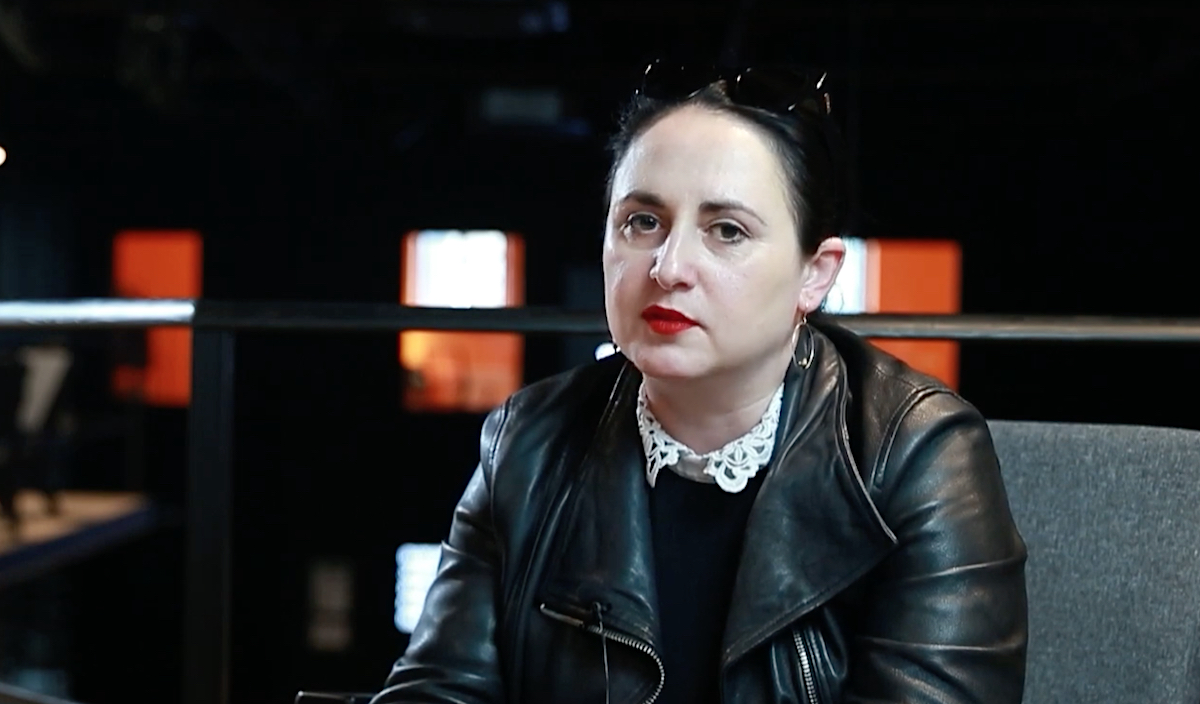
Nino Haratischwili (b. 1982) is a Georgian-born German novelist, playwright, and theater director. She moved to Germany in the early 1990s during the political and social turmoil that followed the collapse of the USSR, then back to Georgia. She now lives in Hamburg, where she works as a theatre director. Her most famous novels include Die Katze und der General (The Cat and the General, Frankfurter Verlagsanstalt, 2018), and The Eighth Life (For Brilka) (Scribe, 2019). She has received numerous awards, including the Adelbert von Chamisso Prize, the Kranichsteiner Literaturpreis, and the Literaturpreis des Kulturkreises der deutschen Wirtschaft.
Netgazeti: In your works, you often address historical and social topics. What are you looking at now ?
Nino Haratischwili: We are witnessing the collapse of the democratic path, which was achieved through enormous effort, labour, sweat and blood, before our eyes. At least there was a shared agreement that our future lay in Europe. Now, however, we see everything that was carefully built – democratic institutions, aspirations and goals – being destroyed.
As a member of this society, it is unimaginable not to feel protest rising within you, especially given our historical experience. We have already lived through what we are now witnessing. The ruling party does not acknowledge this, but its actions speak volumes. For me, this reaction is only natural. I only wish this had not become such a pressing issue, developing with such intensity and speed.
What could be the alternative?
There is no alternative. The only alternative is adaptation, but to what? To being taken back to the past. To losing our democratic path? To becoming a vassal, an obedient slave or a satellite country.
The alternative is paralysis and submission, which are far worse than the effort that citizens must now invest in protesting.
Unfortunately, our society is divided. For many people, this issue does not yet feel urgent. Some believe it does not concern them. Others deny that this direction is Russia or that we are moving backwards.
What role can art play in this process?
Firstly, artists are citizens. Art has the power to generate empathy, build bridges and open people’s eyes. However, in such a polarised climate, it is very difficult to communicate in the language of art. At this stage, we must first speak as citizens and state our position.
Having access to a larger audience is a gift. You can use this access as a platform to amplify your voice. I cannot write something and then fail to live by it. Otherwise, I would be lying. Politics is not just what we hear on the news, or rallies and demonstrations. Politics essentially encompasses everything – wherever there is a society, there is politics.
‘We are setting an example, and I have heard this said many times recently. I truly believe that Tbilisi has become the capital of Europe’
You lived in Europe and saw many protests. How would you compare the two?
At this stage, we are setting an example, and I have heard this said many times recently. I truly believe that Tbilisi has become the capital of Europe. This continuous, tireless protest has become part of everyday life. And it is genuinely admirable. The global situation is extremely difficult. We are experiencing major geopolitical shifts.
We need support and solidarity from Europe. Whenever I have access to the press or write articles, I always emphasise this point, because we are not on a separate planet; we are part of a broader society with shared values. I hope that Europe will become more alert, not only regarding Georgia, but also by moving from slow bureaucratic processes to faster responses. What is happening here is not a local problem. It is global and spreading like metastases.
Your characters often fight against oppression and injustice. How would you describe detained journalist Mzia Amaghlobeli’s struggle in this context?
Like David and Goliath. Her principled stance is exemplary. Many others have also been detained unjustly. We are witnessing courts being turned into a kind of circus. This only deepens the sense of injustice. Her unwavering principled stance is a powerful example. Unfortunately, it seems to have no effect on the authorities. These proceedings have become a circus or an absurdist performance. Sometimes I even feel that those who decide these matters derive a kind of sadistic pleasure from it.
Do you think Mzia’s arrest will intimidate journalists and activists?
Given the pace at which this regime is “developing”, I don’t rule anything out. But what gives me hope is that I do not feel fear. This is why we are not, and hopefully never will be, like Belarus or Russia: the absence of fear and our ability to retain a sense of humour and inner freedom are decisive factors. Wherever you can still mock the authorities and security forces with laughter, there is freedom because power is vulnerable to ridicule. For now, I do not feel this fear, and that is a great strength which I hope we will not lose.
Is there still a “grey zone” in the Georgian Dream government?
No, it's far too late for neutrality now. They have already revealed their position and interests. I don't see that the people around [the leading, pro-Russia party Georgian Dream leader] Bidzina Ivanishvili are united by any shared idea.
There is a cult of personality which has already become pathological. Even today, they do not acknowledge this, which only makes the situation more absurd. We still blame “foreign forces” without naming Russia, but the narrative has completely changed – history is being rewritten. These people represent conformity and opportunism. I am convinced that if Ivanishvili were to embrace radical leftism tomorrow, they would follow him. This makes the situation even more dangerous and unmanageable.
When lies are presented as truth and confusion is deliberately created by intimidating people with slogans such as “Do you want war?”, the situation becomes more chaotic because it is no longer possible to know who or what you are dealing with. Fortunately, based on our painful experiences, we reacted in time and came to understand what was happening. This unmasking began not only with the Russian “foreign agents” law, but also with the start of the war in Ukraine, when our government failed to support Ukraine. At that point, it became clear which side had been chosen.
What are you working on at the moment?
I'm working on a new novel. It's challenging because reality interferes with the creative process, but I'm persevering. It partly concerns Georgia and migration, issues that affect me personally. To write well, I need distance from reality, and that's difficult in the current situation. Literature is always something that has already been transformed or filtered. If I wrote about this now, I would do so as a citizen, not a writer.
📺 Watch this interview on Netgazeti's YouTube channel
œ
Do you like our work?
Help multilingual European journalism to thrive, without ads or paywalls. Your one-off or regular support will keep our newsroom independent. Thank you!


