
















Select a language
In January 2024, with war raging and the front lines drawing near, the owner of the NEMO Dolphinarium in Kharkiv made a desperate call to the Oceanogràfic aquarium in Valencia, Spain: “We have two belugas”, he told them.
Robert Gojceta, marine mammal curator at the Oceanogràfic, explains: “He contacted us to see if we could help, because we were the only aquarium in Europe with facilities for these animals.”
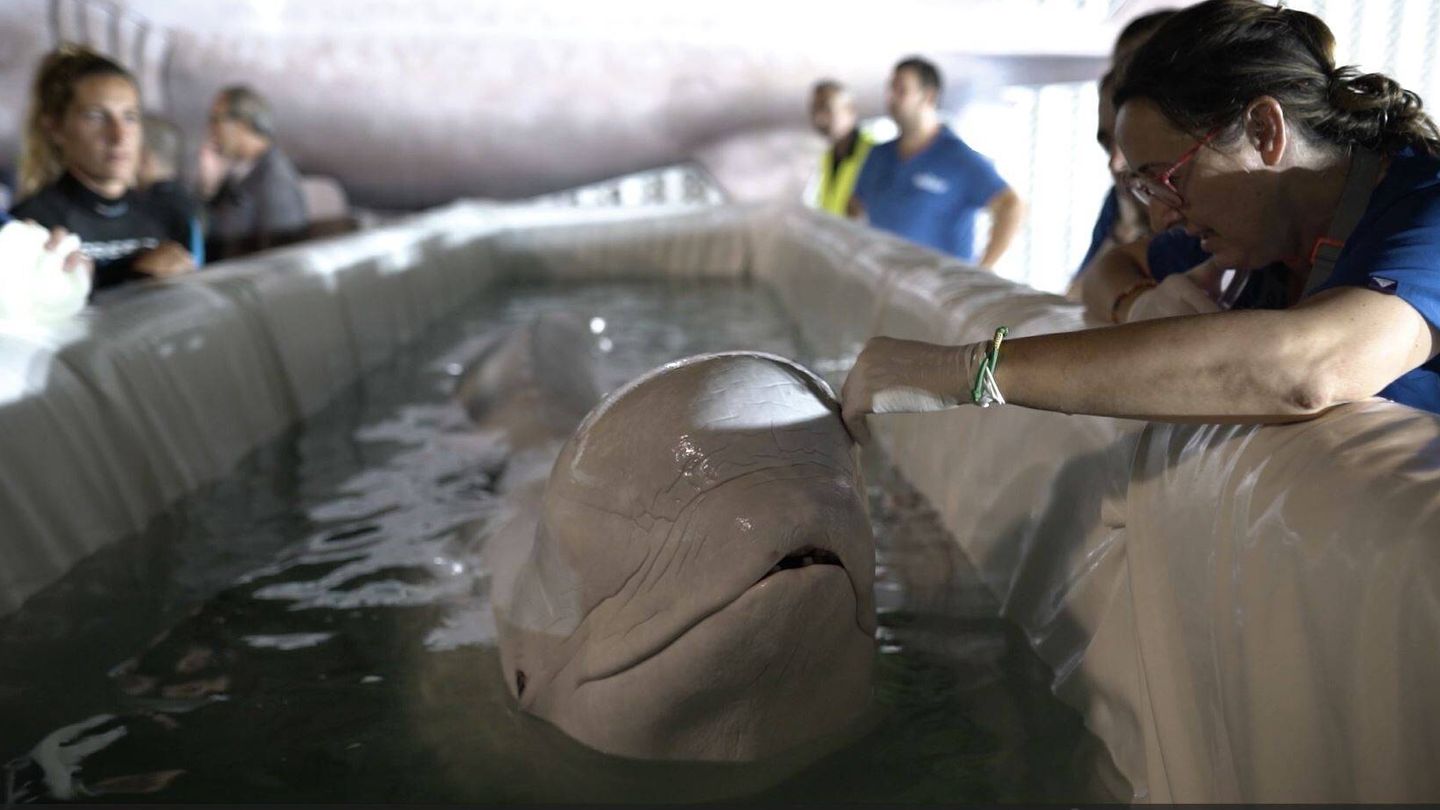
The beluga is a species of cetacean, smaller in size than other types of whale. At the aquarium in northeastern Ukraine, there were two: a 14-year-old female weighing 800 kg, called Miranda; and a 15-year-old male weighing about 1,200 kg and measuring nearly five metres, named Plombir. At the outset of the war in February 2022, the owner of the aquarium (who also managed others, housing dolphins and sea lions) appealed for help to secure food for his animals. The European Aquatic Parks Community jumped into action to deliver fish and other supplies. “At that point, we weren’t thinking about bringing the belugas here”, says Gojceta.
Months passed, and Russian troops advanced until the front line was just 800 metres from the dolphinarium in Kharkiv. The staff protected it with sandbags. But the belugas “likely suffered a great deal of stress from the noise of the explosions and bombs”, sighs Gojceta. Cetaceans live in an acoustic world: sound is their primary means of communicating, navigating, finding food, and detecting predators. So the owner asked for help to evacuate them.
“In my 33 years of experience, I've handled many transports, but nothing like this”, says Robert Gojceta. He has spent decades working at aquariums, initially as a trainer of dolphins and sea lions. He says that every cetacean transport is complex, whether it’s a beluga, a dolphin, or an orca. But this one was “much more so”. Under normal conditions, “there’s a lot of preparatory work: we go to the site to get to know the animals, we gather information, and handle the complex logistics and permits.” On this occasion, none of that was possible given Kharkiv's proximity to the war zone. Besides, says Gojceta, "there were people facing far worse problems than ours. So we had to improvise a bit.“
The easiest way to transport an animal between Ukraine and Spain would normally be by plane, but Ukrainian airspace is closed due to the war. So the only way to evacuate the two belugas was “by road, to Moldova, and then to fly from there", explains Gojceta.
The rescue operation unfolded over 40 hours. A large, airtight tank filled with water was installed inside a truck. The first leg of the journey was a drive of about 700 kilometres from Kharkiv to Odesa. It took over 12 hours. In Odesa an emergency pool was set up in case the animals needed a break in their journey.
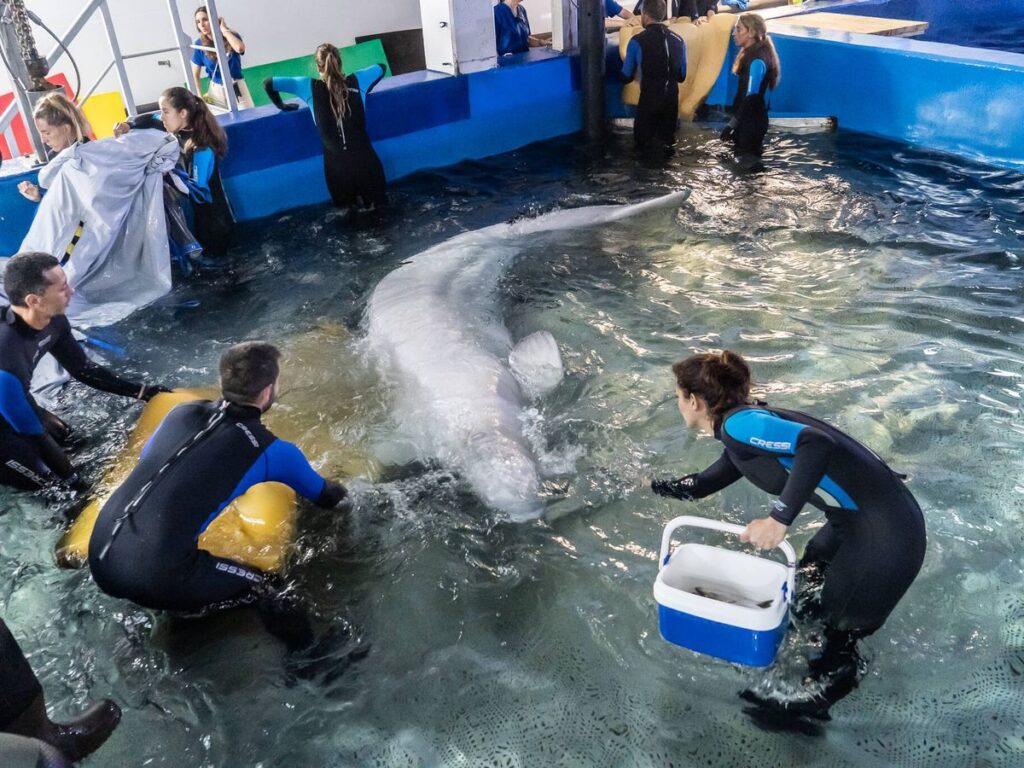
Odesa was where the Ukrainian handlers met the team from Oceanogràfic in Valencia. Staff from Georgia Aquarium and SeaWorld were on site to complete the veterinary checks. The convoy then set off for Moldova, where Gojceta had been a week earlier to inspect the facilities. In the Ukrainian team, only the woman was able to travel: the men were prohibited from leaving the country.
The cross-border journey, with the two belugas in tow, was slowed by checkpoints. But Robert Gojceta says the toughest moment came at the airport in Moldova. “The ground crew and security personnel had never done anything like this before and were very impressed.” But Chisinau Airport is small and lacks equipment for handling large cargo loads. How would they get off the ground with two whales? “It was very stressful“, says Gojceta. ”There was no dolphinarium in Moldova in case something went wrong and the belugas couldn’t return to Ukraine. “We just had to get to Spain.”
That meant only one option. “There’s a type of military aircraft that opens up at the back and has a crane inside”, explains Gojceta. But there was yet another problem. “The company that operates this model is Russian, and we couldn’t fly with them.” In extremis they located a suitable plane in Azerbaijan. It flew to Moldova and from there to Valencia with the two belugas on board.
The experience was “emotionally intense”, recalls Robert Gojceta. “It was a big relief to get off the ground.” The odyssey was even more trying for the Ukrainian handler travelling with the belugas. "She wanted to help the animals adjust, but was of course also eager to return to her family.”
Today, Miranda and Plombir live at the Oceanogràfic in Valencia, alongside two other belugas already resident, Kylu and Yulka.
This was just one of the rescues and relocations of animals from zoos and parks near Ukraine’s front lines, which have included some of the most remarkable and little-known episodes of the war.
In 2022 alone, the Uanimals association says that more than 1,000 animals were evacuated to safety, sometimes in spectacular fashion. They included not just cats, dogs and birds, but also tigers, lions, bears, camels, horses, mouflons, alpacas, cows, raccoons, badgers, foxes, wolves, donkeys, sheep, goats, otters, snakes, salamanders, porcupines, and lemurs. Some 400 of them ended up outside Ukraine.
More than 600 animals have been taken in by Kyiv Zoo, a spokesperson told El Confidencial. Among them are a tiger, several camels, and Abyssinian ground hornbills from Kharkiv. The new arrivals (plus births) have pushed Kyiv Zoo's population from 1,613 animals on 1 February 2022 to 2,050 at the end of November 2025. The zoo is working to secure “a continuous supply of feed and winter reserves, thanks in part to our European colleagues at the European Association of Zoos and Aquaria (EAZA)”. Fortunately, the war itself has not caused significant damage: “only occasional broken glass and damage to roofs from the shockwaves of explosions.”
Rescuing the lions of Kharkiv
One zoo that has suffered badly is Feldman Ecological Park in Kharkiv, a city which was under siege for 199 days. Before the invasion, Feldman was one of the country's largest animal parks. Following a number of perilous rescue operations, a total of 4,750 animals have been saved.
“Some of the rescues were more successful than others”, notes Sofía Santos, a researcher at the Center for Information Resilience (CIR), in a report. Zoo staff have been exposed to dangerous situations, and in one rescue a 15-year-old volunteer died. The documentary Checkpoint Zoo, directed by Joshua Zeman and produced by Leonardo DiCaprio, chronicles the risky evacuation of the animals, including lions and even a family of tapirs. The park has since reopened its doors.
And bears
At the Zarnesti Bear Sanctuary, near Brasov in Romania, lives a 600-kilogram brown bear called Bolik. “He arrived after the war in Ukraine began”, explains Paula Ciotlos, vice president of the Millions of Friends association.
Bolik was evacuated in April 2022 from a tourist resort in Chernivtsi, in southwestern Ukraine, with the support of a local organisation, UAnimals, and the Wild Animal Rescue International Charity.
👉 Original article on El Confidencial.
🤝 This article is part of PULSE collaborative project: Kim Son Hoang (Der Standard, Austria) and Angelina Davydova (n-ost, Germany) contributed to it.
🗣️ Have a question, comment or suggestion? Share it with us through the PULSE reader form – we read and reply to every message. Be part of Europe’s conversation. Your experiences and ideas can inspire the next stories we tell. Join the PULSE readers’ community by filling in this short form.
Do you like our work?
Help multilingual European journalism to thrive, without ads or paywalls. Your one-off or regular support will keep our newsroom independent. Thank you!


