


Select a language
“Tap water is the most heavily regulated foodstuff”, says Annelies Broekman, a researcher with CREAF’s Water and Global Change section. She points out that access to safe drinking water and sanitation was declared a human right by the United Nations in 2010, as it is considered essential for life and for the exercise of other fundamental rights.
In many countries, the right is safeguarded by a comprehensive system of quality control. Mandatory periodic testing ensures that drinking water meets the European standards for microbiological and chemical safety. Such continuous monitoring makes it possible to detect any issues promptly.
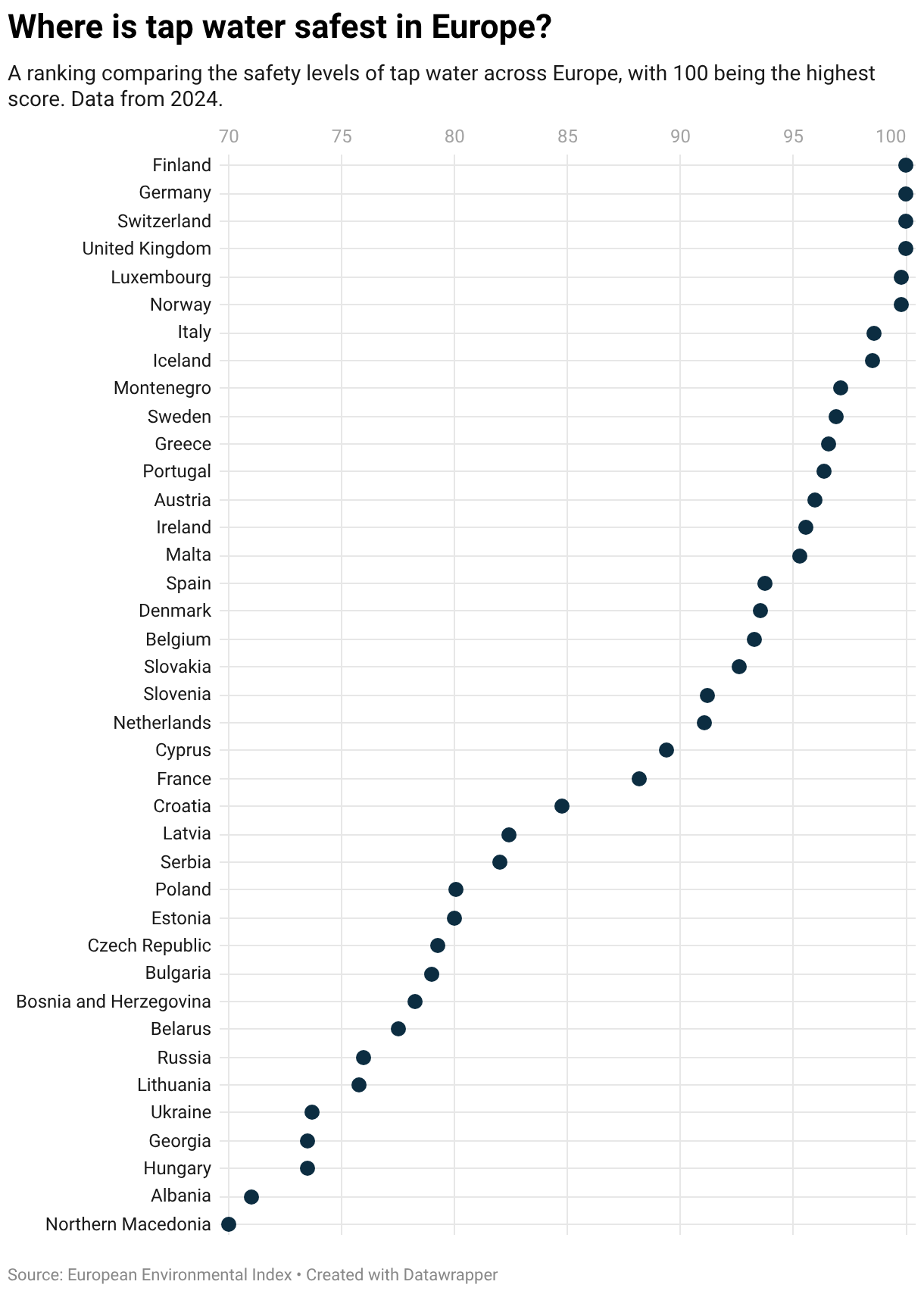
In comparative terms, northern European countries lead the way in quality standards. According to data from the Environmental Performance Index, countries such as Finland, Germany, and Switzerland achieve the maximum score (100) for health and safety.
Pulling up the rear are countries such as Moldova (50 points) and Albania (54.1), alongside EU member states like Latvia, Lithuania, and Romania. It is reflective of Europe's significant regional disparities.
For tap water to be “high quality” means not only that it is safe for human consumption. It also implies that the water is continuously monitored for trace substances (such as the endocrine-disrupting PFAS molecules, pesticides and other microcontaminants), that the distribution infrastructure is well-maintained, and that water's sources are protected from contamination.
Quality starts at the source
According to Broekman, “It’s not just that the North does it better; it’s that water scarcity and river-flow rates can influence the levels of organic pollutants".
On the subject of polluted rivers, this specialist distinguishes between chemical pollutants – mostly from industrial or agricultural activities – and organic pollutants, which are sediments that occur naturally in the ecosystem but still render the water unfit for human consumption.
Thus, the north of Europe has rivers with higher flow rates than those in the south. The greater volume of moving water can help dilute certain pollutants, reducing their concentration in the water table. Upon arrival at water treatment plants, this tends to ease the load on the systems, improving the effacity of the filtration and disinfection.
However, perhaps the most important factor determining water quality is that the source itself be free of contaminants.

“It is not so much about the water-treatment infrastructure as it is about the quality of the source water”, says Broekman. Knowing the origin of the water we consume is key to understanding its availability and quality. It is not the same to draw water from a river, a reservoir, or an aquifer. Each source has distinct characteristics and responds differently to rainfall, droughts, and pollution.
This variable also partly determines how vulnerable the system will be to climate warming and extreme weather events, which are becoming ever more frequent.
Another important factor is how the water is used. The main destinations are human consumption, agriculture, industry, and ecosystems.
Finally, the size of the population served by a single source is critical. The more people who depend on it, the greater the pressure on the system.
The water is running out, and so is the money
Better understanding the situation can thus help institutions to get organized.
Among the specific challenges, the presence of chemicals in groundwater remains a major problem. Groundwater supplies approximately 25% of agricultural irrigation and 65% of drinking water in the EU. According to the European Environment Agency, more than 20% of the bloc’s groundwater is in poor chemical condition, meaning that harmful substances, such as mercury and cadmium, exceed the levels set by the EU Water Framework Directive.
The treatment of nitrates – commonly found in fertilizers – is alone believed to cost the EU up to €320 billion a year. The EU limit on nitrate pollution is 50 milligrams per litre. According to the European Commission, that level was exceeded at 14% of Europe’s groundwater monitoring stations.
In January 2022, the EU approved the first drinking-water watch list. One of its aims is to monitor levels of beta-estradiol and nonylphenol, two endocrine-disrupting compounds that mimic or interfere with hormones in the human body.
National authorities have begun to implement measures in line with this EU framework. In France, for example, the government is strengthening its monitoring of emerging contaminants such as PFAS. Starting in 2026, mandatory monitoring of 20 PFAS compounds will impose a quality limit of 0.1 µg per litre, in line with the European directive. Indeed, France's ANSES agency has gone further, testing for PFAS in both untreated and treated water and expanding the number of substances analyzed to 35.
Similarly, in Hungary, where in 2024 the tap water was reported to be safe in 99.8% of municipalities, the authorities have begun monitoring PFAS in drinking water, starting with the major catchment areas.
“Beyond water-treatment systems, it is important to prioritize the inspection and improvement of distribution systems, since in Spain one of the most common problems is leaks", notes Juan Manuel Garrido, professor of chemical engineering at the University of Santiago de Compostela.
Neighbouring France is already addressing this issue. In its Water Plan 2023–2030, the government has prioritized the reduction of leaks in the water mains. As things stand, around 20% of treated water is lost during distribution. France's package also involves measures to reduce water extraction by 10% by 2030, improve drought preparedness, modernize infrastructure, and diversify supply sources.
A ticking clock
The European Commission's climate projections indicate growing freshwater scarcity in southern Europe, which will put pressure on agriculture and livestock farming. Conversely, some regions in northern Europe might even increase their water reserves, thus further widening the regional disparity.
Climate change will thus only exacerbate existing risk, say experts. The urgent need is to adopt preventive and adaptive measures as soon as possible.
Total water extraction in the EU decreased by 19% between 2000 and 2022. Nonetheless, the European Environment Agency (EEA) reports that water stress remains a systemic problem that affects approximately 30% of Europe's territory and 34% of its population. The impact is particularly severe in southern Europe and in densely populated areas.
Public attitudes toward water are reflected in daily usage and in expectations regarding its quality. “There is a fair amount of awareness about avoiding waste, but there is still much to be done”, says Broekman.
Taste as a consumer indicator
So why do even those European countries with the highest water quality continue to consume bottled water? Taste and quality are linked. But just because water is safe to drink doesn’t mean its mineral balance will suit every palate.
Spain, along with Italy and Greece, ranks among the top three European countries for bottled-water consumption, according to 2024 data from Natural Mineral Waters Europe.
“It’s a human tendency, just like being influenced by the visual appearance”, explains Garrido. “Would we drink red-coloured water even if we were assured it was safe to drink?”

But he believes that consumers may nonetheless be paying for a quality similar to or worse than what they can find simply by turning on their kitchen tap.
“Part of consumption depends on public awareness”, notes Broekman. That view is supported by Garrido, who points out that current technology is capable of “producing drinking water from any type of water”.
The next time we're in the water aisle at the supermarket, the question we might ask ourselves is not which bottle to choose. It's why we forget that there's a system in place that brings safe drinking water right to our taps.
👉 Original article on El Confidencial
🤝 This article is part of the PULSE Europe collaborative project. György Folk (Eurologus/HVG) and Gian-Paolo Accardo (Voxeurop) have contributed to it.
Do you like our work?
Help multilingual European journalism to thrive, without ads or paywalls. Your one-off or regular support will keep our newsroom independent. Thank you!