








Select a language
Let's start with a striking statistic: in 2024, 24% of the EU population aged 16 and older had some form of disability. That represents more than 90 million people. For them, to go to work in another country is to enter bureaucratically unchartered territory.
Kamil Goungor, head of policy and mobility support at the European Network on Independent Living (ENIL), experiences this fact firsthand every day. He works for a Brussels-based organisation but lives in Athens. “I would love to move to Belgium and work there, in the office, with my colleagues“, says Kamil. ”But for me, as someone who needs special care, it’s extremely difficult.”
Country-specific definitions of disability
“Each EU member state has its own definition of disability”, explains Alonso Escamilla, a researcher at the Catholic University of Ávila (Spain) and co-author, with Paula Gonzalo, of a policy brief published in 2025 by the European Trade Union Institute (ETUI). “A person recognised as disabled in Spain may not be considered disabled in Germany, because the two countries do not use the same assessment criteria. In France and Spain, a points-based system is used; Germany and Latvia take a medical approach; and in Belgium and Poland, the criteria for assessment are functional. Each country has its own system, its own deadlines, and its own forms."
When a person with a disability moves to a new country, they must go through a new process to have their status recognised. This can take months. Then there are the steps involved in obtaining welfare and employment benefits in the host country. The entire process often takes several years. During this time, the person has no income support and no access to the care they need. In some cases, such difficulties can even jeopardize their right to residency.
Kamil Goungor believes this situation discourages mobility. “As soon as we leave our country, our specific needs are no longer automatically recognised, nor is our right to care. And without support, we can lose our jobs or fail in our studies. For those who need 24-hour assistance, like me, that can even mean putting ourselves in danger.”
Physical barriers to travelling – and a stigma that won’t go away
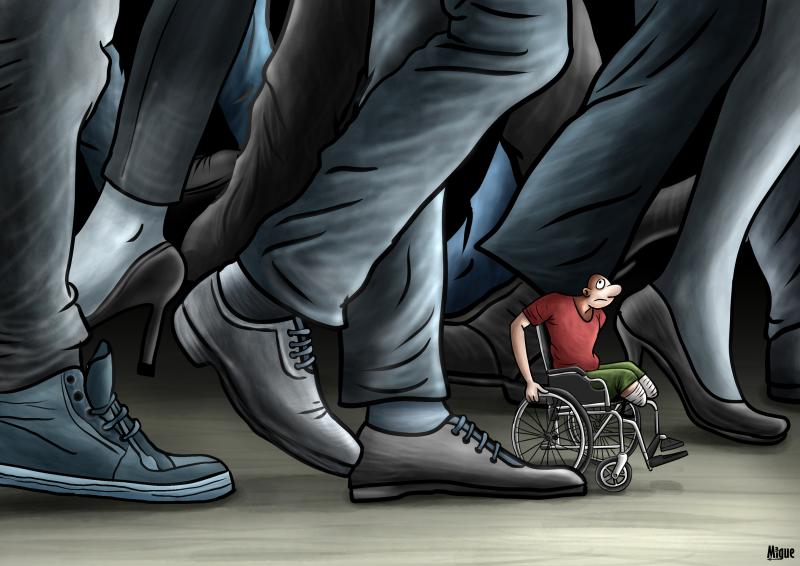
But even before the issue of red tape, “the main barrier is physical”, explains Alonso Escamilla. No dedicated seating on buses: gaps between the train and the platform that are too wide; special seats that must be reserved on planes – and cost extra. For people with disabilities, travelling within the EU is not easy.
At the destination, a new set of challenges arises. In the job market, a stigma persists. It is rarely stated openly, but usually exists nonetheless. “Sometimes, employers prefer not to take risks or incur the expenses necessary to adapt to the work environment”, explains the Spanish researcher. The associations he consulted as part of his study – thirteen organisations active at the European level – confirm that the progress made, while real, remains insufficient.
The European Commission's report on Employment and Social Development in Europe (ESDE 2025) acknowledges the need to integrate workers with disabilities, if only to address Europe's labour shortages. Yet it fails to propose concrete solutions to their specific needs.
The European Disability Card, a tool for short stays and tourism
For their part, the Brussels institutions are setting ambitious goals. Recent years have seen the launch of the European Disability Rights Strategy 2021–2030, the European Accessibility Act, and more recently the European Disability Card, whose guidelines were adopted by the EU Council in October 2024.
On paper, this card provides proof of disability status in all member states, using the same criteria and granting the same rights throughout the EU. However, it only covers short stays of up to three months. The card is therefore intended more for tourists than for workers. Indeed, it explicitly excludes the areas of employment and social security. For anyone who wants to settle permanently, work, and build a life in another EU country, there are no provisions.
For the European Network on Independent Living (ENIL), this shortcoming is crucial. Florian Sanden, the organisation’s policy coordinator, points out that, as things stand, “if a person with a disability who receives personal assistance in their country of origin moves to another member state, that benefit does not follow them.” Without a recognised status in the host country, there is also no legal right to reasonable accommodations for disability at work or in education.
ENIL emphasises that able-bodied citizens already benefit from automatic recognition of their access to welfare benefits. This right to portability remains out of reach for people with disabilities.
Kamil Goungor spent six months in Belgium as part of the Erasmus+ scheme. “I was able to go on this trip thanks to the support provided by the programme, and it changed my life. But it’s not an experience that many other people with disabilities have the chance to have.”
Alonso Escamilla concurs: “At the European level, the idea that people with disabilities might want to go work in other EU countries is rarely considered.”
No data, no tailored policy
Another challenge is the lack of reliable data. How many workers with disabilities move each year? How many have successfully transferred their welfare rights? No one really knows.
“There are no precise figures, no reliable database“, says Alonso Escamilla. ”The Commission has data on tourist travel, but it is quite outdated and does not specifically concern workers.”
Without data, it is impossible to develop appropriate policies. That is why one of the first recommendations in the ETUI’s guidance brief is the creation of a European database on the mobility of workers with disabilities.
The idea is simple: to make visible what is currently invisible.
Alonso Escamilla chooses to be hopeful. “The more data we generate, the more we can do to ensure that the EU respects everyone’s right to freedom of movement.”
Do you like our work?
Help multilingual European journalism to thrive, without ads or paywalls. Your one-off or regular support will keep our newsroom independent. Thank you!