












Select a language
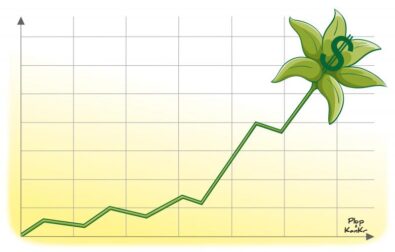
Europe is a worldwide leader in the market for "green" investments, i.e. those that fund environmentally sustainable businesses. Financial companies active in this sector typically promise their customers "sustainable and responsible" investments.
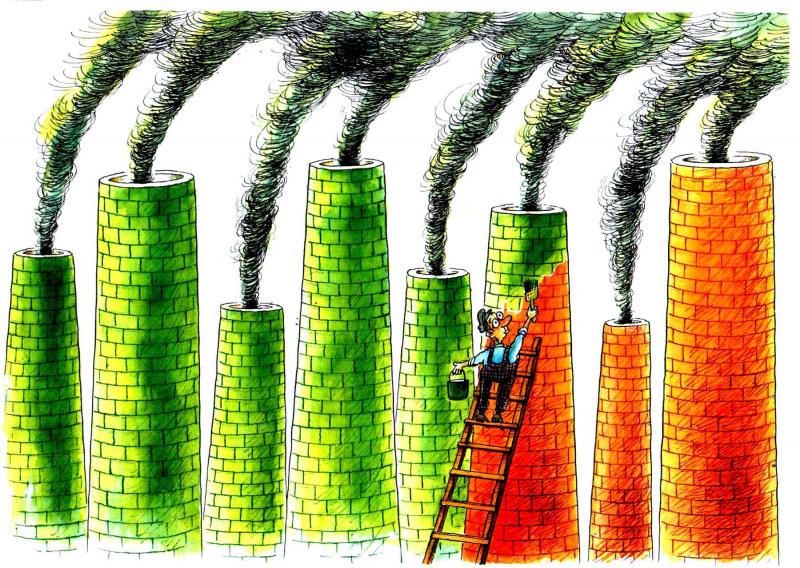
As this investigation reveals, however, those investments are often neither sustainable nor responsible. By exploiting ambiguous regulation and obscure terminology, some of them are actually financing fossil-fuel companies.
To demonstrate this, we analysed four so-called "sustainable" funds offered by Eurizon, an asset-management company controlled by Intesa SanPaolo, Italy's largest bank. Eurizon is one of many financial companies offering "green" products in Europe, but its case is emblematic. It manages client assets worth €381 billion and, according to its sustainability report, advocates a "financial humanism based on respect, responsibility, and awareness of its own qualities".
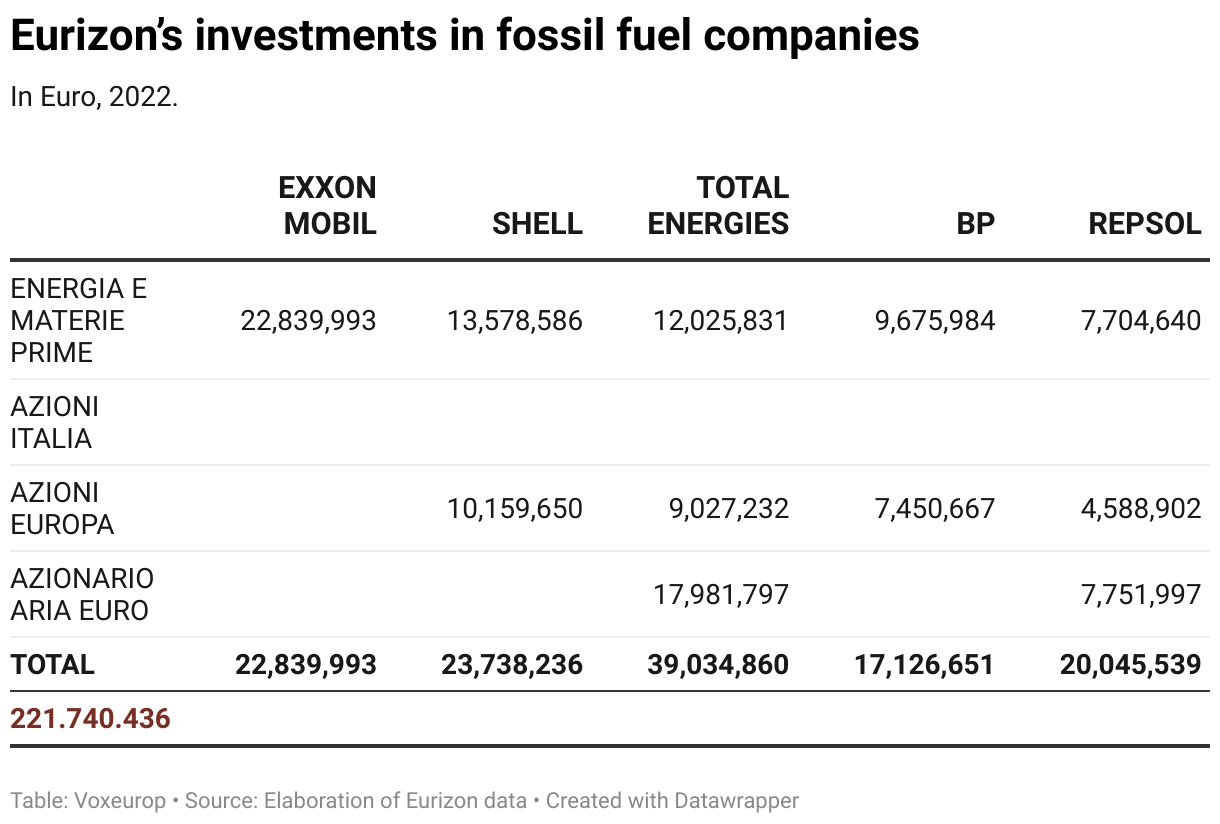
According to our analysis, in 2022 Eurizon bought shares in the hydrocarbon companies Eni, Enel, Repsol, Chevron, TotalEnergies, BP, and Shell for a value of more than €208 million, and placed them within portfolios of "sustainable and responsible investments", as it called them.
An analysis of data from Refinitiv, a world leader in financial information and infrastructure controlled by the London Stock Exchange Group, shows that, as of April 2023, in Italy and France, the above-mentioned fossil-fuel companies have raked in almost €7 billion of investments thanks to their inclusion in green funds. "These companies have an interest in getting into 'green' funds because they will receive more funding that way," explains Fabio Moliterni, a specialist at the ethical finance company Etica SGR.
By attracting investors through ambiguous language, these falsely sustainable funds have managed to outperform their market. They have guaranteed high returns by tracking indices that are completely devoid of sustainability targets.
Moliterni comments: "The European Commission's rules leave a margin of discretion to investors in determining their sustainability targets. This makes it easier for the market to adapt flexibly to changes in the regulatory landscape of asset management, and thus to enable product differentiation. But it does not seem to preclude greenwashing. In fact, many funds are still able to pursue strategies that are not aligned with the Commission's sustainability objectives and instead prioritise returns, with little or no attention to environmental and social impact."
Not everything “green” is sustainable
Alessandro Messina, an expert in impact finance and sustainability for the independent company Avanzi, adds that "fund managers try to comply with EU regulations as much as possible, but if they have a profitable product on the market they do not try too hard to force the rules."
Eurizon's pre-contractual prospectus – the so-called "Key Information Document" (KID), which contains the information on which investors should base their decisions – even presented the funds in question as "sustainable and responsible investments". This despite the fact that they do not comply with the criteria laid down in European regulations.
Thus, in funds that are supposed to promote "environmental and/or social characteristics", Eurizon includes companies from the fossil-fuel sector. Some of them have made extra profits thanks to the surge in oil prices associated with the war in Ukraine.
In its sustainability report, Eurizon even mentions studies by the IPCC (UN Intergovernmental Panel on Climate Change) as reference publications for calculating emissions. In reality, the IPCC's sixth report has quite a clear recommendation: a sharp reduction in the financing of fossil fuels and carbon-intensive activities to allow a rapid energy transition.
Is all this legal? Yes, because the European Sustainability Reporting Regulation for the Financial Services Sector (called SFDR, we will come back to this) does not give a clear definition of investment which respects the so-called ESG – Environmental and Social Governance.ESG is an acronym very much in vogue in the financial markets. It designates investments that promote environmentally and socially conscious business activities. The term was first coined in 2005 in a document of the United Nations Environment Programme.
Instead, the EU regulation allows managers to arbitrarily define their own criteria for setting "green" investment targets, only requiring that they disclose them. "The biggest problem is that regulation focuses on disclosures and reporting, so in practice I can say 'I am destroying the world', but at least I am transparent about it," comments Green MEP Bas Eickhout.
"The supervisory authority of the fund in question should check whether the information in the pre-contractual document contradicts the requirements of the European Green Finance Regulation, which should be avoided," comments the European Securities and Markets Authority (ESMA). ESMA coordinates the work of the national authorities in charge of overseeing the application of its technical standards on transparency of financial products. Italy's supervisory authority, the Commissione Nazionale per la Società e la Borsa Italiana (Consob), refused to comment on the funds' non-compliance with EU regulations, citing confidentiality.
What does European legislation say?
The Sustainable Finance Regulation, which came into force in 2021, imposes transparency criteria that financial advisors must meet in pre-contractual documents and on ESG investment sites.
An interested investor should be steered towards investments that can be classified by the manager into two shades of “green” (corresponding in the regulation to articles 8 and 9) or as "grey", i.e. without sustainable claims (Article 6).
The "light green" products fulfil the criteria listed in Article 8 and must promote "environmental and/or social characteristics". But neither the European regulations nor ESMA's specifications provide a clear definition of these characteristics.
This loophole allows managers to classify their funds as "light green" according to their own principles or according to rating agencies' assessments, even if the funds contain environmentally unsound companies.
ESMA merely says that "light green" funds have a lower ambition with regard to sustainability than "dark green" ones (Article 9). These latter must have as their object a 100-percent sustainable investment, i.e. they must not cause significant damage to the environment or must promote "the reduction of carbon emissions".
The difference between the two terms – products that "promote environmental features" (Art. 8, “light green”) and "sustainable products" (Art. 9, "dark green") – may seem marginal to an inexperienced investor, who might inadvertently interpret them as synonyms. Instead, the distinction is clear from a regulatory point of view. Article 9 funds must meet much stricter criteria. That is why they are more attractive to conscientious investors, but less so to fund managers who would incur greater burdens in complying with the regulations.
It is why in 2023 the funds reclassified from "dark green" to "light green" had a value of €175 billion, according to a study by the financial advisory and analysis firm Morningstar. The SFDR, the European Financial Services Disclosure Regulation already mentioned, is based entirely on transparency. Managers can therefore choose whether to classify funds in one way or another – "grey", "light green" or "dark green". This classification is the basis of the documentation that they need to produce to meet ESMA's technical standards.
The cost of sustainability
As of 1 January 2023 new regulatory standards had increased the transparency burden for "dark green" products to such a point as to prompt a significant migration to the "light green" classification.
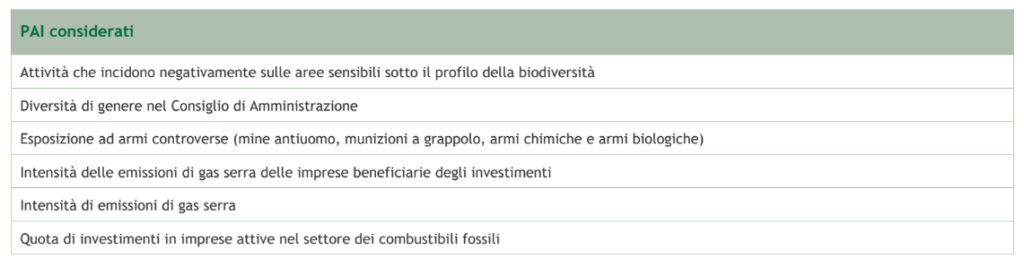
For all sustainable investments (Art. 9), fund managers must provide metrics, data and detailed information on 14 indicators prescribed by EU regulations, called "Principal Adverse Impacts' (PAI). These indicators include the greenhouse gas emissions of portfolio companies (direct, indirect and total), and the presence of fossil-fuel companies in the investment. Social indicators are also measured, such as the adherence of the investment to UN principles for multinational companies, or to gender equality rules. Such criteria are not easy to meet when a fund includes companies involved in extracting hydrocarbons.
The loophole on which fund managers play is therefore twofold. Firstly, thanks to the flexibility offered by Article 8 of the Regulation, fund managers can independently define the criteria by which they consider that a fund promotes "environmental and/or social characteristics" (“light green”). Secondly, by exploiting the semantic ambiguities for the unwary investor, many managers choose to market as "sustainable and responsible" (“dark green”) funds that do not meet the Article 9 criteria.

In its management report, Eurizon defines its funds as "light green" despite the fact that they invest in fossil-extractive companies. Moreover, it leaves empty section III of the sustainability disclosure – the one where the social and environmental characteristics of the product should be described – even though that information is required by ESMA standards. For over three years, Eurizon labelled certain funds as "dark green", i.e. as entirely "sustainable and responsible", in the pre-contractual documents made available to investors. The company only corrected the language after we contacted it for our investigation.

The argument with which Eurizon justifies its decision to advertise its funds as "dark green" is a classification from 2017 by Assogestioni (the Italian association of asset management companies), which is, however, at odds with the provisions of the 2019 European regulations. All the funds analysed (Eurizon Energy and Raw Materials Shares; Eurizon Italy Shares; Eurizon Europe Shares; Eurizon Euro Area Shares) are based on the same classification.
Not only does Eurizon admit that it takes into consideration only six of the 14 indicators provided by the EU for the assessment of sustainable investments, but in its periodic disclosure on the promotion of environmental, social and good corporate governance, it contented itself with merely mentioning them. It did not go into the details of the information required by the EU regulations (methodologies, data sources, metrics, and so on).
The SFDR, the EU regulation, in fact provides a detailed table in which managers must include metrics, periods considered for the calculation, an explanation of the methodology, and forecasts for subsequent periods. These criteria serve to transparently identify and quantify any negative environmental and social impacts of the proposed investment.
Such information is indispensable for investors to assess whether the product is sufficiently sustainable for them before putting their money into it. "The manager can declare whatever he wants, but then he has to document what the adverse impacts are according to the metrics," comments Franco Moliterni of Etica SGR. Yet Eurizon has limited itself to providing the documents mentioned in the regulations but without including the data.

Alessandro Messina offers an analysis: "This seems to me to be a compliance and enforcement issue. You cannot qualify an investment as sustainable if it is Article 8. You can qualify it as 'Attention to Sustainability Elements': that's the difference the regulations make. Evidently there is someone who either has been too clever or doesn't really know what he is talking about.
"Questioned by Voxeurop in May 2023 on this inconsistency, Eurizon said that the sustainable investment qualification "will be removed at the first useful opportunity to update the offering documentation, already planned for next July". On 4 August 2023, Eurizon updated its key information document, removing the words "sustainable and responsible fund", as promised. The update comes 3 years and 6 months after the green-finance regulation came into force.
In its sustainability documents, Eurizon also boasts of being a signatory of the UN Principles for Responsible Investment (PRI) initiative. We asked the PRI to comment on the regular presence of oil investments in Eurizon's "green" portfolios. It said: "The PRI is not responsible for – nor can it monitor – every individual investment or activity in its more than 5,000 signatories’ portfolios. They must be monitored by the investor, in-line with their own investment beliefs, investor duties, commitments, and policies." In essence: it is up to the individual investor to make sure that the proposed investment actually corresponds to the environmental and social criteria proclaimed by those who are selling him or her a financial product. This is a reversal of the burden of due diligence.
It is a very difficult if not impossible exercise to carry out. The UN-backed body makes no reference to the role of market supervisors, but only to the end investor. From its response, it seems that the only relevant actor for PRI is the market, thus mirroring the approach of European regulation.
Alessandro Messina's conclusion: "The European Commission has preferred to abdicate its role as policymaker, asking the market to do it instead, under the illusion that transparency, processes and rules are sufficient to generate better investments. This theory remains to be proven."
This investigation was supported by Journalismfund Europe
Do you like our work?
Help multilingual European journalism to thrive, without ads or paywalls. Your one-off or regular support will keep our newsroom independent. Thank you!