













Select a language
As guests made their way from the street towards the entrance of the massive Maggio Musicale Fiorentino monolithic theatre, where the Voices European journalism festival was taking place in mid-March, they passed a list of names printed on a canvas “wall” that ran alongside the pavement.
Those were the names of the hundreds of journalists killed around the world last year – each one representing a story that will never be finished.
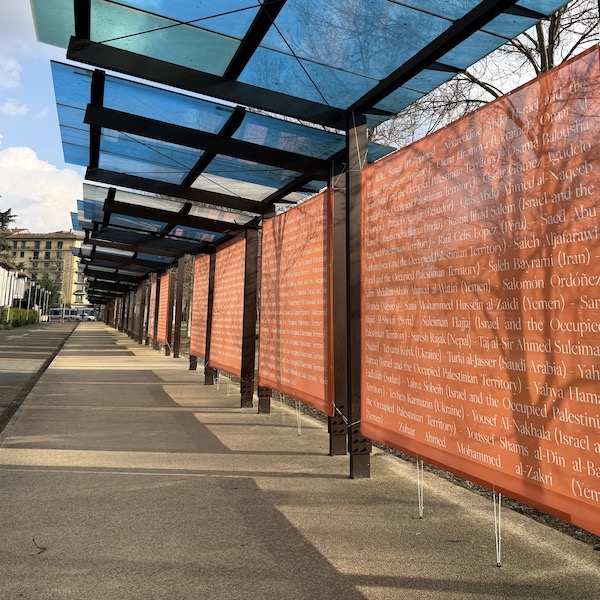
“Even for someone who works in the field of press freedom, for me to see all of these names like this was quite shocking and overwhelming,” says Jamie Wiseman from the International Press Institute. “Because it's an individual case, an individual story, an individual grieving family behind this.”
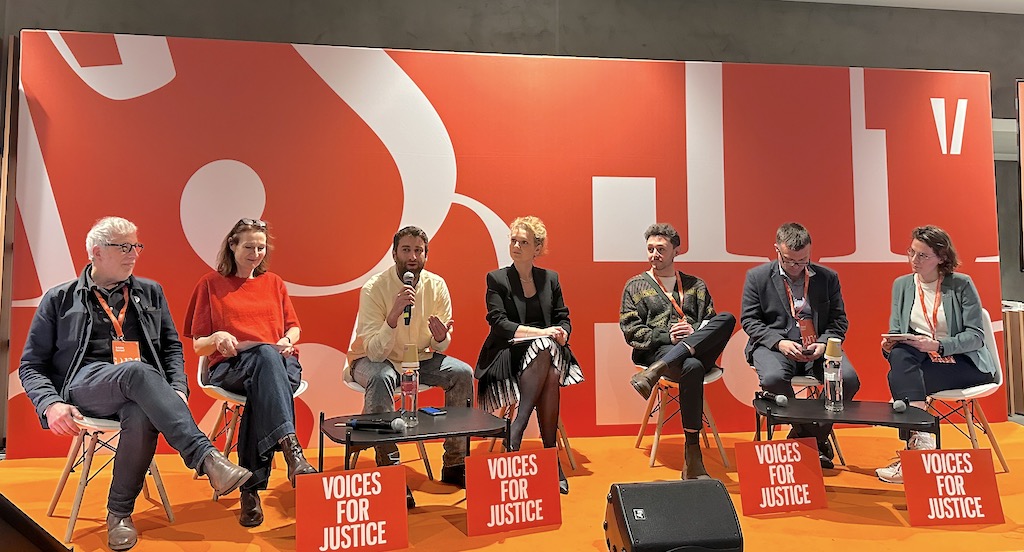
In order to keep the spotlight on this massacre, representatives of leading press freedom and journalism organisations issued an appeal during the festival, calling for justice regarding these murders, and for an end to the impunity enjoyed by their perpetrators and those who ordered them. Their message was blunt: attacks against journalists are increasing worldwide, and the systems designed to hold perpetrators accountable are failing.
“We see a real crisis for impunity globally,” Wiseman warns.
A growing global crisis
According to press freedom organisations, the killing of journalists is no longer an isolated phenomenon.
“Last year alone over a hundred journalists were murdered, mostly in targeted attacks by states,” says Matthew Caruana Galizia from the Daphne Caruana Galizia Foundation. “And countless more are imprisoned, once again to stop them publishing information that is in the public interest.”
For Caruana Galizia, the issue is deeply personal. His mother, investigative journalist Daphne Caruana Galizia, was killed in a car bomb in Malta in 2017. “My own mother, nine years ago now, was murdered to stop her investigations continuing into high-level corruption in Malta and beyond,” he recalls.
But he believes the situation has worsened since then. “My motivation for today's press conference is that I overwhelmingly see more and more that the systems that I myself use and that the rest of my family use to fight for justice for my mother over the past couple of years are being dismantled before our very eyes.”
For journalists and their families seeking accountability, the fight was already difficult. Now, he says, the mechanisms meant to protect them are weakening. “It was already hard within the European Union and the systems that we had available were already very weak,” he says. “But now it is becoming even more difficult as the attacks themselves are increasing.”
A profession under pressure
The danger journalists face does not only take the form of murder. Increasingly, harassment, intimidation and online attacks are part of everyday reporting.
For Renate Schroeder of the European Federation of Journalists, the problem is systemic: “Journalism is a public good,” she says. “Which means that everybody has the right for access to information.” But ensuring that right requires solidarity – within the profession and beyond. “We need solidarity among all of us,” she adds. “Because the enemy, so to speak, is trying to silence us.”
Threats against journalists now occur in multiple forms. Physical violence remains the most visible, but digital harassment has become an equally serious threat. “Journalists more and more are being harassed, attacked, being on the street, be it — and I want to stress that — online,” Schroeder says.
The problem is compounded by the role of technology companies and social media: “We do not only have mean politicians to smear journalists,” she warns. “We have a whole big tech machine who is trying a lot to silence critical voices.”
Women journalists are particularly targeted, with harassment campaigns increasingly using artificial intelligence tools. “Deepfakes are very good at using, at misusing that,” she says.
When journalists are targeted deliberately
While harassment is widespread, in some contexts journalists are being deliberately targeted and killed. In Ukraine, IPI’s Jamie Wiseman says, new technologies are changing the nature of these attacks. “2025 was also the year that globally we've seen the most journalists killed with drones,” he explains.
Drone warfare has made traditional safety practices less effective. In previous conflicts, journalists wearing visible press insignia were less likely to be attacked. Today, that visibility can make them targets. “Press is a target in Ukraine,” Wiseman says.
In some cases, journalists have stopped wearing press vests altogether. “Of the four journalists killed in drone strikes last year, many were travelling in cars with press on the top, and they were specifically targeted by drones,” he says. The situation reflects what Wiseman describes as a broader breakdown in international norms. “As Matthew said, a lot of journalists in that war were killed deliberately because they are journalists, not by accident.”
Gaza: an unprecedented toll
If Ukraine illustrates one dimension of the crisis, Gaza represents another — and perhaps the most dramatic. “Gaza is unpicking the work that we've been doing,” says Tom Gibson of the Committee to Protect Journalists. “This is unprecedented.”
The numbers alone are staggering: “We have over 250 plus journalists who have been killed since the 7th of October 2023,” Gibson says.
For press freedom organisations, the scale of the violence marks a turning point. “This is the deadliest attack that press freedom groups have ever documented on journalists,” he says.
According to Gibson, the killings form part of a broader strategy to control information: “It's part of a coordinated pattern by Israel to silence journalists and to control the information that has been coming out of Gaza.”
The implications extend far beyond the conflict itself. “If we cannot work together to address impunity in Gaza,” Gibson warns, “governments around the world are going to be continuing to say, well they got away with it, we can as well. Impunity in Gaza is impunity everywhere.”
Justice rarely reaches the masterminds
Even when investigations are launched, justice often remains incomplete. Wiseman points to the murder of Slovak investigative journalist Ján Kuciak and his fiancée in 2018. “The pattern we see is that, through sustained campaign for justice, you have the hitmen in prison, the middlemen in prison,” he says.
But the alleged mastermind remains unconvicted: “That's another trend we see around the world,” Wiseman adds. The same dynamic has appeared in other high-profile cases, including Malta. Those who carry out the killings are prosecuted, while those who order them often remain beyond the reach of justice.
Fighting back through the courts
Some organisations are trying to change that dynamic by using litigation strategically.
Antoine Bernard of Reporters Without Borders says his organisation has spent years developing what he calls “fighting back litigation”. “We are going to court,” he explains, “not only alongside journalists and their families, but also as a legal person, to criminal courts in particular.” The goal is to force investigations and create precedents that can break cycles of impunity.
There are some encouraging examples: since the start of Russia’s full-scale invasion, Ukrainian prosecutors have opened numerous investigations into crimes against journalists. “Today, they have 125 prosecutorial investigations open on crimes against journalists,” Bernard says. While the system remains imperfect, he sees the progress as significant. “Ukraine definitely is a world champion” in prosecuting crimes against journalists, he says.
Legal action can also produce results in democratic countries. Bernard cites a recent US court decision blocking an executive order that threatened the future of US global media outlets. “Voice of America is back to legally being able to resume its activity,” he says. The lesson, he argues, is simple: “When there's a will, there's a way.”
Training the justice system
Legal frameworks exist to protect journalists, but they are often poorly applied. Flutura Kusari from the European Centre for Press and Media Freedom believes the solution lies partly in training legal professionals. “We need to have judges, lawyers, prosecutors and police officers who are aware about media freedom standards,” she says.
Too often, journalists who report threats are treated as if they are responsible for the abuse they face. In some countries, however, reforms are beginning to show results. In Kosovo, a man who threatened a journalist was prosecuted quickly: “In 45 days, we have an indictment and a court ruling,” Kusari says.
In Albania, the constitutional court recently struck down a government decision to ban TikTok. “These two decisions are a result not only of advocacy, but also of heavy investment by the Council of Europe in training judges, lawyers, prosecutors and civil society,” she says.
The responsibility of tech platforms
While legal systems play a central role, another actor is shaping the landscape of press freedom: technology platforms. According to RSF’s Antoine Bernard, the economic incentives of social media amplify hostility toward journalists.
“It has become not only politically rewarding to target journalists in many countries for many regimes,” he says. “It has become profitable for algorithms.” In a polarised information environment, attacks on journalists generate engagement — and therefore revenue. “It feeds the divide,” Bernard says.
A collective struggle
Despite the grim outlook, the panel ended on a note of determination. The protection of journalists, participants argued, is inseparable from the protection of democracy itself. For Alexiane Lerouge from the European Broadcasting Union, the stakes are clear: “Safeguarding journalists ultimately means safeguarding democratic societies.”
And for those working to defend press freedom, the fight must continue — even when progress is slow. As Gibson puts it, remembering the names on the mural: each represents not just a life lost, but a story that must still be told: “We need to carry on telling it and we need to carry on pushing,” he says.
Do you like our work?
Help multilingual European journalism to thrive, without ads or paywalls. Your one-off or regular support will keep our newsroom independent. Thank you!


