
















Select a language
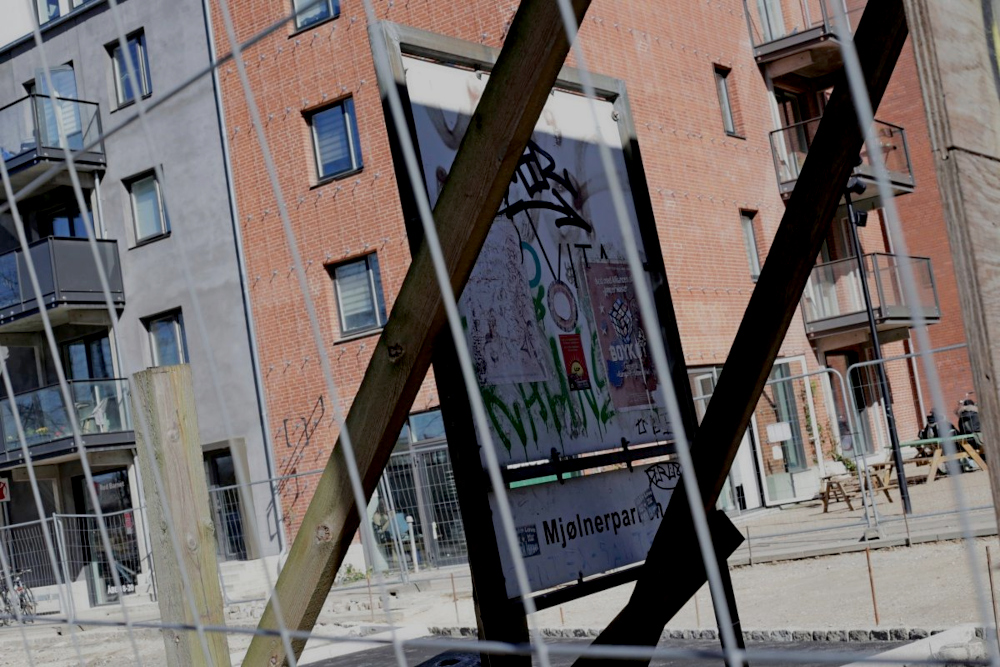
For years now, the Mjølnerparken social housing estate in the Danish capital has been a building site – politically as well as literally. Construction hoardings, construction machinery and construction workers dominate the area around its apartment blocks in the city’s trendy Nørrebro district.
In 2018, then-Prime Minister Lars Løkke Rasmussen used it as the setting for the announcement of his "Ghetto Law", which he said would crack down on so-called "parallel societies" and finally provide a way of dealing with the failed integration of immigrants.
Under this law, social housing estates that meet certain criteria such as low educational attainment, high unemployment rates or high numbers of residents with criminal convictions have been listed as "vulnerable residential areas" and subjected to a range of measures aimed at upgrading them and breaking up the "ghettos".

Over the years, however, the thresholds for these criteria have shifted, meaning that some estates remain on the list despite having improved. The key criterion, however, is ethnic origin, since only estates where at least half the residents are non-Western immigrants and their descendants are designated as "ghettos".
Born a ghetto
In the office of the Residents’ Association, teacher Majken Felle, 52, tells the STANDARD that Mjølnerparken was born on the ghetto list, so to speak. This is because measures are only supposed to be applied to so-called "hard ghettos", defined as residential areas that have been classified as ‘ghettos’ for several years in succession.

Yet work to dismantle this estate with its red-brick buildings and white balconies began immediately.
"The law applied retroactively, so we were affected right from the start," she says. While some areas were given time to improve their statistics and be removed from the list, an immediate plan to reduce the amount of social housing had to be created for Mjølnerparken.
"In Bispeparken, activists knocked on every apartment door, collecting school and university certificates from immigrant residents, since those qualifications might not have been registered in the Danish system. The people there did ultimately manage to improve their educational attainment statistics enough to reduce their points on the ghetto list, but here in Mjølnerparken we weren’t given the chance to do that," says Felle, who has been fighting the measures from day one.
Pressure from the Housing Association
The irony is that Felle actively chose to move into the Mjølnerparken housing complex in 2014 precisely because she liked the sense of community there so much. She still remembers its community centre, which was used for big celebrations and even weddings. People used to chat in the playgrounds and courtyards. They knew each other and spoke Danish together.
The nearby Superkilen Park with its installations celebrating the 62 countries of origin of the district’s residents has won numerous design awards, but now feels almost like a mockery, since the Ghetto Law has forced large numbers of families out of the area. "We don’t have an exact number, since we don’t know how many families would have moved away in any case because they’d found a better flat, or moved away semi-voluntarily because the pressure had become too much for them, and how many have been forced out by eviction notices," says Felle.

She recalls the construction company phoning families who had appealed against their evictions and putting them under pressure, telling them to withdraw their appeals ‘so you don’t end up on the street’. ‘But that would have been illegal,’ she says.
"Here at the Residents’ Association, we tried to ensure everyone knew their rights." She does not know why everything had to happen so quickly – within 2 years – when the law itself specifies 2030 as the deadline for the reduction in social housing, meaning there would still be time for Mjølnerparken to take the necessary measures, even now.
An illegal experiment?
Despite this, 260 homes in two apartment blocks have already been lost, having been sold and subsequently rented out privately. "The people in the new flats don’t really care about a sense of community," says Felle. She can understand that, since they are mostly students, or families just waiting to be able to buy a flat of their own – as is usual in Scandinavia – and therefore not planning to stay there for long.
All the same, she thinks it’s a pity that the community spirit is crumbling and invitations to events now get ignored: "You could almost say we’re living in parallel societies," she says with a wry smile.

A decision could then made by next year at the latest, according to Frederik Waage, law professor at the University of Southern Denmark. ‘It could well be that one of the parties will then challenge that decision at the Supreme Court,’ he says, though he is certain that the Danish government will not be able to retain the Ghetto Law in its current form: its potentially racist elements will have to go.
Meanwhile, it has become clear that the entire ghetto experiment is probably illegal. Last year the European Court of Justice (ECJ) ruled that the immigration criterion may constitute racial discrimination, and referred the case back to the High Court of Eastern Denmark in Copenhagen. Felle was one of the claimants at the ECJ and is expecting the Copenhagen hearing to take place soon.
Unclear outcomes
Sisse Marie Welling of the Socialist People’s Party was elected as mayor last year in what had been a Social Democratic stronghold for a hundred years. She does not view the way the law has been implemented as fundamentally problematic. ‘It hasn’t just been a matter of complying with legal requirements, but of bringing about real, positive change in the affected neighbourhoods,’ she stated in a written reply to the STANDARD, citing the significant investment in childcare and schools that has resulted from it.
Felle cannot see any positive sides to it, however. She opens the office door to the courtyard and points at the construction hoardings. "The playgrounds still aren’t finished, and some courtyards are fenced off," she says, adding that there simply aren’t any places left where people can just meet and talk.
She is keen to pursue her battle, along with the other plaintiffs, because even if the court rules in their favour, a key question will still remain: what will be done about the apartment blocks in Mjølnerparken that have already been sold off? For Professor Waage, the lawyer, the answer is unclear. But Felle is adamant: "If that happens, they’ll have to give them back to us." And she wants to be in the front row if they do.
🤝 This article was produced as part of the PULSE project. Emma Louise Stenholm from Føljeton contributed to it.
👉 Original article on Der Standard
Do you like our work?
Help multilingual European journalism to thrive, without ads or paywalls. Your one-off or regular support will keep our newsroom independent. Thank you!


