










Select a language
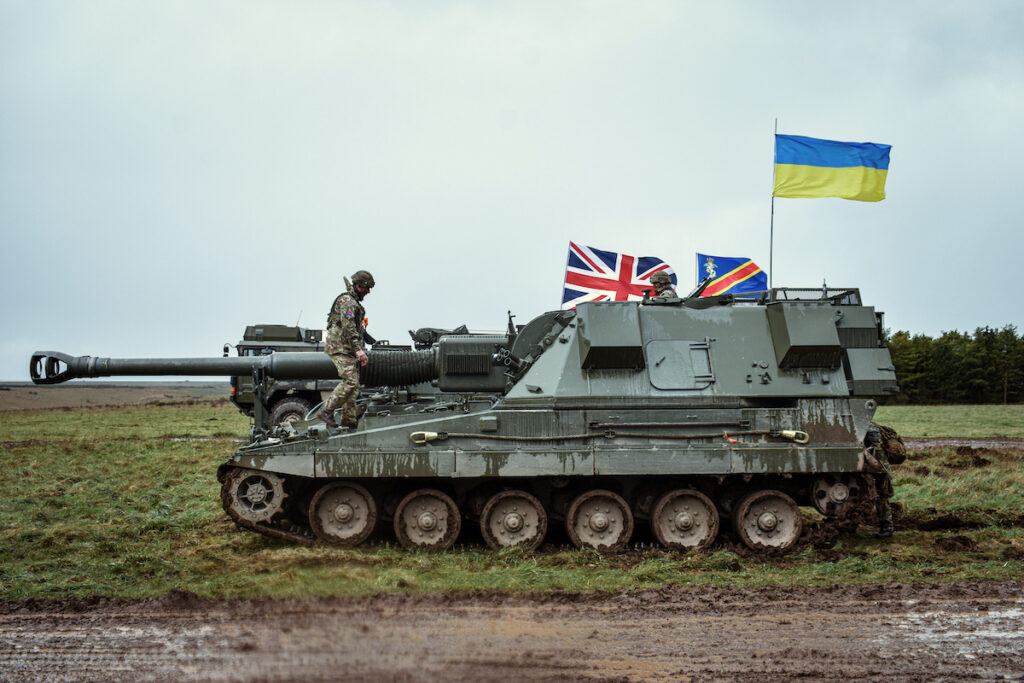
The first cannon shots rang out at 9:55 a.m., just before a heavy downpour on the muddy field. On top of the AS-90 howitzers flutter Ukrainian flags, next to Union Jacks. Sergeant Burnfield grabs her walkie-talkie and orders the six artillery pieces to open fire. Almost fifty rounds are launched over the next half-hour. Thirty of these weapons will soon leave from London with the Ukrainians.
Britain's largest military training ground is an uninhabited zone 30 kilometres across. Sited 3,000 kilometres from Ukraine’s front line, covered by the tracks of military machinery, these flatlands of southwest England are usually veiled by military secrecy. The base is one of four where the British have trained more than 10,000 Ukrainian soldiers since the start of the conflict.
Mikhaylo, 33, is one such volunteer. The father of a four-year-old boy, he was a farm-machinery specialist in Ukraine's northern region of Chernihiv. His training started three weeks ago: "As soon as my town was liberated, I joined the army. I have to do my best to protect the motherland."
As a precaution against reprisals, the Ukrainians only show their eyes. The soldiers can be distinguished from the British instructors by the fact that their jackets have no camouflage.
Who are these trainees?
Of the 150 recruits present that day, half had already faced the horrors of the frontline. The choice of soldiers to be sent to the other side of Europe is a regular subject of interest.
According to Emmanuel Dupuy, president of the Institute for Prospective and European Security (IPSE), the training is mainly for cadets (apprentice officers). But senior Ukrainians are in the minority around the weapons at this site: most men are already intimately familiar with artillery. Yuriy has been at war since Russia's annexation of Crimea in 2014: "This training allows me to perfect my technique and to fire more accurately." The gun Yuriy practises on has a range of 25 kilometres.
London keeps a tight rein on communications
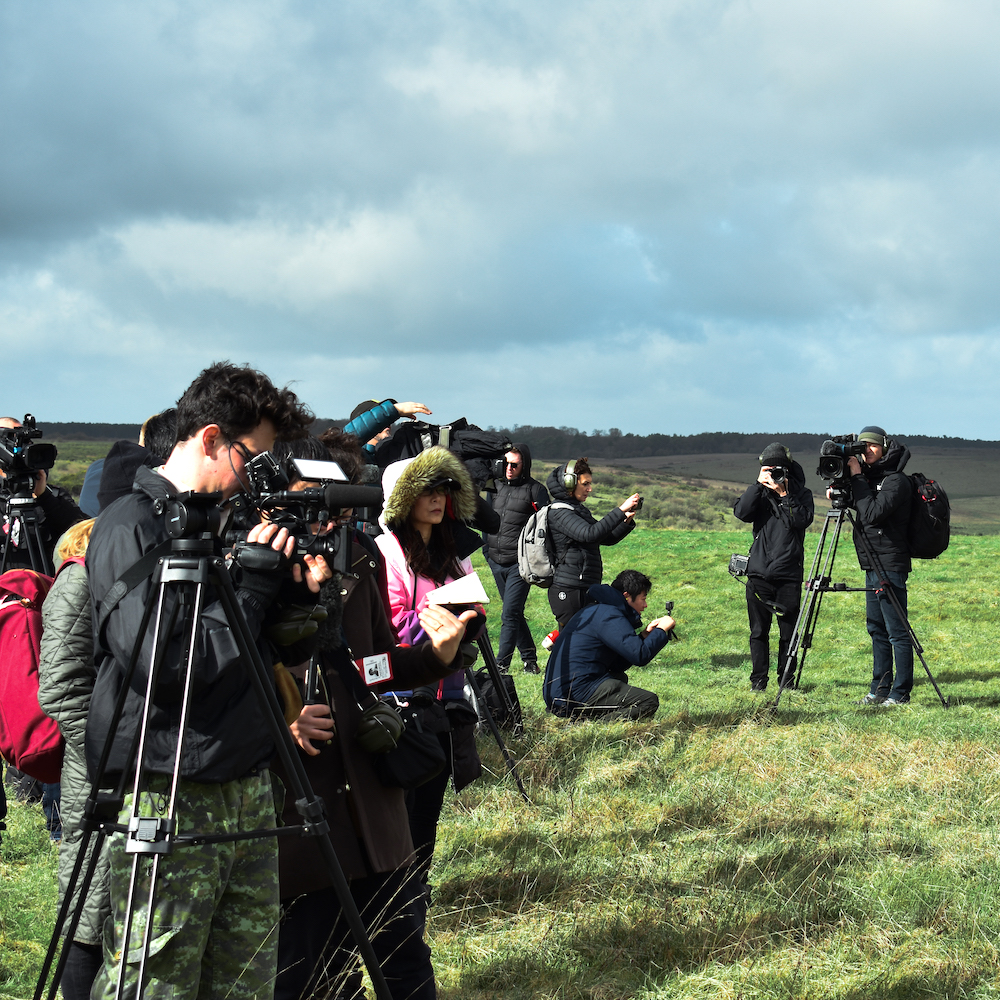
Eighteen journalists were present to watch the manoeuvres on this Friday morning in March. They had received their accreditation in just a few days, and the efficient logistics of the visit made it successful PR for the British Army. By contrast, similar EU-organised exercises remain highly secretive and closed to the press. In Emmanuel Dupuy's interpretation, "the corporate culture of the British armed forces has always been extremely communicative." He points to a habit of public diplomacy that the British have mastered perfectly.
That such training should take place on the western fringes of Europe has raised eyebrows, given that perfectly good sites are on offer in nearby Poland. Bringing thousands of Ukrainians to France, Germany or the UK entails complex and costly logistics.
Poland as a hub for international aid
In reality, Poland takes over as soon as the Western powers deem the Ukrainians fit to return to combat. Poland is the central actor in the Western strategy.
Ukrainian troops selected by Kyiv for training pass through Rzeszow-Jasionka airport, just like 80% of military and humanitarian aid. Before the invasion, Jasionka was a hub for budget airlines. Now its tarmac is the scene of an unceasing ballet of military cargo planes. Trains and trucks then take over to reach Ukraine, 100 kilometres further east. This will be the route taken by Mikhaylo and Yuriy on their repatriation from England.
Jasionka is a reflection of what Poland has become since March 2022: the gateway for European aid to Ukraine. (The United States has its own base at Mielec.) Emmanuel Dupuy talks of a "Polonisation of NATO power". It is a novelty for a country that had got used to being sidelined because of the illiberal drift of its government. By the end of 2023, Poland is expected to be spending 4% of its GDP on its defence budget, the highest such level among NATO countries.
The Baltics: spearhead of NATO
Among the "Bucharest Nine" alliance, Poland is not the only nation to be asserting itself on the international stage. NATO also leans heavily on the three Baltic states, led by Estonia.
In terms of aid to Ukraine as a proportion of GDP, Estonia is the most generous country of all (1.07% of its GDP), and it is closely followed by its neighbours Latvia and Lithuania. By comparison, the figure for the United States is 0.40%. The Russian invasion has reshuffled NATO's European cards, notwithstanding grumblings from the Franco-German duo.
Estonia, which borders Russia, has taken one of the hardest lines on Moscow. "Estonians are constantly preparing for war," says Katerina Kesa, a lecturer at Inalco in Paris. In Estonia, Latvia and Lithuania, the training of Ukrainians is virtually off-limits to journalists.
Military service: Tallinn chooses innovation
In addition to its commitment to training the Ukrainian military, Estonia is also rearming and preparing for a hypothetical Russian invasion on its own soil. Hanno Pevkur, Estonia's defence minister, explained Tallinn's objectives to The Kyiv Independent: "the Estonian army is set to grow from 10,000 soldiers to 20,000 by the end of the year."
To achieve this, a somewhat novel strategy is being put in place. For their compulsory 11-month military service, Estonians can now choose their comrades-in-arms. As other European armies struggle to attract recruits, Estonia’s young conscripts are effectively being allowed to serve in the same unit as their friends, via a list they draw up beforehand.

On Tuesday 7 March, at the Tapa base in eastern Estonia, these young conscripts are training on K-9 Thunder howitzers, equivalent to the British AS-90. In this barracks, which houses 3200 soldiers, they sometimes come across those men with the yellow and blue flag patched on their arm, also in training.
Laask, a 20-year-old Tallinn native who is now a unit leader, said: "After an initial thirteen-week course, the training has become more tactical and we can now consider ourselves specialists. It's great to be able to shoot with a weapon of this size!" The average age of the unit is only 23. The thermometer shows -14°C but the mood of the group warms things up. Waiting for the instructor to check the setup of their camouflage, the ten young people laugh, joke and share cigarettes.
Do you like our work?
Help multilingual European journalism to thrive, without ads or paywalls. Your one-off or regular support will keep our newsroom independent. Thank you!


