











Select a language
Hélène Rytmann-Legotien died, strangled by her husband, the philosopher Louis Althusser (1918–1990), in their campus apartment at the École normale supérieure (ENS) in Paris, where Althusser was secretary for the school of literature. It was 7.55 am, 16 November 1980.
Althusser, who had been diagnosed with manic depression as early as 1947, and was experiencing depressive episodes in the months leading up to the crime, immediately confessed his guilt and was admitted to the Sainte-Anne psychiatric hospital in Paris.
Althusser was a prominent figure and an authority in his field. The ENS is one of France’s most prestigious and selective higher education institutions. The case was dismissed in February 1981: Althusser was declared not criminally responsible under Article 64 of the French Penal Code.
Althusser died in 1990 and was widely honoured for his contribution to culture.
The banality of (male) evil
It took over 40 years for this murder to be recognised as a femicide, and only thanks to the work of feminists, researchers and activists who kept the story alive.

In 2023, a book appeared that caught the attention of the media: Althusser assassin, La banalité du mâle (“Killer Althusser: The Banality of Men”, Remue-Ménage, 2023), written by the Canadian political scientist Francis Dupuis-Déri, an expert on social movements, anti-feminism and masculinity.
The pun in the book’s title, playing on the identical pronunciations of mâle (male) and mal (evil) in French while invoking the title of Hannah Arendt’s most famous work, is one that is now frequently used by feminists.
With translations appearing in English and Indonesian in 2025, and German in 2026, the book and its subject matter have clearly resonated with readers around the world. Further translations are in progress.
Who was Hélène Legotien?
“When I was researching this murder,” Dupuis-Déri tells me, “I thought that this was a story from the past, from another century.” Instead, as he recounts in the afterword to the English and German editions, he received dozens of letters bearing witness to a memory that was still alive, though not yet fully communicated or processed.
“I believe the first thing I ever learnt about Althusser was that he had killed his wife, and that he had done so at the ENS,” Lucie Rondeau du Noyer told me last April, whom I met in a Haussmann-style flat in northern Paris last April. A PhD candidate in the history of economic thought, a historian by training, and a former student of the ENS, Rondeau du Noyer has worked meticulously to reconstruct Legotien’s life and work.
“If the aim is to give someone back their voice, it’s a good start to use the name that the person chose for themselves,” says Rondeau du Noyer, noting that Hélène Legotien’s name appears in various forms: Hélène Rytmann, Hélène Legotien or, indeed, Hélène Rytmann-Legotien.
Hélène Legotien was born in 1910 in Paris. Her family, of Jewish origin, had fled the Russian pogroms. From 1944 onwards, explains Rondeau du Noyer, Hélène Rytmann began using Legotien as her surname, without officially changing it. The name is likely a reference to her past in the Resistance, though there is insufficient evidence to confirm this.
Althusser and Hélène Legotien, who was eight years his senior, met in 1945 and married in 1976. Hélène Legotien worked as a researcher at the Organisation for Organisation européenne de coopération économique (OCDE) between 1951 and 1954, and as a sociologist for the Société d’études pour le développement économique et social (SEDES). Her primary focus was agriculture and rural development systems. Along with other figures she helped shape “a critical and Marxist approach to development” in the 1960s and 1970s, writes Rondeau du Noyer.
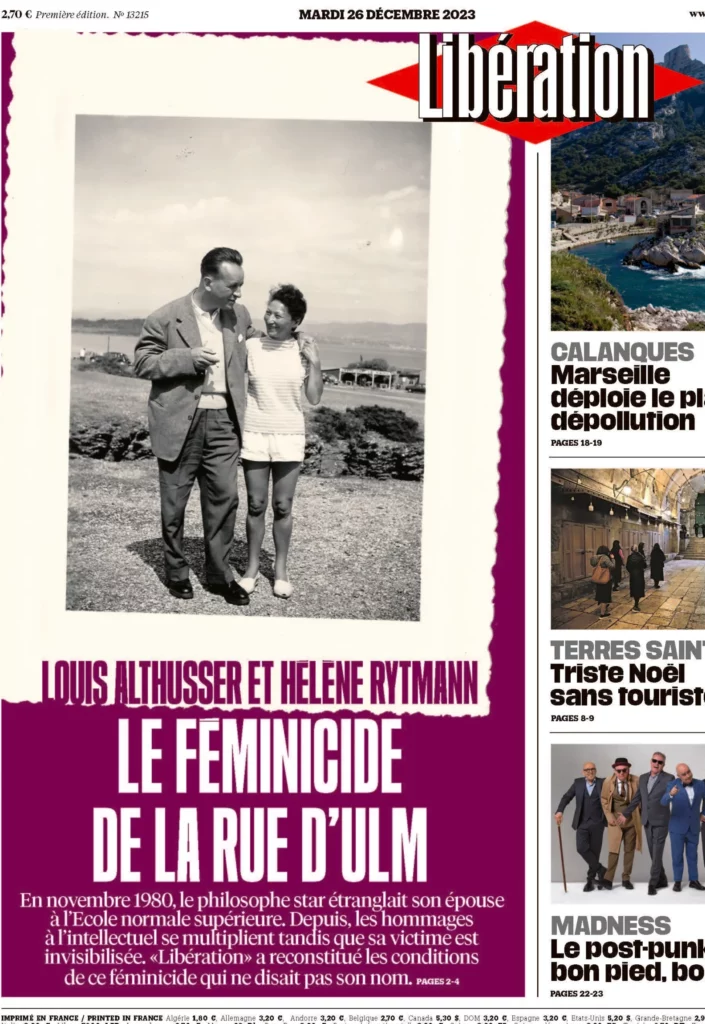
The final months of Legotien’s life were recently recounted in an article by Johanna Luyssen, published by Libération in December 2023, which deserves credit for bringing the story back into the spotlight. Luyssen’s piece features the account of Jo Ros, who had been working with Legotien in 1980, a few months before her murder. They had been working on a project in Port-de-Bouc, a town in the south of France, to preserve the memory of the local working class.
The sociologist, by this time retired, walked into Ros’s office in February 1980 to ask if she could volunteer on the project. She introduced herself as Hélène Legotien. She would later reveal that she was the wife of Althusser, and asked that this be kept secret. Though Hélène Legotien was 70 years old, she still had the desire and energy to be part of a project she had heard about on the radio, in a town she had never visited.
What interested Legotien, explains Rondeau du Noyer, were “the reasons behind the persistent misery and exploitation of the working class despite the three decades of strong economic growth that France had experienced since 1945.”
The news of Legotien’s murder deeply affected the research team she had worked with in 1980. When the research was published in 1984, “in memory of Hélène Legotien” appeared under the title—Du chantier naval à la ville : la mémoire ouvrière de Port-de-Bouc (“From the shipyard to the town: the workers’ memory of Port-de-Bouc”).
“With the resources at her disposal and despite the limitations of the time, Hélène Legotien managed to build a brilliant career as a researcher. She also inspired people who are still alive today, who bear witness to the fact that it was she who taught and trained them,” adds Rondeau du Noyer.
The murderer front and centre
Despite her career spanning many years, Hélène Legotien was always referred to as “the wife of”, “the spouse of” or even “the woman strangled on Rue d’Ulm”. Her name, if it appeared at all, was always buried at the bottom of the articles, explains the investigation published by Libération.
Similarly, the account of this femicide was first told by Louis Althusser himself in his autobiography, L’Avenir dure longtemps (The Future Lasts Forever). Published posthumously in 1992, the book initially sold 35,000 copies and has been translated into a dozen languages.
In the book, Althusser writes his own story, recounting his depression and suffering as a form of justification and giving the events the meaning he himself attributes to them. The book was presented as a “candid account”, and “hailed by intellectuals as a ‘masterpiece of autobiographical literature’”, writes Dupuis-Déri, who regards it as “often trivial and, on the whole, repulsive.”
In his autobiography, Althusser asserts that Legotien had harboured suicidal thoughts in the final years of her life, implying that he had merely helped her fulfill her dream.
In an article published by Le Monde In 1985, journalist Claude Sarraute, speaking of another murderer, the Japanese Issei Sagawa, wrote: “in the media, as soon as we see a prestigious name involved in a sensational trial – Althusser, […] – we make a great fuss about it. The victim? Not worth two lines. The undisputed protagonist is the culprit.”
Discussing Althusser’s account of his own crime, an article published by Der Spiegel in 1992 states: “With clarity and in impeccable prose, Althusser describes an inner drama.” There is not a single word about the victim.
“We can compare this empathy for Althusser with that expressed in similar circumstances. For example, the murder of the actress Marie Trintignant in 2003 by her partner, the rock singer Bertrand Cantat. In both cases, the killers were men belonging to the intellectual or cultural elite”, continues Dupuis-Déri, who quotes the Canadian scholar Lucile Cipriani:
‘Philosopher or not, Marxist or not, mad or not, Althusser is neither more nor less than one of the countless men who, every year, kill their partner or ex-partner. The neglect of social patterns and categories in this case is especially remarkable given that the murderer was the most influential Marxist theorist of his time’ – Dupuis-Déri
“An abuser’s narrative can take up all the space, completely diverting attention from the victim’s suffering to that of the abuser. […] The childhood misfortunes, the jealousies and break-ups, the wounded egos, the pain of existence and the desire for control characteristic of those who abuse women are regularly described by the media. […] Culture offers a platform for the perpetrators’ narrative – a narrative [which] not only diverts attention from the victims’ suffering to their own, but also helps to perpetuate the violence.”
The accepted explanation at the time was that of the murderer’s “insanity”– a thesis that Althusser himself employs in his autobiography. Thus, the problem is presented as personal and singular, rather than structural.
“So much imaginative effort goes into formulating seemingly sophisticated hypotheses, but so much effort is also put into forgetting a relatively simple fact: philosopher or not, Marxist or not, mad or not, Althusser is neither more nor less than one of the countless men who, every year, kill their partner or ex-partner. The neglect of social patterns and categories in this case is especially remarkable given that the murderer was the most influential Marxist theorist of his time”, writes Dupuis-Déri.
Althusser and masculism: feminism as an ideological adversary
According to Libération journalist Robert Maggiori, “to understand this case, you have to understand the immense influence and clout that Althusser wielded over the French intellectual world. (…) He was a guru (...). In pre-‘68 France, [Althusser] exerted a great deal of influence. Régis Debray, Bernard-Henri Lévy, Alain Badiou, André Comte-Sponville… they were all his disciples. Sometimes they would break with him in a spectacular fashion. Being an Althusserian was like adhering to a religion. [Althusser] presided over the era of intellectual gurus: Deleuze, Derrida, Foucault…”
“In the 1970s, across the world, and especially in England,” Althusser’s influence was fundamental, both in academia and within political groups on the communist left, explains Michel Lacroix, a lecturer in the Department of Literary Studies at UQAM.
“Althusser’s influence lent academic legitimacy to Marxism, particularly with Lire le Capital (“Reading Capital”, 1965) and Pour Marx (“For Marx”, 1965)”, he adds. “Althusser was one of the most widely read and most frequently cited thinkers”, which is certainly not the case today.
Whilst working in Althusser’s archives at the Institut Mémoires de l’édition contemporaine (IMEC), Michel Lacroix discovered two unpublished texts by the Marxist philosopher. Thanks to the help of Lacroix and Dupuis-Déri, I was able to view these documents.
In these writings, Althusser speaks of feminism as an “ideological movement” that identifies men as primarily responsible for the exploitation of women. In his view, the movement aims to take “historical revenge”, and even “bring about the physical and social separation of certain groups of women.”
‘What is striking is how the primitive anti-feminism we associate with today’s masculinism could also be present in a theorist of the highest calibre and international stature such as Althusser‘ – Michel Lacroix
Althusser goes on to argue that one could hypothesise the emergence of “a ‘masculinist ideology’” which attacks “the centuries-old exploitation and oppression of Man by Woman”.
Francis Dupuis-Déri, who discusses some of these passages in the English and German afterwords to his book, tells me that they are most likely a reaction to radical feminism and, in particular, to a text by Christine Delphy, “L’ennemi principal” (The Main Enemy), published in 1970 in the journal Partisans and subsequently turned into a book.
Althusser’s text, unearthed from his archives, is in line with other “classics” of anti-feminism in its portrayal of men as the victims of women, only in this case the author actually murdered his partner. As Dupuis-Déri writes, “Today, we know well what such victimhood resentment can justify, in terms of murderous violence.”
For the most part, feminism was often seen as a secondary issue in Marxist circles (a view that is still common among certain factions), because the primary struggle was that of the working class. “If feminists gave rise to a movement of their own,” Lacroix says, “it is because within Marxist movements, the struggles of women were always relegated to a secondary role.” From this perspective, Althusser’s “anti-feminism” fits within this paternalist lineage and hierarchy of struggles, which was also the case for the “vast majority of Marxists of the time.”
But, Lacroix adds, “Althusser goes further.” What is striking is “how the primitive anti-feminism we associate with today’s masculinism could also be present in a theorist of the highest calibre and international stature such as Althusser. It reveals a powerful patriarchal foundation, but also something that is perhaps new: Althusser invents masculinism for himself.” This, the scholar explains, reveals “a sort of terror or resentment which drives him beyond his usual points of reference”: feminism is no longer a “secondary ally”, but becomes an “ideological adversary, a deviation to be defeated at all costs.”
According to Francis Dupuis-Déri’s definition, masculinism is an “anti-feminist current based on the mistaken idea that men suffer because of women, feminists and the feminisation of society”, a narrative that fuels the myth (taken from the title of the author’s book of the same name) that there is a “crisis of masculinity”.
This does not mean that everyone who subscribes to elements of masculinist discourse is prepared to kill. What is important to remember, adds Dupuis-Déri, is that, within the “overarching logic of masculinist discourse and ideology”, there are elements that can be repurposed to justify femicide.
Following research by Lucie Rondeau du Noyer, Nathalie Léger, director of IMEC, has initiated a project to establish a Legotien archive within the research centre.
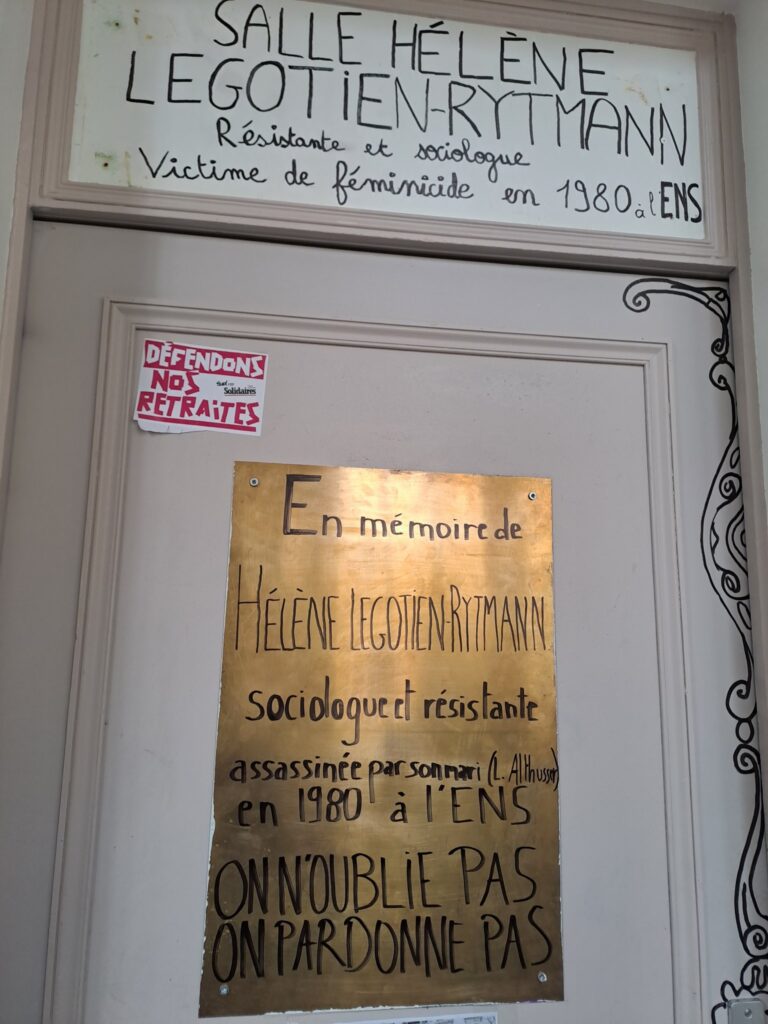
In March 2023, a group of students renamed the Aron Room the ‘Hélène Legotien Rytmann Room; Resistance fighter and sociologist; Victim of a femicide at the ENS in 1980’: subsequently, the school’s management decided to dedicate another room to the memory of Hélène Legotien Rytmann: the announcement was made on 25 November 2024 during a ceremony and work is currently underway.
The room is expected to open to ENS students during the 2026–2027 academic year.
Louis Althusser in Greece
The daily newspaper Efsyn explains that Louis Althusser has been very well received in Greece. There is a whole bibliographical and academic tradition centred on him, with his works having been translated and monographs and doctoral theses having been written about him. He also features regularly in theoretical publications. However, no public Greek feminist campaign concerning Hélène Legotien has been identified, nor is there any known Greek commentary reinterpreting the murder of his wife as femicide.
In most Greek texts on Althusser (book reviews, intellectual histories and academic references), the murder is mentioned briefly and attributed to his psychiatric condition. The analysis then immediately returns to the philosophy of his work.
Nevertheless, over the last two to three years, even intellectuals and journalists who admire his work have gradually begun to use the term “femicide”, as in the case of Panagiotis Sotiris, a lecturer, PhD holder in Political Philosophy and author of a thesis on Althusser’s work, who has written another article about him. In the article, Sotiris refers to Legotien, writing: “Not only as a victim of femicide – for that is what it was, regardless of the treatment Althusser received – but also because the importance of her research and contribution to sociology, and her role as an irreplaceable point of reference and inspiration for Althusser, has been and continues to be underestimated in the vast majority of studies on Althusser”
🤝 This article is part of the collaborative journalism project PULSE Europe, of which Voxeurop is a member. Contributors include Flora Mory (Der Standard, Austria) and Kostas Zafeiropoulos (Efsyn, Greece)
Do you like our work?
Help multilingual European journalism to thrive, without ads or paywalls. Your one-off or regular support will keep our newsroom independent. Thank you!