












Select a language
 11 days of discussion and hardly a thing to show for it. Just hours away from curtains on the UN Climate Change Conference, no-one seems to believe the goal set for the conferees can be achieved. Apparently, a binding agreement to curb carbon dioxide emissions and keep global warming down to two degrees centigrade is politically out of reach. The blame goes to a number of key players, starting with the Danish government hosting the summit. “The Danes are incompetent,” headlines Politiken, summing up the international verdict on the presiding nation. Its compatriot paper, the Berlingske Tidende, trains its sights on climate minister Connie Hedegaard, “disparaged for her want of patience and politeness”. But if the big countries prevented the Danes from clinching a deal, argues the Danish daily, it’s because they didn’t want the “kudos for an agreement going to the Danish government”.
 The Copenhagen conference is about to end in a “big belly-flop”, anticipates the Spanish daily ABC. “International public opinion is at a loss as it watches a sort of haggling between incompatible positions,” writes the conservative paper, pointing its finger at certain leaders’ “institutional ecologising, which reveals the main shortcomings of such an approach”: after all, “ideology is no match for big economic interests”. “China holds the world to ransom”: The Independent of London accuses Beijing of refusing to assume its responsibilities as a major new polluter. And yet, as the Le Temps of Geneva observes, a “sea change” has occurred over the past few years. Before, the world was dominated by the US-Europe-Japan troika imposing its will on others, especially the Third World. Nowadays, “Brazil, India, China, Malaysia and plenty of other countries have opened schools of international relations that turn out formidable diplomats sincerely committed to defending their national interests. Better prepared and cheekier to boot, negotiators from the South have finally got over their complexes towards their European and American counterparts.”
A calamitous summit
 So are we witnessing the failure of a kind of diplomacy that is ill-suited to the present times? In Dziennik Gazeta Prawna, British philosopher John Gray expounds his bleak view of modern times: “The world does not speak with one voice on global warming or other issues. Rather than a new world order, we are witnessing global chaos.” “Each country seeks to achieve short- and long-term goals that it puts above global goals,” adds Gray. “It’s nonsense to believe we can save the planet.” Libération, on the other hand, tries to see the bright side in the 11th hour of this disastrous summit. The French daily editorialises that the mere fact that Barack Obama came to Copenhagen represents a break with the “self-seeking imperialism shamelessly practiced by his predecessor” and has rekindled “the dream of open-ended and effective international cooperation”. “This worldwide meeting should set a precedent,” the left-wing newspaper hopes. “In a word, we need to move on from realpolitik to a different approach. The mere combination of national interests, which served as the intellectual framework for old-school strategists, will not suffice to safeguard the future of the planet. It is the progress towards democratic world governance that will now determine the future of the human race.”
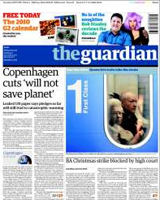 And after all, reflects Naomi Klein in The Guardian, “Better to have no deal at Copenhagen than one that spells catastrophe.” The Canadian essayist regrets that “Africa was sacrificed” during the discussion. “The position of the G77 negotiating bloc, including African states, had been clear: a 2C increase in average global temperatures translates into a 3–3.5C increase in Africa.”. Citing Matthew Stilwell of the Institute for Governance and Sustainable Development, “one of the most influential advisers in these talks,” Klein observes that “the negotiations are not really about averting climate change but are a pitched battle over a profoundly valuable resource: the right to the sky. There is a limited amount of carbon that can be emitted into the atmosphere. If the rich countries fail to radically cut their emissions, then they are actively gobbling up the already insufficient share available to the south.”
Growing green economy
In the aftermath of the Copenhagen disappointment, the time has come to rethink our relation to the planet. Noting that the Chinese and US economies “are, at the very least, so tightly interconnected that a hiccup for one could become a cough for the other”, Spiegel-Online argues that “mutual dependence must necessarily be reflected in climate policy”. So after this fateful face-off in Copenhagen, the two economic superpowers should now “enter into true economic competition for the greenest technologies”, a sure-fire source of abundant jobs and investment. An economist in the Standaard argues that “personal interest and the idea that green attitudes and entrepreneurship have something to offer will prove more successful than imposed regulations or a feeling of collective guilt”. Geert Noels, founder of Econopolis, an economic consulting firm, explains that “the green economy is growing every bit as fast as the Chinese economy. A country that adopts a sustainable economy will have a powerful driver of growth. Denmark and Germany have already got the message [...]. They didn’t wait around for binding regulations from Copenhagen or Brussels [...]. They don’t consider the green challenge a ball and chain, but a lifesaver for the economy.”
Do you like our work?
Help multilingual European journalism to thrive, without ads or paywalls. Your one-off or regular support will keep our newsroom independent. Thank you!