











Select a language
Chapter 5
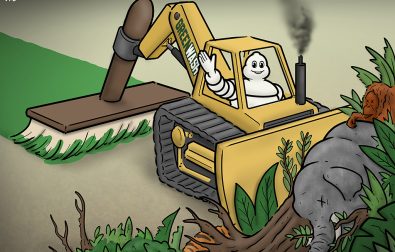
The island of Sumatra, in Indonesia, is home to one of the last remaining habitats for endangered tropical species such as elephants, tigers and orangutans. In recent years this landscape has been subjected to unbridled clearing, for timber, for rubber, and by illegal small-scale farmers. For several of those years, French tyre giant Michelin invested in the region in partnership with its Indonesian partner, the conglomerate Barito Pacific Group.
👉 All the articles from our investigation are available here.
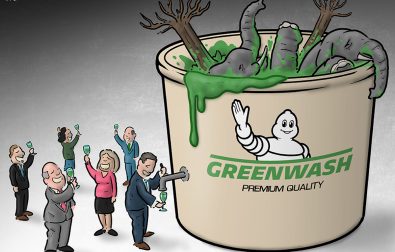
Financed by so-called "green" bonds, their rubber plantations were supposed to represent a form of reforestation. The tyre giant could thus claim to be protecting endangered animals while reducing its carbon footprint. In previous chapters, we revealed how Michelin and Barito were able to issue their certified sustainable bonds. The bonds were issued through the Tropical Landscapes Finance Facility (TLFF), a financing platform for projects related to the Paris Climate Agreement (see Chapter 1). TLFF was co-created by international stakeholders including the United Nations Environment Programme (UNEP) and the French bank BNP Paribas, as we revealed in the previous chapters of this investigation.
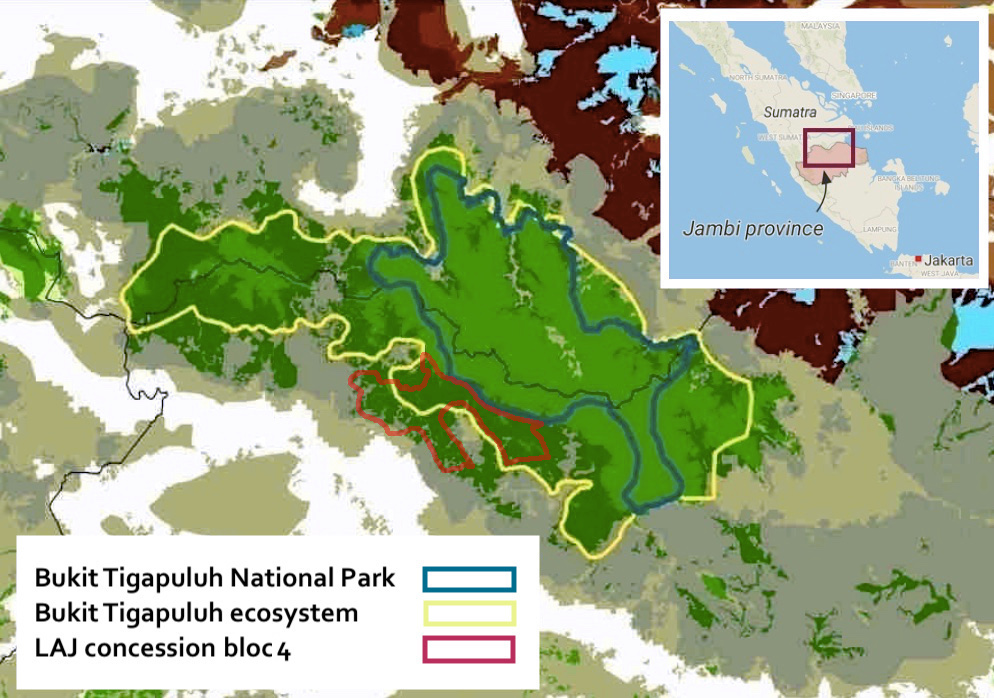
We explained how these plantations, owned by Royal Lestari Utama (RLU), a joint venture between Michelin and Barito, were set up on supposedly protected land on the edge of the Bukit Tigapuluh National Park ("Thirty Hills" in Indonesian), whose vegetation had been destroyed in a clear violation of green-finance criteria.
This habitat was reduced to almost nothing by the combined effect of RLU's industrial deforestation and the more "artisanal" deforestation carried out by illicit local farmers. It was against this grim backdrop, mostly hidden from investors, that Michelin and Barito Pacific took advantage of green bonds.
RLU's responsibility was finally acknowledged by Michelin in a recent exchange with our colleagues at Mediapart. Some of the project’s investors also recognised the abuse that had taken place. "No one is disputing what happened in the past, our aim is to do things differently", said Lisa Genasci, CEO of ADM Capital Foundation, during a meeting in December 2020 of her investment fund, the other co-founders of TLFF, and the NGO Mighty Earth. Voxeurop was able to consult the minutes of that meeting.
Michelin refunded the investors for the green bonds in summer 2022, after fully buying out RLU, in which it had previously held a 49% stake. The TLFF has since been disbanded and RLU has stopped commissioning progress reports from independent consultants. The latest report, covering 2022 and 2023, was published on 27 May 2024. Written directly by RLU, it makes no reference to the sustainability commitments made to green bond buyers, nor to the specific conservation targets that were previously quantified annually. We asked Michelin the same day some questions about the content of this report, but the group said it was not in a position to respond quickly.
"I don't think it's greenwashing when the financial sector rewards a change of direction by a company that has the power to drive conservation", says Bastien Sachet, CEO of Earthworm (which in 2015 carried out a field audit for Michelin revealing RLU's responsibility for deforestation). "We should focus on what has happened since RLU made its commitment not to deforest. We should check whether the objectives of conserving ecosystems (and also improving the livelihoods of local communities) have been achieved."
By looking at the official documents and data, and drawing on specialist expertise, we will show in this chapter how Michelin, despite some efforts, is still failing to live up to its commitments to investors – and is certainly nowhere near achieving its own environmental targets.
The Michelin era begins – badly
In 2015, to put a green gloss on its rubber venture, Royal Lestari Utama commissioned the environmental group WWF to approach the Frankfurt Zoological Society and a number of grassroots NGOs that had previously fought its deforestation operations. RLU's official aim: to find a way of preserving what remained of the ravaged ecosystems in the two concessions it owned in the province of Jambi, Sumatra.
As recommended in Michelin's 2014 audit by the environmental organisation Earthworm Foundation, RLU decided to commission an assessment to map both High Carbon Stock (HCS) and High Conservation Value (HCV) areas in all the concessions belonging to its subsidiaries, including those in Sumatra and Borneo. The assessment was carried out by Indonesian consultancy Tropenbos. Michelin can thus claim to have been the first big company to apply voluntary standards for the protection of ecosystems in the rubber sector (1).
However, rubber production continued in parts of a concession managed in Jambi by an RLU subsidiary, Lestari Asri Jaya (LAJ). The area in question was a transit zone for elephants and had been demarcated by Tropenbos as HCV. This derogation was agreed with the WWF itself, the company said. WWF declined to comment on the matter.
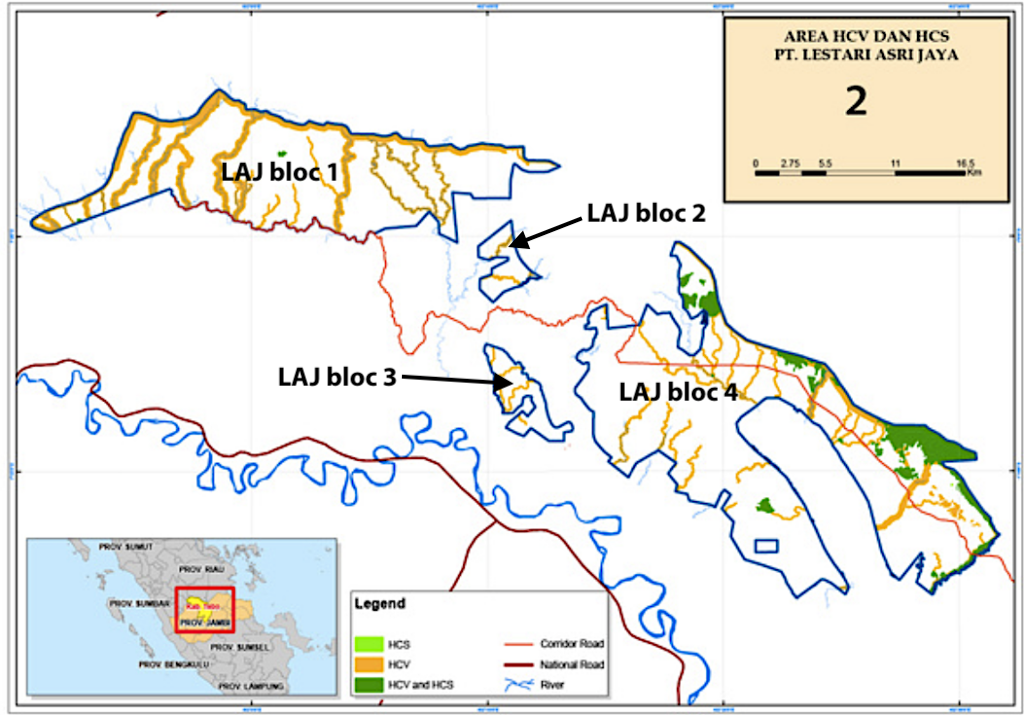
When RLU began operations in March 2015, Michelin imposed a six-month moratorium on logging until the Tropenbos study was published. Once the moratorium was lifted, the Royal Lestari subsidiary, LAJ, is alleged to have resumed clear-cutting in areas to be planted with rubber trees, including areas where elephant forests used to exist. The razed land included forest in which elephants lived, according to several testimonies from villagers quoted in a study carried out by researchers from Germany’s University of Göttingen.
"Every year, RLU would clear the shrubs that are the main source of food for the elephants", laments an anonymous source from the NGO Conservation International. "These parcels of forest were not likely to be saved in the long term, and there has only been marginal illegal felling by encroachers", counters Michelin’s public affairs director, Hervé Deguine, while acknowledging that RLU operatives later "mistakenly" cleared 125 hectares of forest that should have been left intact, which have been fully offset by the allocation of other areas of equivalent size for conservation.
WWF has provided us with evidence that, in addition, in 2016, new clearings were carried out, without specifying whether by RLU or by illegal loggers, in areas that the company is supposed to protect by being formally responsible for their management.
The Tropenbos assessment (which WWF itself found lacking) and its poor implementation seem to constitute a breach of the commitments made by Royal Lestari Utama’s two shareholders, Michelin and Barito Pacific. They could even represent a breach of the international principles on the protection of ecosystems (see point A of the documentation).
Green bonds: an embellishment of reality
Meanwhile, RLU and other local businesses operating in Jambi entered into discussions alongside Michelin with the WWF and Frankfurt Zoological Society. The NGOs urged them – unsuccessfully – to let elephants cross their concessions so as to alleviate pressure on local communities' land, and thus reduce the risk of the animals coming into conflict with residents.
"In 2017, the memorandum of understanding with the NGOs was finally cancelled due to the opposition of Edouard de Rostolan, in charge of sustainable development for the purchase of natural rubber at Michelin", another anonymous source at Conservation International told us. In a radio interview in 2023, Rostolan boasted of RLU's green achievements without ever mentioning the troubled situation on the ground.
Hervé Deguine defends his colleague Rostolan, saying that "the NGOs were proposing a much wider spacing between the rubber trees to grow bushes (as food for the elephants) and to let the animals use any area of the concession at any time, which would inevitably have caused major damage to the rubber and put our employees at risk from the elephants".
Behind the scenes, NGOs were denouncing Michelin's and Barito Pacific's lack of commitment to conservation, particularly that of elephants. Yet investors were presented with an idealised picture of the situation. At the bond issue, TLFF was trumpeting that "the project involves collaboration with WWF, which has worked with Michelin and Royal Lestari to set aside the remaining forests [...] in the RLU concessions".
It should be noted that the WWF was being paid by Michelin as part of a global partnership signed in 2015, while also being responsible for monitoring RLU's environmental performance. "If it is true [that there was such a payment], that is a huge conflict of interest", exclaims Alex Wijeratna, campaign director of the NGO Mighty Earth. “It is not because we have several partnership agreements with financial compensation that WWF has been complacent. We have had major disagreements,” says Deguine. For its part, WWF has denied that it was paid specifically for its work on the project in Indonesia.
BNP Paribas, the French bank responsible for marketing the green bonds issued by TLFF, carefully prepared the information prospectus, highlighting its socio-environmental goals while ignoring the deforestation previously caused by RLU (2). BNP Paribas also appears to have violated its own sustainability policy, which insists on respect for High Conservation Value areas, a respect that was flouted by Royal Lestari Utama. BNP Paribas declined to comment on its involvement in the project.
The marketing blurb for investors on the TLFF website (now inaccessible) indicates that 18,370 hectares out of a total of 70,716 ha in Jambi province (or 25% of it) were to be allocated to conservation, while 25,458 ha (or 36%) would be reserved for local subsistence farming. Only the remaining 28,026 ha (39%) were earmarked for rubber cultivation.
"The initial objective at Jambi was to plant 45,000 hectares," explains Luc Minguet, former purchasing director at Michelin. Hervé Deguine, the public affairs director, confirms that there was a change of tack: "From then on, we limited planting to a smaller scale. That is because, as the project moved forward in 2014-2016, some illegal growers rushed to settle in places where RLU was planning to put plantations, in an attempt to sell the land (which they didn't own) back to RLU."
Our source at Conservation International elaborates: "Most of the areas set aside for conservation in Jambi are in parts of RLU's concessions that it had already lost to illegal farmers. So there was no real sacrifice for the company, which would not have been able to plant rubber there anyway,” says our anonymous source at Conservation International, “this meant a net loss for conservation and maximum profit for the company, which in effect gave up nothing, despite the impression their official maps may give."
Production continues in the conservation area
The maps show in particular the Wildlife Conservation Area (WCA) which RLU created within the concession of its Lestari Asri Jaya subsidiary in 2017-18, following the issue of green bonds. This is a 9,700 ha strip stretching along the edge of the Bukit Tigapuluh National Park and two other separate concessions, known as ABT, which were managed by the WWF (3).
According to Hervé Deguine, "there was no longer any reason to sign the memorandum of understanding previously negotiated with the NGOs, because the creation of the WCA [...] was much more ambitious, allowing elephants to have more space to live in freedom". For his part, Deguine says that "RLU reallocated the WCA to forest conservation [..] even though rubber trees could have been planted there legally".
In reality, only a small part of the WCA is natural habitat. According to the former project website, there were 2,364 hectares of forest remaining inside it in 2019 (a year after its creation). That is less than a quarter of its total surface, defined by Deguine as a "forest area".
More than a quarter (around 2,670 ha) of the WCA is planted with rubber trees to the detriment of rainforest regeneration, according to Leo Bottrill, director of the geospatial technology company MapHubs, estimates. Of these, almost 1,800 hectares are managed by Royal Lestari Utama. RLU's continuing operations in this critical elephant habitat is contrary to the recommendations of the Tropenbos consultancy in its study.
“When we set up the WCA in 2018, we agreed with WWF that the existing plantations would be returned to nature at the end of the first 25-year operating cycle," admits Hervé Deguine.
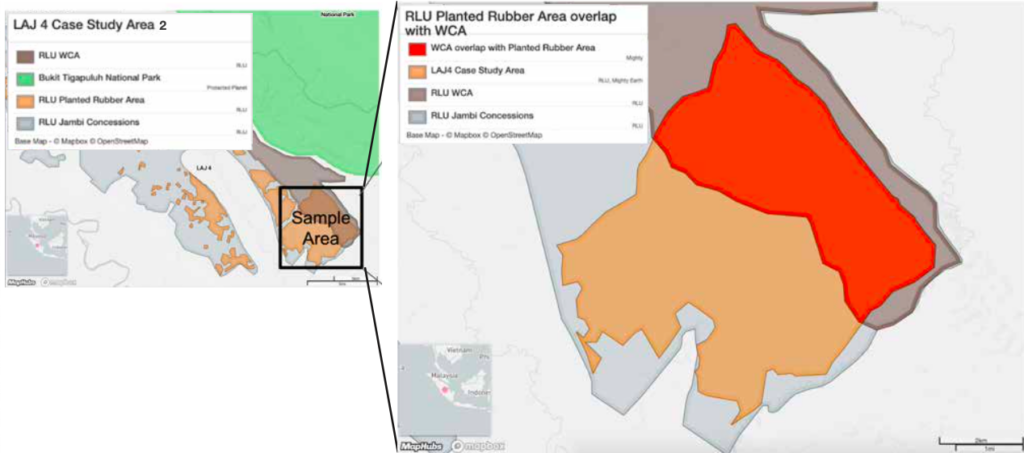
This plantation had been set up in 2013 by RLU after it cleared the area with the help of bank loans that were largely repaid with green bonds. This we revealed in Chapter 1 of our investigation.
The elephants’ losing battle
"The company has continued to hinder the movement of elephants in the area of the WCA still reserved for rubber production", claims our anonymous source at Conservation International. "Villagers and the Frankfurt Zoological Society have repeatedly had to warn Royal Lestari, the WWF and the Indonesian Nature Conservation Agency (BKSDA) of the increasing number of elephant intrusions into adjacent fields."
The same source warned against "delays in implementing conservation measures", because "the smaller the area where elephants can live, the greater the risk that human-elephant conflict will compromise the survival of the elephants".
Our source argues that "the WCA is not a safe habitat: angry farmers are pushing elephants out of it, and they have also erected illegal electric fences which, together with the traps set by poachers, pose a threat to the elephants".
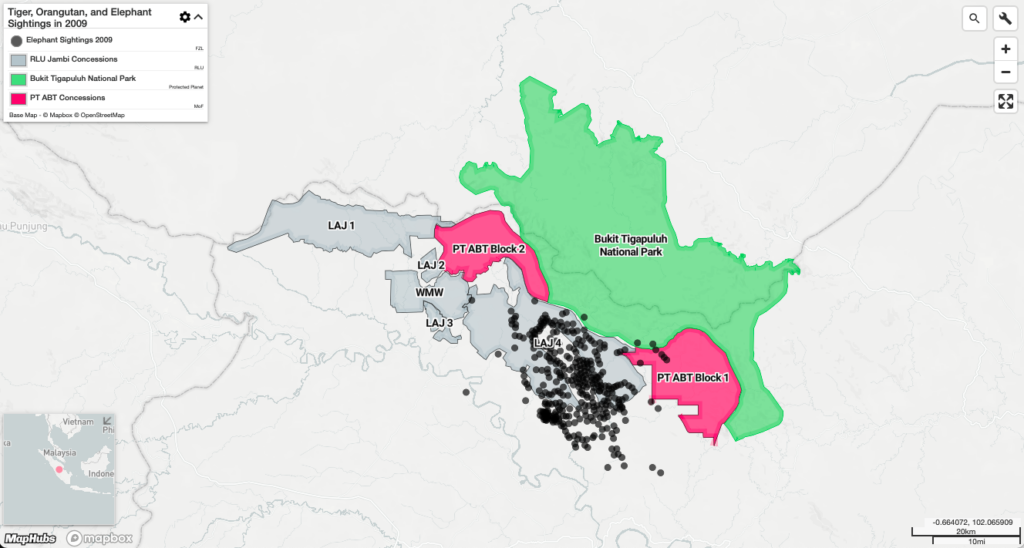
According to the local press, several elephants have been killed in the vicinity of Bukit Tigapuluh National Park since 2014, including at least three in the LAJ concession: the first in 2019; the second in 2022 (an infant elephant probably caught in a trap); and the third in May 2024 "as a result of electrocution near an illegal fence in an illegal palm oil plantation", according to our source.
Despite this macabre tally, Michelin claims that its elephant detection system and public awareness campaigns have "reduced the number of conflicts" and even that there are "more elephants" since the project was launched in 2015. “We don't have precise quantitative data, but we know, because we see it on the ground (many cameras are triggered when animals pass by)”, says Deguine, who adds: “It's obvious that in territories that we don't control, the situation may not improve”.
Yet one of the group's field managers in Indonesia admitted to us that there are "more young elephants in the groups". This fact does not necessarily mean that the population (currently around 150 individuals – 10% of all the specimens in Sumatra) is in good health, say scientists (as confirmed by several sources, see point B of the documentation).
A failure, in figures
In 2022 the consultancy firm Daemeter published a new analysis of areas of High Conservation Value in the Lestari Asri Jaya concession, based on research carried out in 2019. The analysis recommends freeing up an additional 15,000 hectares for habitat conservation. For reference, the Tropenbos study recommended only 12,150 hectares, which the WWF also deemed insufficient.
According to the analysis by Leo Bottrill, director of the geospatial technology company MapHubs, all the areas considered as HCV, more than a third (9,500 hectares) is currently covered by rubber monocultures. This includes those of Royal Lestari and those of the smallholders, many of whom are illegal. Some of these small farmers sell their rubber to Michelin as part of the partnership signed by the company with local communities.
"We don't encourage the farmers to plant rubber trees in these areas, but what can we do if they plant them anyway? And how can we then explain to the villagers that we are buying production from one of them but not from another?", pleads Hervé Deguine, Michelin's public affairs director. He adds that "there may be transitional clauses which include the purchase of certain outputs in return for long-term commitments. This is the only way for us to regain control of certain areas".
Taking into account that RLU also purchases rubber from smallholders in the Lestari Asri Jaya concession (around 18,000 hectares in 2019), the total area commercially exploited by the company may exceed the area it officially reported in its recently published report. This report only mentions the 18,750 hectares planted directly by RLU in Jambi (including the LAJ concession and the neighbouring Wanamukti Wisesa concession). This difference, which Michelin has not clearly explained, is apparent from the Indonesian government figures cited in Daemeter's report.


The Daemeter study confirms the ecological disaster, although it does not explicitly accuse Michelin. It merely states that "massive habitat destruction in recent decades has pushed elephants to the brink of extinction and led to intense conflict with humans". It acknowledges that the secondary forest within the WCA's perimeter "is a high quality habitat" that has been reduced "in the company's area due to the expansion of production and [...] cultivation by local communities".
The findings of the study imply that Royal Lestari Utama was responsible, directly and indirectly, for the net loss of biodiversity prior to its commitment to non-deforestation. This degradation took place long before Michelin came on board. Its aim was to ramp up sufficient production to attract investment, as we explained in the third part of our investigation. This contravened the standards of the International Financial Corporation (IFC), which Royal Lestari undertook to respect in the document provided by BNP Paribas to investors (4).
Furthermore, when the habitat is home to endangered fauna such as elephants, tigers and orangutans, the IFC standards become stricter. It was not enough for RLU to avoid the loss of biodiversity: a company must achieve a net gain in biodiversity by extending the protected habitats and therefore the surface area of protected forests inside or outside its area of operation, compared with the situation existing at the start of the project. This was recommended by the authors of the most recent reports on RLU’s socio-environmental progress (which were depublished following the company's takeover by Michelin).
What is currently happening in the RLU concession is exactly the opposite, even if the counter is set to zero (i.e. not taking into account the deforestation previously carried out by RLU). Natural regeneration and the active planting of native trees have not been fast enough to compensate for the continual clearing of forests by smallholders, including within the Bukit Tigapuluh park itself, next to the concession. Photos taken in November 2022 by our Indonesian partner Tempo show trees being cut down and trucked into the Lestari Asri Jaya concession.

"We cannot prevent illegal loggers from using the land in our concession as they wish; we have neither the means nor the right to do so", Hervé Deguine tells us. "It is the public authorities who must enforce the laws."
According to Indonesian government data, RLU reports and MapHubs's Bottrill analysis, forest cover (concentrated almost entirely in the WCA) appears to have fallen from over 3,000 hectares in 2016 to just over 2,000 hectares in 2022. This represents a loss of between 400 and 1,100 hectares of forest since Michelin's arrival (see point C of the documentation).
Michelin disputes this dramatic decline, arguing that the satellite analyses are inaccurate and insufficient to assess changes in forest area over time. The company claims to have carried out a more reliable study (which it has not published) making use of satellite images and field checks. “We can confirm that the current size of the forest is 2,831 hectares,” says Deguine.
Even such a one-off measurement, however, would not indicate a substantial reversal in the downward trend.

Michelin optimistic despite everything
The previous progress report, dated 2021, indicates that RLU was still not complying with IFC standards. The auditors from Ramboll pointed to a "lack of commitment [and] "motivation" within the company.
"The road is longer than we thought. Nine years is a very short time in such a difficult environment," says Hervé Deguine. The group claims that it is still committed to meeting IFC standards and that it has accelerated its efforts since becoming the sole shareholder of the plantations in 2022, following the purchase of Barito's shares.
"We are doing everything we can to meet and exceed our reforestation targets", adds Deguine, “We will conserve at least 5,000 hectares in Jambi that would have disappeared without us,” says Deguine (without specifying whether this includes part of Bukit Tigapuluh Park outside the concession). He adds that in 2023 Michelin released an additional annual budget of 1 million US dollars to reforest 3,000 hectares over the next twenty years.
The group has thus postponed by around fifteen years the promise it made to its investors in its 2019 Landscape Protection Plan. In this document, the Group announced that it would extend the forest area within the Lestari Asri Jaya concession to 4,480 hectares by 2033.
Incidentally, that represents almost half of the 8,468 hectares that – according to Bottrill's analysis – RLU would have cleared in its concessions before 2015 in the same province of Jambi. In the end, RLU "cleared the forest to make way for its rubber plantations, then sought public recognition – and investment – for a project to restore half of it", observes Wijeratna. Bottrill agrees: "Setting a deadline for rebuilding a forest in order to qualify a project as sustainable, when the timetable has not been met – that is greenwashing."
Johannes Kieft, former head of the TLFF secretariat and representative of UNEP (where he specialises in development and the green economy), paints a different picture: "Based on our assessment, since 2015 RLU has been effective in combating deforestation and, in the future, it will save more forests than those it cleared itself in the past." The decline in forest cover also calls into question the project's climate objectives. The CO2 absorption announced by RLU will necessarily be lower than the target (see point D of the documentation).
Michelin is naturally keen to blow its own trumpet. "We chose to go ahead anyway, even if it meant being criticised, to show that we can succeed in producing rubber in a sustainable way, even in some of the most difficult conditions in the world", says a spokesperson for the group.
A similar note is struck by Hervé Deguine, the public affairs director: "Of course, the project is not 100% successful! But what would have happened [...] if Michelin had not committed to building the RLU project? Would the situation today be better or worse?"
Notes and references
(1) The methodology for identifying and protecting densely forested areas with high carbon sequestration potential (High Carbon Stocks - HCS) was developed by Earthworm and Greenpeace and is overseen by the High Carbon Stock Approach (HCSA) organisation. In contrast, the methodology for areas that often have little or no vegetation but are critical for wildlife and indigenous people (High Conservation Value - HCV) was created by Earthworm and Greenpeace and is overseen by the High Conservation Value Resource Network (HCVRN). In theory, every land development project should be preceded by an HCS-HCV survey. However, given that deforestation is a thing of the past for most companies, in practice the HCSA and HCVRN methodologies only apply from the date the company commits to no future deforestation.
(2)The BNP Paribas document contains enticing phrases such as 'the borrowers propose to set aside half of the concession areas in areas reserved for local livelihoods', 'wildlife conservation' and 'forest/land protection/restoration' with the aim of creating 'corridors for the many iconic species' and 'creating a contiguous buffer zone to protect the Bukit Tigapuluh National Park from further encroachment'.
(3) These two concessions (around 38,000 ha), which should have been integrated with the WCA and the rubber plantations to form a green belt preventing the expansion of deforestation into the park itself, turned out to be a failure. In 2020, the government withdrew the management licence from WWF, blaming it for not preventing the fires set by illegal clearcutters. In the same year, WWF broke off its partnership with RLU, considering that the project no longer met its objectives.
(4) The BNP Paribas document refers to the prescriptions contained in the due diligence study commissioned by RLU from Daemeter Consulting in 2007. This is the only official document that RLU submitted to Vigeo Eiris, the social and environmental rating agency, when it hired them to assess and certify Green Bonds before they were issued. "The report [...] by the Daemeter consortium did not mention the illegal industrial-scale deforestation carried out by RLU," confirms Emilie Beral, head of methodology for sustainable finance, first at Vigeo Eiris and now at Moody's (which bought Vigeo), in an email exchange with Mighty Earth (consulted by Voxeurop).
👉 Glossary and abbreviations
👉 Read chapter 1: European green finance is paying for deforestation in Indonesia: the case of Michelin
👉 Read chapter 2: How a project decried for its environmental impact became a flagship of European green finance
👉 Read chapter 3: How Michelin and its Indonesian partner sidestepped the rules for green bonds`
👉 Read chapter 4: In Indonesia, Michelin turns a blind eye to environmental vandalism
The fieldwork in Indonesia carried out by our partner Tempo was supported by the Global Initiative Against Transnational Organized Crime. The investigation was also supported by the Environmental Reporting Collective, Journalismfund.eu, Mediabridge, the Environmental Reporting Collective and Grid Arendal.

With the support of Investigative Journalism for Europe
Do you like our work?
Help multilingual European journalism to thrive, without ads or paywalls. Your one-off or regular support will keep our newsroom independent. Thank you!