
















Select a language
Arriving at Tbilisi airport, you know immediately that you are in a special place. Georgia. The Caucasus. A female customs officer with fashionable glasses stamps my passport indifferently. A placid middle-aged Russian-speaking taxi driver drives me past crumbling Soviet-era buildings along a perfect highway framed by mountains and hills to Rustavi, half an hour from the capital. The emptiness and abandonment are palpable. We see the odd sheep grazing, and other signs of life, but the taxi driver says: "They all live in Tbilisi. There’s almost nothing left around here, nobody grows crops any more, there’s nothing left."
The landlady of the guesthouse where I am staying, Marika, is a primary-school teacher who has been teaching since Soviet times. She is adored by the schoolchildren and has lived here all her life. Her husband, Avtandil, works at the famous Rustavi metalworks in eastern Georgia, which was one of the largest in the USSR. Avtandil is 74 years old and wakes up every morning at six to go to the plant.
He is the brains of the pipes, as his colleagues put it: without him the metalworks would go to ruin because there is no generational continuity. The same thing happens in Russia and other post-Soviet countries with this type of industry. Salaries are low, even derisory, so no one wants to spend time learning such pearls of industrial wisdom.
Marika and Avtandil come to visit us regularly. They bring chacha (a type of brandy made from grape marc or fruit), which I have never tried, along with other excellent liqueurs – and cakes, which Marika bakes. Besides singing, playing the piano and knowing Georgian and Russian poetry by heart, Marika is also an excellent cook.
With me are Igor from Moscow, Nastja from Mariupol, and Yumi and Yuda from Osaka, a pleasant Japanese couple who arrived before us and decided to extend their stay until the end of April. Marika adores them: they are polite and modest people, always smiling and helping with the cleaning. In truth Marika dotes on us all, and while we are here we become part of her family, alongside the two children and grandchildren she already has.
A time machine
Rustavi has two souls: a new one and an old one. We live in the new one, the one that is teeming with life today. The old town was built by prisoners after the war. This was told to me by a talkative fellow passenger on the bus, who spoke Russian even with Georgians. "It was not only Germans who built it, but of course there were many of them here... I used to teach in the best kindergarten, but after the collapse of the USSR it was a disaster, children were fainting from hunger. There was no electricity, the water supply was patchy, even the food was bad. What hard times!"
The traces of the decadence of that time are still visible. Ghost houses with sealed windows, and so many abandoned Soviet buildings that one loses count. The contrast with the new ones is striking, it is like travelling from one era to another in a time machine. "We have a new mayor, a woman, she is energetic. Do you see how the city has improved with her?", says my travelling companion proudly.

If the new Rustavi resembles the modern suburbs of Moscow, the old one is more like a Stalinist Georgian city: solemn, geometric, austere. It stretches along the banks of the Kura and brings to mind the capital Tbilisi, which lies downstream on the same river.
Walking down the avenue and then across the bridge over the Kura – dotted with fishermen hanging out with their friends – one travels from the new town to the old town, and it feels like moving between eras. On the road connecting the two worlds it can even feel like Italy, or perhaps like a landscape sketched by Andrei Tarkovsky or Michelangelo Antonioni. Multicoloured houses, slightly faded, stand in the haze. A field of grazing sheep is set against a backdrop of mountains.
In the old Rustavi there is a beautiful park with a lake. For some it is like returning to childhood: here is the old pier, there are the pavilions from Soviet times. Although now covered in murals, the scene still inspires nostalgia, and indeed there is a certain childlike atmosphere despite the asphalt. The ruins of Rustavi's fortress deserve a wander: there are no staff, no security guards. The freedom is a kind of poignant dream that enraptures the soul. A dream from which one might prefer not to wake.
“You could breathe the vitality and joy. Now the cities are empty, the young people are moving to Europe.” – Marika
Teona, a friend from Tbilisi, is a filmmaker and photographer, a true bohemian Georgian with hippy parents, born and raised in Rustavi. She shows me another magical place in the old city: "My grandfather used to work here, at this water station in the city. It was a brilliant place. Here you would bathe in a huge round pool, like in the films of the Armenian director Sergej Paradžanov. Just imagine: white concrete, water and these men swimming around slowly... And now it is like this, abandoned. It's just how things are today!"
To Tbilisi and back
A minibus takes you to the capital. "They've been promising to build a metro line from Tbilisi to Rustavi for a long time, we've been waiting for six years," says Avtandil. What would happen if the metro arrived? The magic would end. But the city needs to develop.
Tbilisi is very politicised. Georgian attitudes towards Russians are . The official policy, with rare exceptions, is very balanced, neutral even. You immediately feel that there are lots of Russians around, because they make themselves known. But you also sense the dissatisfaction of some citizens: not everyone is happy with this presence. The crazy rental prices in Tbilisi, for example, are not at all appreciated by my taxi driver: "Now we pay like the Russians. We've become tourists in our own home."
On Saturdays, the most active Russian-speaking expatriates gather on Rustaveli Avenue. At the microphone, their voices broken with emotion, they declared that they do not support the policy of their government. They seem desperate to justify themselves. In reality, no one asks them to do so, and perhaps no one really cares. As a Georgian taxi driver in Tbilisi told me: "Why should we argue with you, everything is obvious!"
And it's not just a matter of money. The fact is that in Georgia "ordinary" people understand more than their politicians or the Russians themselves.
Tbilisi, despite being ten times bigger than Rustavi, resembles it underneath. The contrasts here are even greater. Food prices are even higher, a third more expensive than in Russia, while almost half the market consists of Russian imports.
On new year's eve In Rustaveli Avenue, Tbilisi's main street, I buy a volume of Pushkin's poems. The Georgian seller has a huge pile of books, mostly treasures from the Soviet era. There is everything, and I would buy all of it: from "Plants of the Tropics" to detective stories and art books about Michelangelo and Titian.
The crazy rental prices in Tbilisi, for example, are not at all appreciated by my taxi driver: “Now we pay like the Russians. We've become tourists in our own home.”
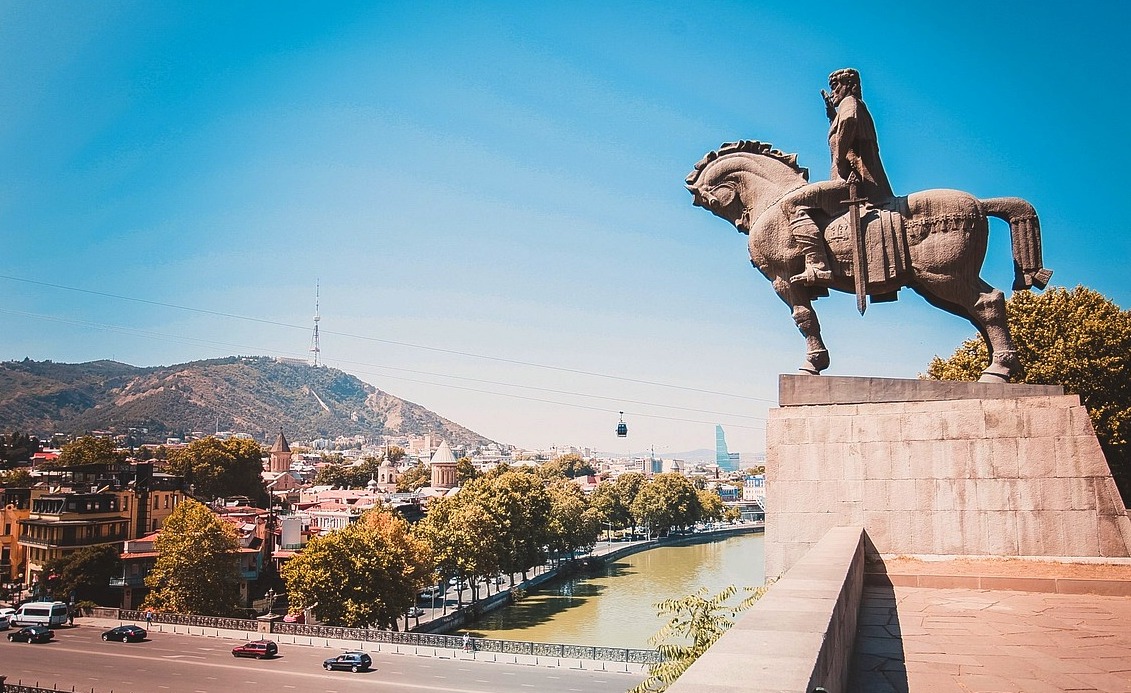
To an inexperienced traveller like me, coming to the Caucasus for the first time, Tbilisi reminds one a little of Moscow and Saint Petersburg. The former for its visible luxury and snobbery; the latter for its somewhat gloomy hallways that evoke the wells in the works of Dostoevsky and Gogol.
What I feel is optimism, joy even, despite the abundance of gloomy faces. Life in the capital has become expensive and difficult, but not everyone gives up. In fact people continue to enjoy life as much as possible.
Faith, music and poetry
Georgians are not only "hedonistic" or "gloomy at times", they are also melancholic. This is entirely appropriate for an ancient nation, and in it they resemble the Greeks. There is a kind of sadness in Georgians. Perhaps it is the Christian culture that predisposes them to philosophy. Both older and younger generations are attracted to faith.
Travelling in a minibus there is always at least one person who, with the tacit consent of the others, makes the sign of the cross at the sight of a church – not just once but three times. Even in hipster cafes young people can be seen making the sign of the cross, and marking their food, before eating. It is considered normal, and meets approval.
Many families go to church on feast days. Even Epiphany, which is celebrated on 19 January, is a public holiday. Christmas is on 6-7 January as in Russia, unlike the Greeks who celebrate it on 24-25 December.
On the day of Epiphany, Marika came to us dressed for a feast. "We have been Christians for the longest after the Greeks. We have churches from the third century. And what a history we have!" Marika is rightly proud of Georgia's cultural heritage. And she laments, understandably, that Georgian culture has long lived in the shadow of Russian culture. "What poets, what writers we have! But hardly anyone knows them. Rustaveli has no equal in the world, and what depth... Ilia Chavchavadze is our greatest contemporary poet, with such suggestive imagery in his poetry!" She recites some in Georgian. It sounds like music.
She also sings songs in Georgian together with Avtandil, to the accompaniment of a magnificent antique piano. It's like being in a drawing room of pre-revolutionary Russia. We all listen intently.
Her daughter Asmat, on the other hand, prefers Georgian rap. She is very sensitive to the lyrics, declaring to her mother: "This is the best rap of today, these words are really about us! They say that we have all become insensitive, that we are drawing water from a murky source..." Asmat gets misty-eyed.
Asmat's son Demetri knows little Russian – "the younger generation is like that, they grow up without Russian, they don't need it anymore" – but he speaks good English. And then I am told about a Georgian boy who liked the Russian TV cartoon series "Masha and the Bear" so much that he eventually learned Russian by watching it, and now he translates from Russian to Georgian.
These things happen in this country. Personally, I can't help noticing that many young Georgians understand Russian without any problem. And if it were not for politics and other excesses, there would be many more. We are still very, very close in certain aspects. It would be a shame if all this were lost.
Epilogue: leaving to return
There are changes in our house. Igor from Moscow is leaving for Southeast Asia. It had been a bit difficult living with him, but it had still been fun and moments of affection were not lacking. Before that, Nastja from Mariupol left. She liked it here so much that she will surely want to return one day. In their place is Anja from Sochi, a Georgian who lived in Rustavi as a child and has returned to obtain her citizenship.
Fates and paths intertwine, but the place remains unchanged. Rustavi is the same, sinking sleepily into a world of fables. "In Soviet times, this was a garden city: even the factory was well cared for, everything was beautiful and new and the city flourished," reminisces Marika unexpectedly. "You could breathe the vitality and joy. Now the cities are empty, the young people are moving to Europe."
She recalls her university years in Batumi, the best time of her youth. Avtandil says: "The Soviet Union should not have been destroyed! We were robbed of everything. The workers were left in the street." And not only the workers. Traces of this decadence are still visible here and there, even in touristy Tbilisi.
The last leg of this visit to the Georgian capital was a great success. We finally got to see the city's grandiose botanical garden, which is located at the rocky foot of a mountain. It has a waterfall and is overlooked by the Narikala fortress, making it a little world of its own. To see the whole garden is impossible: it seems never-ending with forking paths that bring to mind a Jorge Luis Borges story. An Avenue of Forgotten Fruits stands in memory of the great Italian poet Tonino Guerra. The effect is pure mysticism, like a daydream.
One way or another, Tbilisi embroiders a place for itself in your heart. We have got to know its simple, dream-like charm. It is one that stays with you.
👉 Original article on Republic.

Voxeurop is a partner of ZEG Storytelling Festival
Tbilisi (Georgia), 8-11 June 2023. 👉 Buy tickets here
Do you like our work?
Help multilingual European journalism to thrive, without ads or paywalls. Your one-off or regular support will keep our newsroom independent. Thank you!


