










Select a language
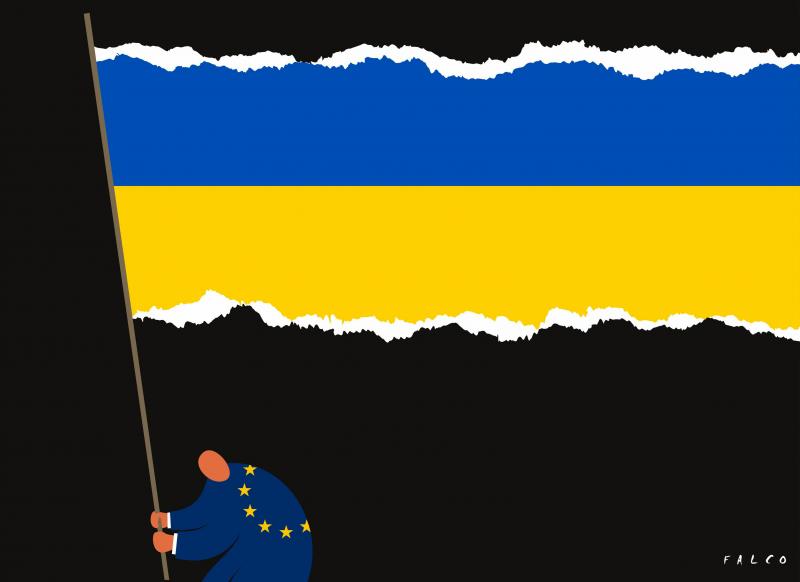
On 28 February 2022, four days after Russia's full-scale invasion of Ukraine, the country applied for EU membership. Speaking from Kyiv, President Volodymyr Zelensky called for Ukraine to be admitted immediately through a “special procedure” (although no such procedure exists under the EU's accession rules), and within hours, the presidents of eight member states had urged an accelerated process. The president of the European Commission, Ursula von der Leyen, endorsed the idea that Ukraine “belongs to the European family”.
This came just four days after the invasion began, marking the end of a period that started in 2013 when President Viktor Yanukovych's refusal to sign the EU Association Agreement sparked the Euromaidan protests. Dozens of demonstrators were killed in clashes and crackdowns in Kyiv; part of Ukrainian society was literally paying with its life for the idea of 'Europe' as a political and moral destiny, not merely a socio-economic direction.
EU-Ukraine: a troubled relationship
Beyond cooperation under the European Neighbourhood Policy, the prospect of European integration has long been presented in Kyiv as a means of modernisation and escape from post-Soviet stagnation. This idea is often invoked by pro-European parties during election campaigns. However, for many European capitals, Ukrainian ambitions — which intensified after the Orange Revolution in 2004 — had to be carefully managed and represented a delicate geopolitical and institutional risk, particularly in the early 2000s when several member states viewed relations with Russia as essential.
2014 marked the first turning point: the EU-Ukraine Association Agreement was signed in two stages in March and June, but did not fully enter into force until 1 September 2017 due to unexpected public resistance in the Netherlands. The agreement included a Deep and Comprehensive Free Trade Area (DCFTA), which aligned large parts of Ukrainian legislation and standards with those of the EU.
Another long-awaited symbol of this came in June 2017, when Ukrainian citizens with biometric passports were granted the right to travel visa-free for short stays (90 days within any 180-day period) in the Schengen area, with the usual EU exceptions.
However, until 2022, EU membership remained more of a distant prospect than a realistic goal. In its 2022 assessment, the Commission linked progress to structural reforms concerning the rule of law, corruption, and oligarchic influence. The Commission recognised advances, but also pointed to systemic fragilities. The so-called “enlargement fatigue”, which followed the “Big Bang” enlargement of 2004 and was reinforced by the economic crisis and austerity years after 2008, was also a factor in the background. The last accession was Croatia in 2013.
It was only after Russia's invasion that Ukraine's prospects became more concrete — after all, enlargement is primarily a political decision.
How EU accession works: criteria and acquis
Accession is not a discretionary political 'reward'; its framework is set out in the treaties. According to Article 49 of the Treaty on European Union, any European state that respects the Union’s values may apply. This triggers a lengthy process guided by Commission assessments and unanimous decisions by member states. The “Copenhagen criteria”, defined in 1993, provide the substantive compass: stable democratic institutions and rule of law, including respect for human rights and minorities; a functioning market economy; and the capacity to take on the obligations of membership. This means adopting the EU acquis (the political and legal heritage of European integration) and being able to cope with internal market competition.
Technically, alignment relates to the 33 chapters of the EU acquis. Under the current methodology, these chapters are grouped into six clusters: “Fundamentals”, “Internal Market”, “Competitiveness and Inclusive Growth”, “Green Agenda and Sustainable Connectivity”, “Resources, Agriculture and Cohesion”, and “External Relations”. A key political rule applies: the “Fundamentals” cluster is opened first and closed last, as it determines the pace and credibility of the entire process.
‘The anti-Ukraine wave of right-wing populist governments could also grow, even in western Europe. The countries most at risk are France and Germany’ – Roman Petrov
When, on 17 June 2022, the European Commission recommended granting Ukraine candidate status, it also listed seven immediate priorities: constitutional court reform; continued judicial reform; anti-corruption measures, including governance of anti-corruption agencies SAPO and NABU; anti-money laundering rules; implementation of the “anti-oligarch” law in line with the Venice Commission; alignment of audiovisual media legislation; and revision of national minority laws.
In its Ukraine 2024 Report, the Commission outlined the process that would lead to the formal opening of negotiations in June 2024. It noted that the remaining steps had been completed and that the reforms were considered satisfactory, paving the way for the adoption of the negotiating framework.
However, the problem is that the acquis requires years of screening, opening and closing clusters, and, above all, unanimous decisions at every stage, from progress to final ratification. This is where national vetoes come in. In recent months, Viktor Orbán’s Hungary has been the most vocal opponent, while Robert Fico’s Slovakia — another government close to the Kremlin — has tied its support to a 'strict interpretation' of accession conditions. Both countries, along with far-right and populist parties across much of the EU, also highlight the alleged unsustainability of Ukraine's impact on the EU budget.
According to Roman Petrov, the Jean Monnet Chair of EU Law at the National University of Kyiv-Mohyla Academy, this has created a paradox. The clusters are not 'officially' open, yet technical work continues informally through the so-called Lviv format. Meanwhile, Kyiv is waiting for political unanimity to turn these steps into formal negotiation stages.
However, that unanimity may not come soon, despite the ten-point plan presented by Enlargement Commissioner Marta Kos and Ukrainian Deputy Prime Minister Taras Kachka to speed up reforms and unlock the clusters. “For now we have problems with a couple of countries with a clearly anti-Ukrainian stance: Hungary and Slovakia above all.
These governments may change in the future, of course”, says Petrov. Hungarian general elections are scheduled for April this year, with Orbán’s party nearly ten points behind in the polls. “But the anti-Ukraine wave of right-wing populist governments could also grow, even in western Europe. The countries most at risk are France and Germany”, he adds.
The difficulties of a “fast-track” accession
In recent months, many analysts and politicians have called for faster and more streamlined enlargement not only for Kyiv, but also for other advanced candidates: Montenegro, Moldova and Albania, which are far smaller and less geopolitically significant than Ukraine. These hopes were revived in November when EU foreign policy chief Kaja Kallas said that new accessions by 2030 were possible.
For Ukraine, such scenarios resurfaced during the slow and opaque peace talks between Kyiv and Moscow, which were mediated by the United States under Donald Trump. Some have even suggested that Ukraine could join as early as 2027 as part of the security guarantees sought by President Zelensky, in the form of a “membership-lite” arrangement: technically inside the EU, but without full rights, including the veto. In a recent article, Politico's chief EU correspondent, Zoya Sheftalovich, outlined five steps to make accession in 2027 feasible.
“I don’t think this is a realistic prospect,” says Petrov. “We first need to define the terms. If we are talking about full membership, as it has always been, these timelines are not feasible. By 2027 Ukraine will not manage it; negotiations have not even started because they are blocked by Budapest and Bratislava. If we refer to other formats, we must remember that there is no such thing as ‘partial membership’ without voting rights. I think these are populist narratives without any real substance. Either we talk about full membership or nothing else, because other formats simply do not exist. Treaty reforms, partly because the current system is outdated and still based on unanimity, are necessary, but it is also unrealistic to expect them soon.”
Although the German chancellor Friedrich Merz has already ruled out any kind of light accession for any candidate state, including Ukraine, President Zelensky has diplomatically stated that Ukraine will at least try to be technically ready by 2027. Germany's position still carries significant weight in the European balance.
“We face a growing tension between the time which is needed to apply a credible, merits-based approach and growing pressure from external players on our candidates – pressure intended to raise the political cost of moving forward on their EU path,” the Enlargement Commissioner Kos said in Tallinn in early February.
“Our enlargement model requires time, stability and gradual reform. But today’s geopolitical environment is unstable and often coercive,” she added, warning that any new models under consideration must start from the same baseline: “Full membership comes only after full reforms.” Kos had already warned against admitting new “Trojan horses” into the Union, in order to avoid a repeat of the Hungarian scenario.
What can Kyiv realistically hope for?
“As long as the war continues, accession is not possible. I have written about this extensively,” says Petrov. “It is not possible for several reasons: security, economic and legal. And the member states themselves are not ready for it — to accept a country at war and therefore be responsible for its territorial sovereignty under the EU solidarity principle. Financial and military aid is one thing; sending contingents and soldiers is another. So accession is not possible while the war continues, even if some mention the Cyprus model. But the Republic of Cyprus joined the Union when fighting had been frozen for decades, with a peace plan in place and clear borders.”
However, this remains a matter of debate rather than an established EU position. Although serious political, legal and security obstacles persist, accession during wartime is increasingly being viewed in Brussels as an unprecedented challenge rather than an outright impossibility. Over the past year, preparations for Ukraine’s membership have progressed on several fronts. The so-called “Lviv format” has enabled the other 26 member states, together with the Commission, to accelerate the process.
Ukraine has received the detailed benchmarks and technical criteria that are usually only provided during formal negotiations. Work is now underway at a granular level, with the Commission unpacking interim and closing benchmarks on issues ranging from judicial reform to public procurement. However, during her recent visit to Kyiv to mark the fourth anniversary of the full-scale invasion, Commission President Ursula von der Leyen struck a cautious tone. She declined to endorse Kyiv’s ambition to join the EU by 2027, stressing that accession cannot be tied to fixed deadlines. Nevertheless, Ukraine continues to push for a clear timeline.
‘We must remember that there is no such thing as partial membership without voting rights. I think these are populist narratives without any real substance. Either we talk about full membership or nothing else, because other formats simply do not exist’ – Roman Petrov
Kaja Kallas has also said that EU governments are not ready to offer Ukraine a date for joining the EU, despite Zelensky’s request. “My feeling is that the member states are not ready to provide a specific timeframe,” she told a panel at the Munich Security Conference. “There’s a lot of work to be done.”
According to Petrov, the cluster most aligned with EU standards is External Relations, covering trade, foreign, security, and defence policy. Alignment here is mainly political and diplomatic, based on coordination between the foreign ministry and Brussels. Petrov says that it is mostly the foreign ministry’s job to harmonise our foreign policy with that of the EU.
The situation is different in the other chapters. In the Internal Market cluster, legislative reforms are technically feasible but could encounter resistance from certain economic sectors, particularly agriculture and food, which are traditionally protected by the state. The main bottleneck remains the Fundamentals cluster, which covers the rule of law and corruption.
Continuous reforms and tangible results will be required in this area: “Corruption continues, scandals do not disappear, and these areas will always be under the EU’s scrutiny”. Last summer's scandal involving the anti-corruption bodies NABU and SAPO – which parliament had voted to place under government control before Zelensky reversed course following mass protests – demonstrated the fragility of progress.
Petrov adds that many reforms are also difficult to implement in wartime, especially in areas such as connectivity and the green transition, as these require not only laws, but also investment and administrative capacity.
He also highlights two political factors that are often overlooked. The first is the evolution of US–EU relations: any divergence in strategy between Washington and Brussels would inevitably affect Kyiv, as it is allied with both. In this context, the future of NATO is also uncertain. If the alliance were to weaken or transform, many EU member states could advocate for a common European defence. In that scenario, Ukraine, with its military experience and strategic importance, would become a highly sought-after partner.
The second factor, which is often underestimated, is the need for internal EU reform. The current institutional architecture, based on the Lisbon Treaty, is widely considered unsuitable for large-scale expansion. Simultaneous accession by Ukraine, Moldova, and the Western Balkan countries would require significant changes, including curbing unanimity in certain areas and strengthening common policies, particularly defence. However, such negotiations would be complex and politically challenging for the twenty-seven member states.
In the end, Petrov agrees that “enlargement is first and foremost a political process”. Without unanimity among member states, even significant reform progress may not be enough: “these are the rules”. Every national parliament will have to ratify accession, raising difficult questions: “who will control the processes in national parliaments? And which governments will be in power when the votes take place?”
Even a country as strongly pro-Ukrainian as the Netherlands experienced a controversial referendum on the EU-Ukraine association agreement in 2016, which ended in victory for Eurosceptics. It still maintains a cautious stance. What might happen if such a situation were to be repeated in Hungary or other countries, as Orbán has proposed? The outcome would depend more on domestic politics across the Union than on Kyiv.
🤝 This article was written as part of a cross-border European journalistic collaboration within the EU Neighbours East project
👉 Original article on OBC Transeuropa
O
Do you like our work?
Help multilingual European journalism to thrive, without ads or paywalls. Your one-off or regular support will keep our newsroom independent. Thank you!


