















Select a language
Since Russia’s invasion of Ukraine, the European Union has radically changed its approach to supply chains and dependence on Russia. A key pillar of this strategy is the Global Gateway, the programme through which Brussels funds infrastructure in countries considered key to Europe’s economic security.
The Global Gateway is the most concrete expression of a goal formulated after 2022: Europe must break decades of dependencies on Russia, one piece at a time. The story has several pieces that together paint a coherent geostrategic picture.
The Middle Corridor and the Central Asian challenge
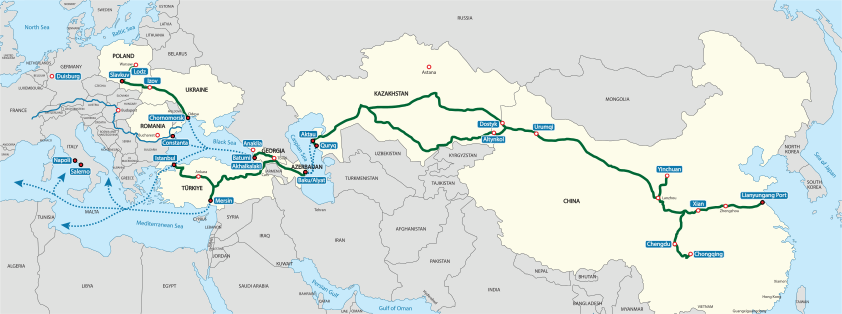
In Central Asia, Brussels has committed €12 billion to develop the Middle Corridor, a route for Kazakh uranium, oil and minerals that completely bypasses Russia. It is the EU’s biggest such financial commitment, to be divided between projects concerning transport, critical raw materials, and energy.
It also signals that Brussels views Central Asia as a strategic alternative to Russia, at at time when security of supply has become a top priority for European industry. Some of the Global Gateway projects are simply rebrandings of projects that were already greenlit: the European Court of Auditors reports that investments worth roughly €8 billion had already been contracted by the end of 2023.
In the South Caucasus, infrastructure works are advancing particularly fast, mainly due to efforts by Azerbaijan. The Baku-Tbilisi-Kars railway, whose renovation was completed in 2024, has an annual capacity of 5 million tonnes and eliminates the need for transit through Russian territory. Also in Azerbaijan, the rapidly expanding port of Alat (near Baku) handled 37% more containers in 2025 than in the previous year.
The European Commission's support package amounts to €200 million in total (a less substantial commitment than in Central Asia or Armenia). Meanwhile, an existing 1999 agreement with Azerbaijan is being renegotiated and a proposal has been tabled for a new connectivity partnership.
To Armenia, the EU has pledged around €2.5 billion. Europe is committed, both rhetorically and financially, to TRIPP, a major new transit corridor through Armenia’s Syunik region that was negotiated by the United States. There is a clear paradox here: although Brussels is investing considerable sums and has publicly endorsed the project, it has no formal role in the project’s coordination. It is a clear example of the limits of European influence in the region – cash, but little control.
Georgia has long served as the crossroads of the Middle Corridor, and was the EU's preferred partner in the Caucasus. But in recent years Tbilisi has been increasingly at odds with Brussels, which complicates the financing of infrastructure.
The main priority is the port of Anaklia, which is intended to link up with Romania's port of Constanța. The Anaklia project was championed by Georgia's former pro-European president Mikheil Saakashvili. After initial reticence the current Georgian Dream government pursued planning for the project, firstly through a Georgian-American consortium (whose contract was terminated in 2020), then through a Chinese consortium (which withdrew in 2024), before finally deciding to fund the project itself. Dredging work only began in August 2026, using a vessel from the Belgian firm Jan De Nul.
There is a contradiction here: the EU has designated Anaklia as a strategic priority of the trans-European transport network, yet it is not funding it. The main EU-funded project in Georgia is an undersea electricity cable. Anaklia is set to become the main link between Central Asia, the South Caucasus and the port of Constanța. The EU therefore needs it.
Meanwhile, political tensions have led to the suspension, since March 2026, of visa-free travel for holders of Georgian diplomatic passports, and Brussels now treats Georgia as an EU membership candidate in name only. However, the pressure goes both ways. If work stalls, Georgia could be bypassed on the southern route, via Armenia and Turkey. Tbilisi has an economic reason to press ahead with the port, regardless of the state of its relationship with Brussels.
Moldova: a small but symbolic investment
In Moldova, the sum involved is much smaller – €12 million for a rail grant – but its symbolic significance far exceeds the figure. The money has funded the upgrading of the country’s north-south rail corridor to European standards, as well as a connection to the so-called Solidarity Lanes – the rail corridors that kept Ukraine’s exports moving after the embattled country’s Black Sea ports were blocked.
For Chișinău, the project is not just about tracks and trains. It also marks an irreversible physical integration into the European logistics network – i.e., precisely the kind of integration that Moscow has been trying to prevent for decades. Moldova can now transport Ukrainian grain by rail to the port of Giurgiulești, thus giving a new lease of life to its railway network.
Romania, the gateway to Europe
Romania is increasingly becoming the Western crossroads on the map of Europe. The port of Constanța, the largest on the Black Sea, is currently undergoing an expansion worth nearly €2 billion. It has inherited a significant proportion of the Ukrainian grain traffic rerouted to avoid the Russian blockade of the Black Sea, and has taken over management of the Moldovan river port of Giurgiulești from the European Bank of Reconstruction and Development.
Constanța recently signed a memorandum with various Eurasian transport organisations to position itself as the European terminus of the Middle Corridor. In effect, the port is becoming the point where European investment, Central Asian ambitions and the needs of Ukraine and Moldova physically converge.
The main challenge for Romania is that the port of Constanța is growing faster than the rail infrastructure that transports goods onwards into Europe. The contract for the third phase of modernisation of the port’s rail infrastructure was signed in July 2026, for a period of 13 years.
In the tender documentation, the government specifically cites the reduced capacity in the port area following the surge in freight volumes at the start of the Ukraine war.
Who pays, and who decides?
Taken together, these pieces paint a clear strategic picture, albeit one that remains deeply uneven. It links three ongoing European debates: the rapprochement of Moldova and Armenia with the EU; the role of the Middle Corridor as an alternative to trade and supply routes controlled by Russia; and, perhaps most importantly, the question of whether the EU can ever turn investment into real geopolitical influence, as China has done through the Belt and Road Initiative.
The answer to that last question remains unclear. The Global Gateway shows a European Union willing to spend billions to break Moscow’s grip, funding Moldovan rail corridors and Kazakh uranium routes. But big money does not automatically mean geopolitical control. The case study of TRIPP – where the EU pays but the US does the talking – clearly illustrates the difference between a financier and a strategic actor.
Nor has there been much improvement in coordination. This year, the EU Commission launched a platform designed to bring together transport, energy and digital infrastructure projects along the Middle Corridor. The launch meeting was attended by representatives from Armenia, Kazakhstan, Turkey, Ukraine, Moldova and the Central Asian states. But Azerbaijan and Georgia were not present. The two countries through which the route necessarily passes were absent from the table where it is being organised.
The EU also lacks a single coordinating body for investment planning. There are the Global Gateway; the Eastern Partnership; the EU Strategy for the Black Sea; and member states’ national instruments, such as the Three Seas Initiative. Each of them targets segments of the same routes. There is no transparent framework to determine what should be funded first.
For Moldova, the stakes are clear: every kilometre of railway rehabilitated, every connection to the Solidarity Lanes, every tonne of freight redirected via Giurgiulești and Constanța is progress that ties the country irreversibly into Europe's logistics networks. What remains to be seen is whether this kind of quiet integration will succeed where political declarations alone have not – i.e., in definitively freeing the country from domination by Moscow.
For Romania, the stakes are just as high, but less comfortingly so. Every year of delay on the Brașov-Sighișoara line; every stage of railway modernisation at the Port of Constanța pushed back by another decade; every tonne that arrives at the port and remains there turns a geographical advantage into a missed opportunity. A terminus with no connections to the interior is less a gateway than a waiting room.
In this region, the United States, Turkey, China and Russia are all competing for the same routes. Can the EU at last become a credible player in this geopolitical competition? Or will it remain a generous benefactor while others make the rules?
👉 Original article on Republica.ro
🤝 Bogdan Cozma contributed to this article, which was produced as part of PULSE’s Thematic Networks, a European initiative supporting transnational journalistic collaborations.
🗣️ Have a question, comment or suggestion? Share it with us through the PULSE reader form – we read and reply to every message. Be part of Europe’s conversation. Your experiences and ideas can inspire the next stories we tell. Join the PULSE readers’ community by filling in this short form.
Do you like our work?
Help multilingual European journalism to thrive, without ads or paywalls. Your one-off or regular support will keep our newsroom independent. Thank you!


