









Select a language
The World Health Organisation (WHO) lists loneliness among the priority public health issues facing contemporary societies. In its report, which also mentions social isolation (an objective lack of relationships or human interactions), the WHO defines loneliness as a “subjective emotional state resulting from a discrepancy between one’s desired and actual experience of connection.”
Loneliness is not a one-dimensional concept. It is not merely relational and emotional, but is also a social and political issue.
Incels and loneliness
In recent years, we have witnessed the spread of the term “incel” in connection with terrorist attacks carried out in the name of this ideology (which forms part of the broader world of masculinist movements) and the popularity of the Netflix series Adolescence.
The term, an abbreviation of “involuntary celibate”, has reignited the debate on male loneliness, but has also given rise to a narrative that needs to be debunked.
Sociologist Katarzyna Dębska discusses the issue in the Polish journal Krytyka Polityczna: “It is said that it is more difficult for men to find a partner, even though there is no shortage of stories about women who want to build a fulfilling relationship but suffer one failure after another.”
Dębska, a researcher at the University of Warsaw Faculty of Sociology, writes of men’s greater “capital” in the so-called marriage market. The same topic is studied by sociologist Eva Illouz in various works, including Why Love Hurts: A Sociological Explanation (2012) and The End of Love: A Sociology of Negative Relations (Oxford University Press, 2018), in which Illouz shows how male capital remains significantly greater in romantic relationships than female capital.
| Male capital according to Eva Illouz For Illouz, male capital (within the context of heterosexual relationships) is the value and desirability that a man can bring to romantic relationships thanks to factors such as social status, income, professional prestige, autonomy, self-confidence, the ability to avoid commitment, and access to potential partners. Men, especially those who are socially and economically better off, accumulate capital with a combination of social success, sexual desirability and emotional freedom. In contrast to women, this can give men freedom to choose, delay commitment, multiply their options and maintain a certain emotional distance. According to the sociologist, male capital is linked to the development of neoliberal society, which dismantles the rules and destabilises established structures even in the realm of romance and sexuality. |
Nevertheless, Dębska continues, today “the face of loneliness is increasingly that of a man without a partner. Research indicates that being in a romantic relationship brings men greater benefits in terms of mental and physical health than it does women, who are more often part of extended social networks.”
For this reason, Dębska adds, “male loneliness is a real problem that should be taken seriously by researchers, public institutions, political parties and political circles alike, especially those with an expressed interest in gender equality and equality in general.”
Loneliness, a ‘political battleground‘
What are the causes of male loneliness? The answer to this question, Dębska continues, is a “political battleground.” For the “manosphere” and anti-feminist circles, the blame lies with women’s emancipation – rhetoric that must be challenged.
In recent decades, women’s position in society has strengthened: access to education and employment, as well as social spaces, has called into question not only traditional gender roles but also the formation of couples. “The picture is completed by sexual and emotional capital”, Dębska writes. “The former is discussed by sociologists Dana Kaplan and Eva Illouz in the book What is Sexual Capital? The physical or behavioural characteristics that are highly valued, and those that cause social discredit, are determined by historical and cultural factors. In certain eras and contexts, for example, women’s virginity is highly prized, while in others, it is instead a string of sexual partners (especially in the case of men). As the sociologists observe, sexual capital boosts individuals’ self-esteem, helping to build a sense of agency and control over one’s own life.”
Dębska also adds another piece to the puzzle: it is men from working-class backgrounds who are most acutely aware of these differences. “These men, due to their class position, cannot embody hegemonic masculinity, which the Australian sociologist Raewyn Connell describes as the most coveted form in a given society, usually associated with having an advantage not only over women but also over other men, which includes respect and recognition.”
The ‘involuntary celibates’ who are not incels
In an article for the independent Czech newspaper Deník Referendum, reporter Petra Dvořáková interviewed eight men about their involuntary celibacy. None of them, she writes, regularly visit incel forums, nor do they identify with misogyny.
All of these men describe profound suffering linked to isolation, low self-esteem, relationship difficulties, trauma, bullying, depression and, often, symptoms or diagnoses of ADHD or autism. “Most of the men emphasised that their shy and non-competitive nature does not correspond to the ideals of traditional patriarchal masculinity.”
“Interpersonal and emotional skills,” one of the interviewees tells Dvořáková, “are a privilege reserved for those born to emotionally mature parents.”
“My name is Tomáš, I’m thirty-eight years old and it’s impossible to love myself.” This is how Dvořáková’s first interview begins. “I don’t identify with the ‘incel’ label; I don’t like people being pigeonholed, but as someone who is involuntarily celibate, it annoys me the way this label is treated in discussions and in the media.” Tomáš is unemployed due to chronic depression, and has been struggling with suicidal thoughts since his teenage years. He describes himself as someone who is impossible to love. Though he has pursued friendships with women in the hope that they might develop into relationships, he withdraws once it becomes clear that he is seen as just a friend. Tomáš claims no right to sex or love, but experiences every rejection as confirmation of his own exclusion from humanity. For him, sex is not merely about pleasure: it is a shared experience that would make him feel part of the world.
According to data, in the Czech Republic around 6% of women and 9% of men have never had sexual intercourse. Among 18 to 25-year-olds, the figure rises to almost a quarter of women and over a third of men. Dvořáková cites studies showing that single women are, on average, more satisfied than men, because they are more likely to have emotional support networks and friendships, while many men rely almost exclusively on their partner for emotional support.
“As a man, you have nowhere to find emotional support,” Peter tells Dvořáková. “I’ve always missed not having someone to talk to about things you can’t talk about with other men.” Peter, in his thirties, lives with his mother in a Slovak village, and refuses to meet Dvořáková in person due to lack of trust. For over ten years Peter was bullied, which taught him that other people are “dangerous.” Peter struggles in groups: whenever he tried to fit in, he was told he just needed to be more confident.
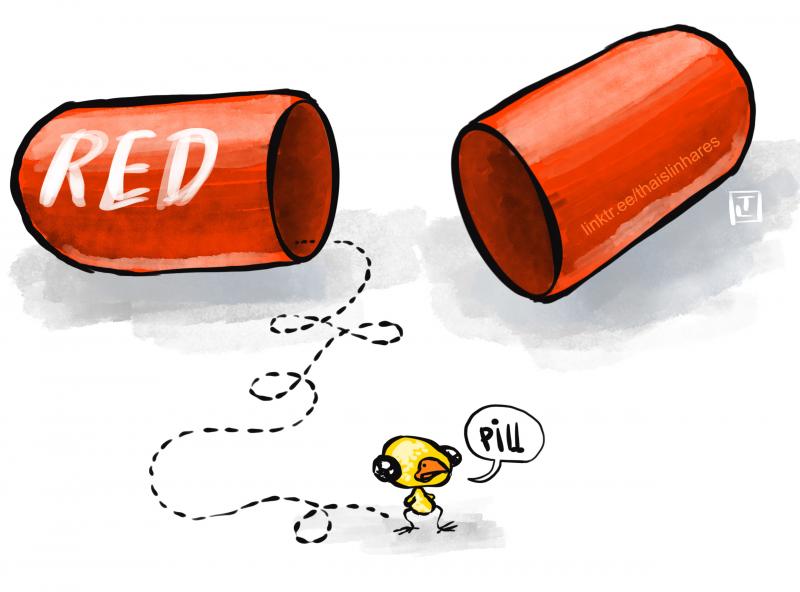
“Whatever you think of the traditional division of gender roles, it is a system with rules. Today, nobody knows what is expected of men. On the one hand, you hear ‘I want a sensitive man, gender roles should be abolished’; but you also hear things like ‘men today no longer know how to be men.’ This is a source of confusion for people like me, who find it difficult to understand social rules,” says Lukáš, aged 25. He too was a victim of bullying; following an unrequited crush, he sought explanations in red pill culture, which attributes male suffering to the chaos caused by women’s liberation and calls for a return to traditional gender roles. He says he no longer believes in it.
According to Dvořáková, these men do not embody the dominant patriarchal model, but suffer its effects. They are not strong, competitive, charismatic or sexually confident; this is precisely why they are marginalised. Patriarchy, writes Dvořáková, harms not only women, but also the men who are unable or unwilling to conform to dominant masculinity. Dvořáková believes that reducing involuntarily celibate men to misogynistic grotesques is short-sighted.
Though a minority may become radicalised, and incel violence certainly exists, most of these men suffer in silence. For Dvořáková, more care, listening and early intervention could lead to many of these men to become allies in the critique of patriarchy, instead of being pushed towards reactionary communities built on resentment.
| Loneliness in figures According to a Gallup survey, young men in the US are among the loneliest: according to data collected in 2023 and 2024, 25 per cent of men aged between 15 and 34 reported feeling very lonely during the previous day, a higher percentage than the population average of 18 per cent and than the similar figure for young women. At least one in five young men in nine other OECD countries report feeling lonely. These countries include Turkey (29 per cent), France (24 per cent), Ireland (23 per cent) and Canada (22 per cent). Generally speaking, levels of loneliness among young men in most OECD countries are similar to the national average. Only in three countries — the United States, Iceland and Denmark — is the loneliness rate among young men higher than the overall adult rate. Conversely, young men in nine countries are less likely to report feeling lonely: Slovakia (4% compared to 15%), Greece (15% compared to 25%) and Colombia (14% compared to 23%). Gallup began researching loneliness in 2023. A 2025 OECD study reveals that, since 2018/19, men and young people have experienced a decline in social connections; many of these declines are evident among young people. The same study found that women report slightly higher levels of loneliness, while men report lower levels of social support. However, the overall differences are minimal. The first EU survey on loneliness, conducted in 2022, found that 13 per cent of respondents said they had felt lonely most or all of the time in the four weeks prior to the survey, whilst 35 per cent reported feeling lonely on some occasions. No significant gender differences were observed in this survey. Loneliness was most prevalent in Ireland (20 per cent), followed by Luxembourg, Bulgaria and Greece. The lowest levels were observed in the Netherlands, the Czech Republic, Croatia and Austria (all below 10%). Several publications have resulted from this survey, which can be accessed here. |
🤝 This article is part of the collaborative project PULSE. It draws on material gathered by Petra Dvořáková (Deník Referendum, Czech Republic) as part of a series of articles on masculism produced by the project partners.
Do you like our work?
Help multilingual European journalism to thrive, without ads or paywalls. Your one-off or regular support will keep our newsroom independent. Thank you!