
















Select a language
 The Spanish football team have won the Cup, beating the Netherlands in the finals. This is the greatest triumph in the history of Spanish football, which, coming on top of other victories of no lesser importance, puts Spain in the vanguard of major world sports, including basketball, tennis, cycling and motorcycle racing. We have long since run out of superlatives for these sportsmen who set an example by their performance on the playing field, but also, and most importantly, by their team spirit.
For several years now, the Spanish national football team has borne out the notion that its accomplishments are owing to sound planning, the selection of the best players, the primacy of the common good over individualism, excellent management and the collective pursuit of goals, all of which was so spectacularly crowned at the 2010 World Cup.
A message of solidarity
 Over the past few weeks, the victories of the Spanish team and the improvements in their game since the defeat at the hands of the Swiss have given rise to comparisons between the first-rate stewardship of the national team and the general plight of Spain. One cannot help contrasting the few hours of euphoria and resurging self-esteem the team has treated us to with the despondency that prevails in this crisis-ridden country before and after every match.
Nonetheless, even if we might legitimately ask why Spain doesn’t work like the team, why their values are not those of the nation as a whole, of the political establishment, not even of our society, such a comparative verdict ought to be turned into a message to the citizenry. A message of solidarity, of teamwork, healthy ambition and clear-cut ideas that goes out first and foremost to Spanish society.
Pride in being Spanish
 The team is a metaphor of what Spain can be, provided we’re prepared to apply the same principles that propelled them from strength to strength. It would be a good thing if the collective enthusiasm about the team were to spur Spanish society to surmount its current trials and tribulations, to emulate this group of young men – including Gasol [basketball], Nadal [tennis], Pedrosa [motorcycle racing], Alonso [Formula 1], Contador [cycling] et al. – who now compel the whole world, literally, to hold Spain in high regard. In a word, the nation ought to work the way they do.
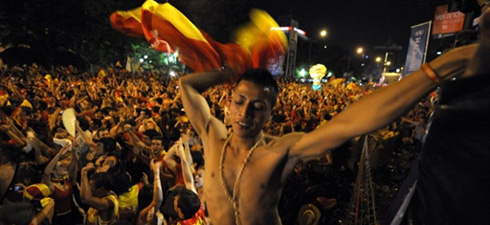
Above and beyond its exemplary effect, the team’s success finally allows us to express unabashedly something as fundamental as pride in being Spanish. Needless to say, it would be a terrible mistake to twist this sentiment into a Spanish nationalism opposed to outside nationalisms. But it wouldn’t be reasonable either for these weeks in which we showed our national colours to end abruptly the day after victory, as though the red and yellow flag belonged to the team and not the whole country.
Towards a positive, constructive patriotism
 On the contrary, we should rediscover a positive, constructive patriotism, recoup our pride in this symbol of Spanish national unity and identity. This civil explosion of “Spanishness” should be understood by society as an enriching value at a time when Spain needs solid foundations for a recovery that is not only economic. That patriotism should also be rightly construed by the political establishment, both on the right and on the left, as the expression of a proud, confident, joyful Spain – which would be all the more so if it had the leaders it deserves.
We had to wait for the World Cup to buck up again in the face of adversity, to feel a sense of unifying patriotism. Yes, indeed, it took the national football team to show the Spanish that, as a nation, the only limitations they face are self-imposed.
Opinion
Doing things the Del Bosque way
With eight of its players hailing from Catalonia, Spain’s World Cup winning team encapsulate philosopher José Ortega’s definition of a nation as “a stimulating project of life in common." So writes professor of human behavior Ignacio García de Leániz in the pages of El Mundo. Spain’s footballers have lent “invaluable prestige to Spain as a brand at a critical time”, de Leániz argues. The trinity of productivity, quality and innovation are qualities the Spanish economy now lacks, he writes, but which national coach Vicente del Bosque embodies, with his “calm leadership and guiding prudence”. In stark contrast to a Spain where, in recent years, there was a “triumph of seeming over being - which explains the deep economic, social and institutional crisis we are suffering”, the “simple exemplarity” of Del Bosque shows the way forward. “I wish Spain would be as united as this team”, Del Bosque declared. “And this is the Spain that could be”, argues García de Leániz.
Do you like our work?
Help multilingual European journalism to thrive, without ads or paywalls. Your one-off or regular support will keep our newsroom independent. Thank you!


