










Select a language
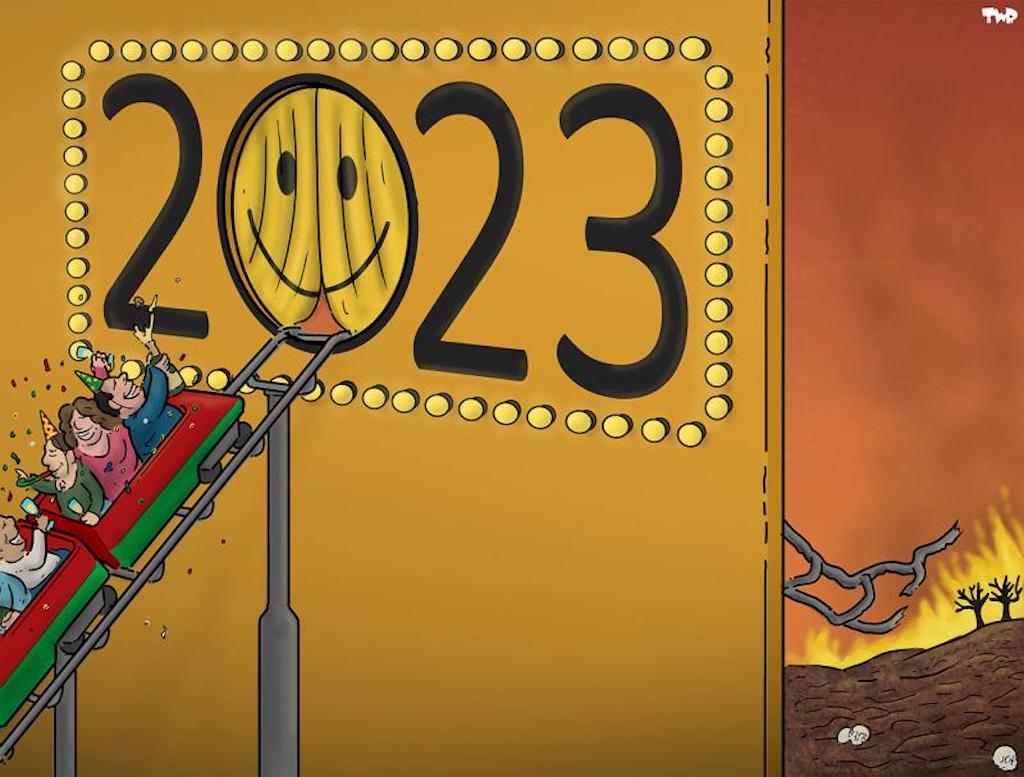
This year saw the fifth crisis of the nevertheless still young century. After the terrorist attacks of 9/11, the Great Recession, the so-called “refugee crisis”, and the COVID-19 pandemic, 2022 brought the Russian full-scale invasion of Ukraine. This provided politicians with the opportunity to finally declare the pandemic over, despite continuing high numbers of cases, but also confronted them with new challenges in areas that they had tried to ignore, or at least depoliticize, for decades – notably the closely interconnected fields of defence and energy.
Although defence and energy are closely linked to the issue of national sovereignty, within the European context they are fundamentally international. And they confront Europeans with a very painful reality: Even though the European Union is the third largest economic power in the world, it is heavily dependent upon the United States for defence and on Russia for energy.
The Ukraine War has forced Europe to finally address these fundamental vulnerabilities, which are not just challenges for individual countries but also for the EU itself.
So far, most of the world is in crisis mode. As the EU has implemented economic sanctions against Russia, and Vladimir Putin’s cronies, much of the rest of the world, in particularly in the so-called “Global South”, has joined more in words than deeds. As a consequence, the sanctions did not have the expected results, something the stricter December sanctions hope to remedy. Irrespective of the outcome, defence and energy will be on the top of the European agenda in 2023. It is crucial, however, that these challenges are confronted without falling into the illiberal trap.
Defense Policy
The Russian full-scale invasion of Ukraine hammered home that Europe remains completely dependent upon the US for military protection. Even in terms of military support for Ukraine, European countries are almost inconsequential. Not only did the US pledge about five times as much arms/weapons transfers to Ukraine as all European countries combined, the United Kingdom alone offered more than the total of all EU countries!
Although President Joe Biden enlarged the already massive US troop presence in Europe, the continued dependence on the US is a (too) risky strategy for Europe. Donald Trump was exceptional in the bluntness of his critique of NATO, and the lackluster financial commitments of its European members, but these sentiments run deep within the Republican Party.
In line with weak support among the base – only half of all Republicans think the US should support Ukraine “for as long as it takes” – various Republican leaders have criticized the US aid packages to Ukraine. And now that the party controls the House again, there is a good chance that they will oppose Biden’s alleged “blank check” approach to Ukraine more actively and effectively.
However, it is crucial for Europeans to understand that “Europe fatigue” is a bipartisan issue in the US. Joe Biden is literally a politician from a bygone era, a Cold War veteran who has invested decades of his career in building and strengthening transatlantic relations. The current Democratic Party is much less Eurocentric, representing a multicultural electorate whose cultural connections are more to Latin America and Asia than “the Old Continent”.
Moreover, for several years now, China has been seen as the “top threat” to the US, and this one of the few bipartisan positions left in the country. In fact, Biden ran an even more aggressively anti-China campaign than Trump in 2020 and his administration has made it clear that it sees China as “the only competitor” for global leadership. If anything, the weak military performance in Ukraine has only confirmed Russia’s secondary status in Washington.
All of this means that Europe must develop its own military capacity, and sooner rather than later – imagine the Ukraine War under a second Trump administration! While this is increasingly acknowledged by European governments, most of the proposed measures are modest at best. For instance, most countries merely pledge to finally live up to the NATO norm of spending 2% of GDP on defence.
And although the Ukraine War has highlighted the dangers of relying on illiberal regimes, the EU seems not to have drawn that lesson yet
German Chancelor Olaf Scholz’s pledge to anchor a 100 billion euro defence fund in the Constitution is a big commitment – although it amounts to just about one-eight of the US defence budget – Germany will face immense implementation challenges, particularly in the short term. The European Commission openly acknowledges these “defence industrial gaps” and “capability gaps” but its proposed measures to address these gaps mainly confirm the complete lack of an EU defence apparatus.
Energy Policy
The situation is not much better in terms of energy policy. Europe’s dependence upon Russian gas is based on a complex combination of motivations, from the lofty – the environmentalist argument to do away with coal and nuclear energy – to the more mundane – easy to transport. Although the modernised Ostpolitik arguments of the 1990s lost most of their authority during Putin’s rule, a combination of powerful economic interests and short-term political interests prevented a more fundamental rethink of Europe’s energy policy. Even the recognition of the disastrous consequences of this dependency for climate change could not change this.
But where climate change failed, the Ukraine War succeeded. With about one-third of Russian gas to Europe flowing through Ukraine, the Russian full-scale invasion forced all European countries to revisit their energy policy. Sure, the most dramatic scenarios have not come true so far, i.e. imploding economic production and a “winter of discontent”, but energy policy reform will remain high on the agenda in 2023.
In theory, the severity of crises creates the possibility for a fundamentally rethink and overhaul of long standing policies and practices. In practice, their (sense of) urgency often creates an incoherent patchwork of hurried and opportunistic policies lacking a clear, let alone alternative, vision. So far, this is the case with Europe’s energy policy, or better policies, as well.
The Ukraine War has led to a “pivot to wind and solar energy”, but a feared recession has so far limited the investments in renewables. Moreover, because of decades of underinvestment in renewable energy, the increase in production can only compensate for a small part of the loss of Russian gas. As a consequence, most European leaders are looking for quick fixes, which means fossil fuels from other providers.
Illiberalism
The Russian full-scale invasion of Ukraine has shifted the focus to defence and energy and somewhat away from the issue of illiberalism. This is also because Putin is mostly criticised for his foreign policy, not his political regime. And yet, Europe has become more vulnerable to illiberalism (again) in 2022. Largely unrelated to the Ukraine War, Italy got the first radical right (dominated) government in postwar Western Europe, while the Sweden Democrats became an essential support party of the new right-wing government in Sweden.
Against my hopes, Viktor Orbán used the Ukraine War, through his ironclad control of the media, to convincingly win the free but unfair Hungarian election and extend his authoritarian rule. That said, his unapologetic protection of Russian interests has further marginalised him within Europe, even straining the relationship with Law and Justice (PiS) in Poland.
And although the Ukraine War has highlighted the dangers of relying on illiberal regimes, the EU seems not to have drawn that lesson yet. In terms of energy policy, Russia is mostly replaced by other illiberal autocracies, some with similar or even worse human rights record, like Azerbaijan and various Gulf states. Fear of Russian influence is now dominating the EU relationship with the Western Balkans and could lead to even less critical support of authoritarian leaders in the region.
And while Hungary has been increasingly ostracised for its pro-Putin position, Poland has been embraced for its outspoken anti-Putin position. European Commission President Ursula von der Leyen was by and large ready to unlock billions of euros from the EU’s post-pandemic recovery fund, but a political backlash has postponed this – for now. And given Poland’s ambition to become a “military superpower”, there will be even more pressure to ignore the country’s descent into illiberal democracy for the sake of a strong, united anti-Putin front.
For years, the EU has let economic profits take priority over liberal democracy in Hungary. A key reason for the lack of sanctions against Orbán was his loyal voting record within the European Union, and particularly as part of the European People’s Party (EPP). Today, Hungary is an “electoral autocracy” and Orbán has become a major obstacle in the fight against Russia.
This should be an important lesson for the EU. The PiS government might be an ally in the Ukraine War, but it is still an illiberal democratic party, which is fundamentally opposed to core institutions and values of the EU. Accommodation now will come back to haunt the EU later.

Check out Cas Mudde’s podcast show Radikaal. In the latest episode, which will be the last one before RADIKAAL takes a break, the political science power couple Maria Sobolewska and Rob Ford, who published the book Brexitland: Identity, Diversity and the Reshaping of British Politics with Cambridge University Press in 2020, which won the prestigious WJM Mackenzie Prize of the Political Studies Association. You can follow Maria Sobolewska on Twitter at @ProfSobolewska and Rob Ford at @robfordmancs.
Do you like our work?
Help multilingual European journalism to thrive, without ads or paywalls. Your one-off or regular support will keep our newsroom independent. Thank you!


