





Select a language
I am a man with a blue passport. On it the coat of arms of my country is printed in gold. Its cover announces my citizenship at once in three languages, including English, so that none of the Europeans who look at my passport should entertain any illusions as to my true nature. I’m a real son of a bitch, a monster – because there it is, written in three languages.
It’s OK to despise me.
It’s OK to slash the tyres of my car.
It’s OK to smash the windows of my car.
The very fact of my living in your city is to be reported to the police. Who knows, I might be a spy or a saboteur. Once he sees my passport, any European border guard will turn me around and make me go right to the back of the queue. Formally this is to allow women and children who are fleeing from war through first. But no one is under any illusion as to what is going on. The whole queue will understand. And will not try to conceal the contemptuous way they look at me. There’s another way of expressing your attitude: by spitting on the ground. It’s not even like an insult. Just someone who has too much of a bitter taste in his mouth.
I am a citizen of the Republic of Belarus. From the territory of the country that gave me my passport planes are taking off to attack Ukraine. Rockets are being launched from here as well to destroy Ukrainian cities. Therefore I am guilty.
I am that rare biological type – a Belarusian from Belarus. My current place of dwelling is not Poland, Lithuania or Germany – it is Belarus. Most people like me – people who do not think and breathe in unison with the system – left in 2021. I decided to stay in a country that has come to know what mass arrests are. Only a few weeks ago this was regarded as daring, as audacious. People who had left the country wrote me words of support, and those who stayed let me know it was nice not to be alone in the echoing darkness.
The man who has agreed to allow the Russian army onto our territory is not a president elected by me. I did not vote for him
Now it’s seen as cowardice.
As not being prepared to face the contempt in the way Europeans are going to look at you.
However, let me say a few words in my defence. After all, even someone on trial has the right to make a final statement. It rarely – or in the case of justice in Belarus, never – has any influence on the severity of the sentence, but it does give the guilty party a chance to speak out.
So right, then.
The man who has agreed to allow the Russian army onto our territory is not a president elected by me. I did not vote for him. More than that, in 2020 many people believed that absolutely nobody had voted for him. “Three percent,” is what was said at the time. Do you remember the four hundred thousand protestors on the streets of Minsk – a city with no more than two million inhabitants? Those four hundred thousand came out to protest back then only because they were firmly convinced that the official results of the election – declaring the victory of the man who has allowed the presence of the Russian army on our land — were false. That we had been deceived. That the victor was in fact another, completely different candidate, one that was now compelled to hide abroad.
The candidate who was victorious but lost the election at the same time, Sviatlana Tikhanouskaya, immediately condemned and continues to condemn the invasion of Ukraine.
Can we bear any responsibility for the decisions of a politician whom we did not elect? And to what extent was this decision of his made after taking into account the will of the people he is supposed to govern? Granted, he has long been accustomed to declaring himself the winner, irrespective of the real result of elections. Granted, ever since 2001 whatever might be regarded as the ‘will of the people’ has come to have no meaning. Who is he going to take any notice of? Who is there that he needs to hold himself accountable to?
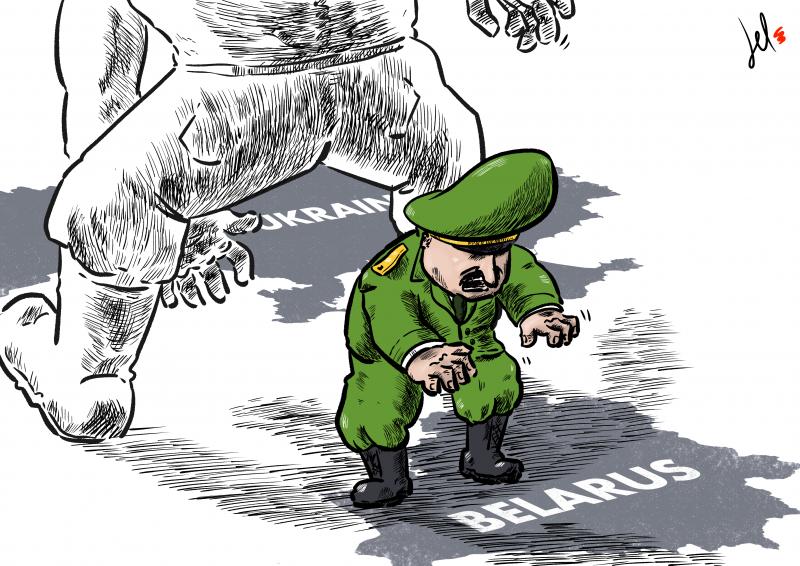
In our particular instance that means being accountable to the man who stands behind his back. Who defends him from his enemies, Europe and the USA. Who covers for him in the United Nations. Who gives him money. Vladimir Putin.
When Russian rockets began flying towards Kyiv, it became crystal clear to everyone here in Minsk why Putin turned a blind eye to everything that was going on in Belarus in 2020. Why he was deaf to requests to defend citizens who had been arrested on the streets of our cities – among them citizens of his Russian Federation. Now we understand it! Ukraine holds no interest for Putin as a country. Only as a territory. One that could be snapped up by NATO, his number one imaginary enemy. What the people who live on this territory actually think, and in particular what they think of Russia, is their problem.
It’s exactly the same with Belarus. Putin needed it not as a country but as a territory. As a bridgehead from which he could send his troops into Ukraine. He did not therefore have to take any notice of the wailings of Russian liberals when they demanded that he condemn the repressions in Belarus.
It’s a situation in which Putin is both the boss and the electorate. A situation in which it doesn’t in fact matter what ten million people with blue passports think. Any kind of decision can be taken in their name.
All he has to do is use the fig leaf of being elected in ‘honest and fair’ elections.
I do not know of a single Belarusian who supports the invasion of Ukraine. Literally, not one. Belarus is a small country, and, unlike Russia, we are not burdened by a sense of imperial grandeur. There’s nowhere for us to get such a thing from. As the victims of colonialism we are always going to sympathise with people being subjugated, rather than with the people who are doing the actual subjugating. Moreover, Kyiv is close to us and some two thirds of families here in Belarus have relatives in Ukraine. And they describe in detail what has been happening in the early days of the war.
The same applies to the idea that the Belarusians are zombified victims of Russian propaganda. Well, you see, after 2020 all the independent media were exterminated. No private sites were left, not even neutral ones. In this sense we were used as a testing ground for the kind of thorough disinfection that is taking place in Russia today. Sites and portals have been scoured, editors have been arrested, journalists have been subjected to intensive searches, there has been a total blockade, firstly at the provider level, and then at the level of the country. That explains why we have all learned how to use proxy servers over the past twenty months. Take, for example, the sixty-year-old woman sitting next to you on the metro: you can see her using the Telegram messaging service that neither Russia nor Belarus has been able to cope with. Belarus attempted to block it, but then decided it was hopeless, so simply declared that all the channels on the service that it couldn’t control were ‘extremist’.
Can we bear any responsibility for the decisions of a politician whom we did not elect?
Correspondingly, as soon as the Russian rockets started heading for Kyiv, readers in Belarus – no, they didn't switch their televisions off, over the past two years televisions have been used only to watch pirated Netflix serials downloaded from Russian torrent sites – so, as soon as the war started, everyone discovered Ukrainian chat channels on Telegram and began to follow them avidly, just as they had previously used Telegram to follow the explosions of stun grenades on the squares of their cities.
So we know perfectly well who attacked whom.
And here’s the amusing thing: many of my Belarusian friends are in Kyiv. Absolutely all of them moved to Ukraine after the events of 2020. Some of them had completed the regular administrative sentence of fifteen days inside and so came under the restrictive measures of the bodies responsible for the enforcement of court verdicts. Others, even after being found guilty of a criminal offence and sentenced to a period of confinement, managed to escape from the places where they were serving their sentence. All of them found in Ukraine a refuge from repression. And Ukraine as it were understood the specifics of our political situation. Belarusians had their permission to stay in Ukraine extended, they were able to rent accommodation without difficulty. In other words, they found sympathy in Ukraine.
After the arrest of thirty six thousand people in 2020 no one could possibly believe that we liked the situation in our country and that we were responsible for the man who rules it.
After 24 February this year, however, the Belarusian refugees in Ukraine suddenly turned into ‘aggressors’. Into ‘lukashists’ and ‘putinists’. Into people, whose homes could be visited by the Ukrainian security services after the neighbours had complained that there was a Belarusian living in the flat. This was some kind of new, widespread European attitude.
Go get ’em!
They supported the war, didn’t they?
But how did things turn out this way?
Volodymyr Zelensky is the only European president to have gently declined an official meeting with Sviatlana Tsikhanouskaya. He did not want to spoil his relations with Aleksandr Lukashenko.
Ukraine did not restrict its import of Belarusian refined petroleum products after 2020. This trade made a significant contribution to the sanctions-hit Belarusian budget.
So why did the Belarusians in Ukraine suddenly become enemies and traitors? After all, they had tried to change things in 2020 and then found themselves completely isolated in 2021 when their country was turned into a branch of the GULAG. There were hourly – not just daily – reports of persons being arrested for taking part in the protests of August 2020 following the use of facial recognition software and video recordings.
Belarus today is a country with more than one thousand political prisoners. One thousand people have been given terms of imprisonment for openly stating their political views. Those views most frequently amount to an unwillingness to accept lies. So we are somehow supposed to be responsible for the decisions of our ruler? Decisions that led to protests and one thousand people in a country of ten million having their lives blighted as a result?
And – so that you should have a better understanding of the atmosphere prevailing in Belarus today: when Russia attacked Ukraine from our territory, the only phobia that spread at the speed of light in conversations and the social media was the fear – no, not of Ukrainian counter-strikes on the towns close to where the Russian rockets were launched – but the fear of compulsory mobilisation. The reason for whole crowds of people preparing to flee the country, crowds – I would add – made up of precisely those people who had had the courage to remain in the country after 2020 and 2021, was the fear that all men between the ages of 18 and 65 were now going to be called up, given weapons and ordered to shoot at Ukrainians.
Take the sixty-year-old woman sitting next to you on the metro: you can see her using the Telegram messaging service that neither Russia nor Belarus has been able to cope with
In other words, we continue to be more afraid of our own state than of those ‘enemies’ that Russia is attacking from our territory.
Where has this phobia come from? Why has the very idea of Belarus becoming involved in this war become so deeply rooted in peoples’ minds, that Lukashenko has had to deny it on several occasions, although nobody believes him. Why is mobilisation needed in principle in a country which is not under attack? It seems to me that here we have a conditioned reflex of disbelief in the workings of the state: over the past twenty months we have become trained to think that anything at all can come into the head of the head of state, and that ‘anything at all’ will be passed on to us without hesitation.
We are accustomed to living in a correctional labour camp. A camp with closed borders; our iron curtain clanged shut some time before there was talk of such a thing in Russia. The system in our state, acting on the paranoid belief that the protests in 2020 were funded by the West, decided to make it impossible for anyone without a residence permit or work contract for an EU country to leave Belarus by any of the land frontier crossing points. This decision was justified by ‘coronavirus restrictions’, never mind that such restrictions are usually applied when entering a country, not when leaving it. Then came the incident with Roman Protasevich that voided any possibility of leaving the country by air. And now war has made an appearance in our correctional labour camp. Naturally, the first thought to enter the country’s collective head was that we would be mobilised and packed off to the meat grinder of someone else’s war.
So who exactly are we Belarusians? Are we really aggressors? Or are we rather victims? What is it we are guilty of? Of not expressing our opposition to war sufficiently loudly? When it comes to freedom of expression Minsk after twenty months of never-ending repression has come to resemble Grozny in Chechnya. You don’t need to go out on to the streets to be punished – all you need to do is place a white sheet of paper in your window (the fashion in the middle of 2021 when it was already too dangerous to hang out a white-red-white flag). Despite all this, the citizens of Minsk turned out in large numbers to protest on 27 February this year, and more than eight hundred of them were arrested.
And this in spite of the fact there was not a single meeting here in favour of aggression.
It’s a situation in which Putin is both the boss and the electorate
From where do European heads get these bright ideas? For example, not processing visa applications or not prolonging residence permits for those people who at one time had had to flee their country precisely because they had dared to protest, were arrested and then mangled in the meat grinder of legal process. How did it happen that all the Belarusians in Ukraine have had their bank cards blocked? Was it simply because of their citizenship? With no attempt to sort out servants of the regime from those who had sought refuge in Ukraine?
Doesn’t this remind you of the classic situation where the victim becomes the accused? The victim who was the first to be subjected to violence, was then handcuffed and therefore unable to avert the violence being done to other victims?
And to be precise: I am not seeking to justify myself. I am not seeking to put blame on anyone else. I acknowledge my guilt. Nothing that has been written here in any way alters the fact that I am ashamed, although shame is not necessarily a feeling intrinsic to an individual who is guilty of something.
Do you like our work?
Help multilingual European journalism to thrive, without ads or paywalls. Your one-off or regular support will keep our newsroom independent. Thank you!